Robins building nests

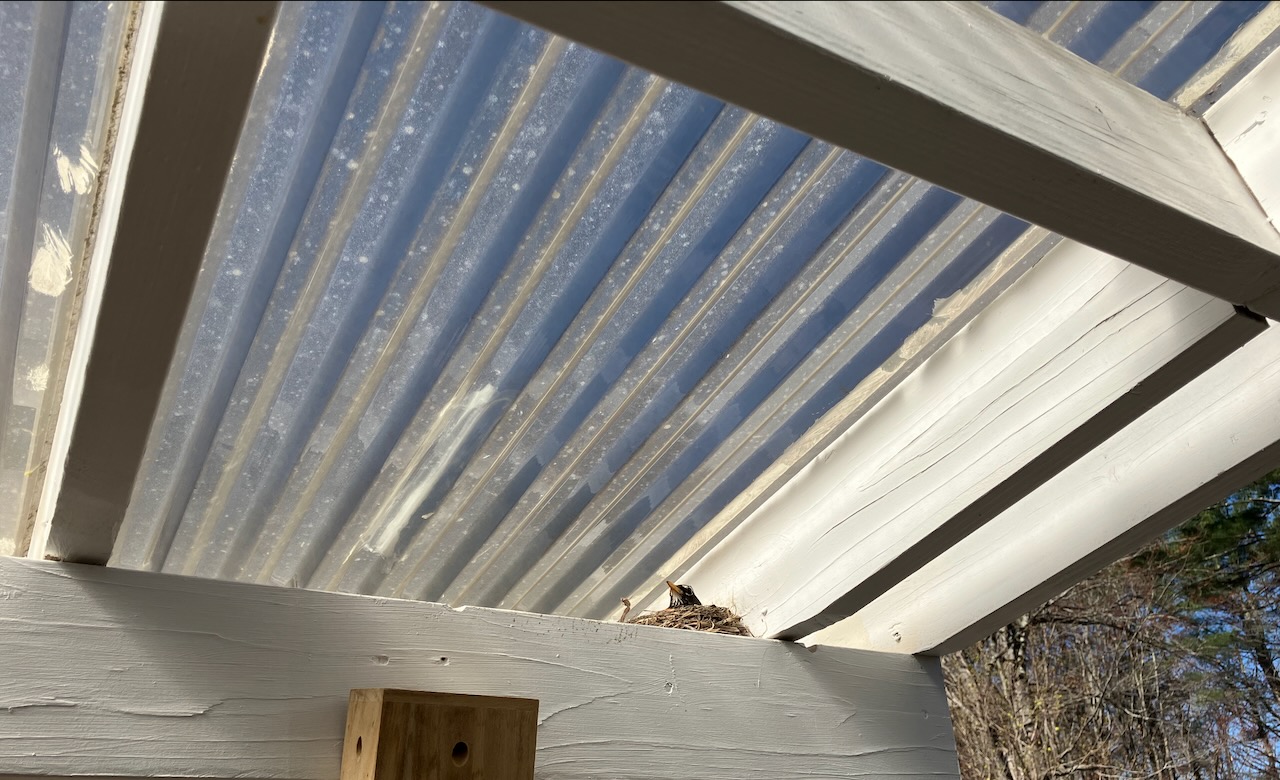
clear ceiling over deck beam with robin in nest on beam

We have robins nesting again in the beams of our deck! Two years ago, a pair of robins raised three broods of chicks over the course of the season. The year before that, in 2022, they had tried, but failed, and it seemed the clear ceiling raised the heat too much for the babies. So I created a shade from cloth to go over them. That worked for 2023. Last year, no nests on the deck. But this year, they were rooting around again on the beam. Imagine my chagrin when a robin starting building a nest in a different section of the beam, with no shade cloth. I could already see her with her beak open on a warm sunny day. One day when she was gone from the nest, I counted three blue eggs.

So I tried a different solution. It was a bit of a risk, but I went out with a ladder and painted the ceiling above the nest with some white primer/paint. She had flown off when I got close, but after I finished she came back, and I am happy to say has continued to sit on the nest every day. I hope this helps her babies to thrive, as I wish for all babies to thrive. I am thinking of the babies in Gaza who are being starved right now.

Robin in nest with shade from painted ceiling

Another joy is that there is also a robin nesting in the bush near our front door. You can just barely see her from our living room windows–she is so well camouflaged from above. But she too is still sitting.

Spring is bursting all over. The cherry trees have some blossoms and the peach tree is starting too. I just hope all this rain we are getting this week doesn’t prevent them from being pollinated. The rain is much needed because of drought, but I miss the sunny days we had last week. I did a holistic spray for the trees the week before. Our trees struggled last year so I am trying to be more attentive this season.

Cherry blossoms against blue sky

Being in the garden is so healing in light of all the devastating news each day from our country, and from the world. One more photo of beauty, daffodils Margy picked from the garden. May the beauty be a prayer for peace.

yellow and orange multi-layered daffodils

What the garden does with us

Monarch caterpillar on milkweed

While on my morning walk, I suddenly saw a monarch caterpillar on a milkweed that had planted itself in our roadside strip. The next day (today), I saw three more. All we did with the milkweed was let it keep growing where it showed up on its own. There are two plants by the road, and three or four more in a patch out back near the pond. But the monarchs found them all the same.

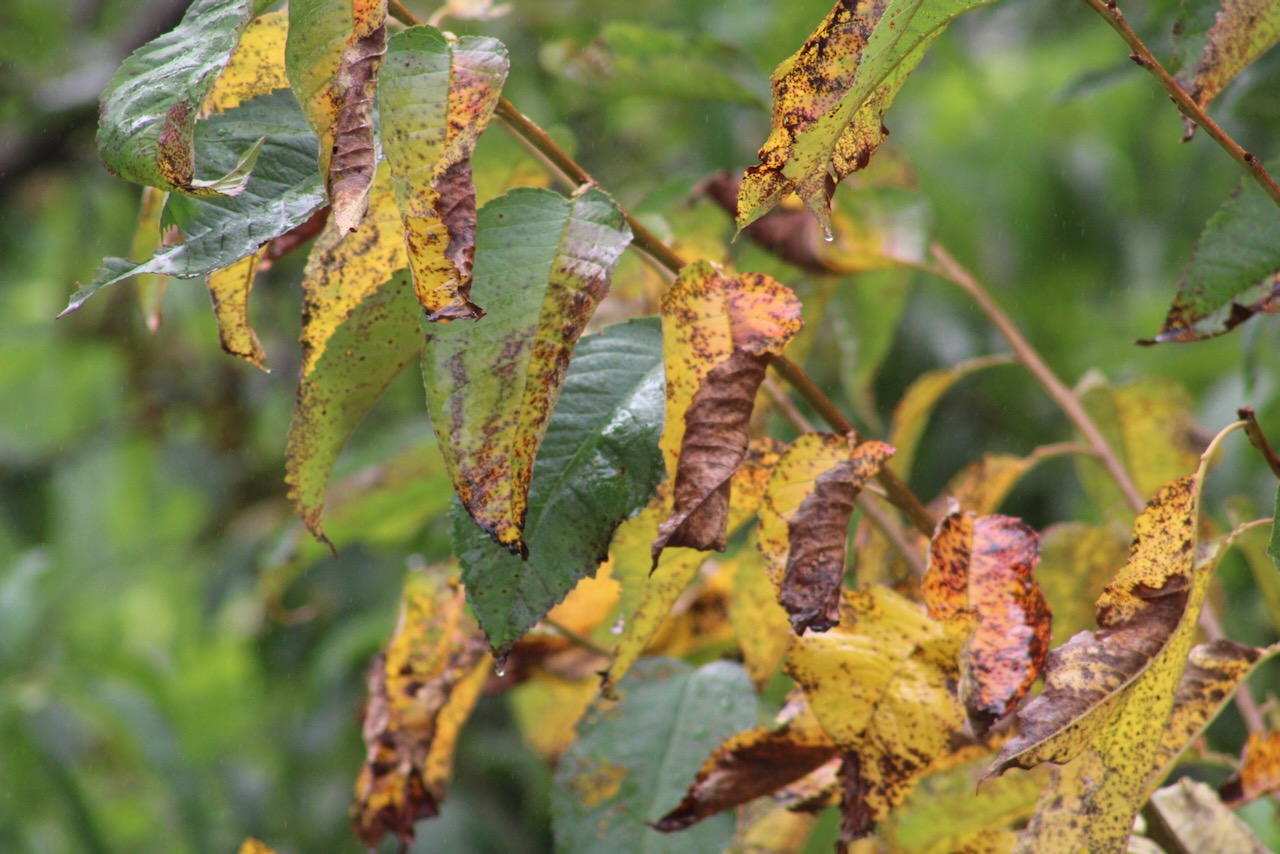
I have been feeling discouraged lately about my ability to garden. First of all there is the challenge of chronic fatigue that limits my energy such that even one small project outside in the morning can wipe me out for the rest of the day. But then there is the limitation of my own knowledge about the green growing beings. Right now, it is the cherry trees that are struggling with some disease. I am thankful to Aaron Parker of Edgewood Nursery who suggested, after seeing photos, that they are most likely dealing with Cherry Leaf Spot.

The possible answer is to clean up all the infected leaves on the ground and on the tree, and use an organic probiotic “Monterey complete disease control.” But even so, it might not work. Another website suggests natural remedies such as neem oil, potassium bicarbonate, and copper fungicides, which can be used to manage fungal infections like leaf spot. This season, I hadn’t done any holistic sprays because the sprayer takes a lot of personal energy to use. So I feel sad about the cherry trees, and even though I ordered some of the Monterey remedy, I feel discouraged about how much more work I’ve made for myself. Will it even help?

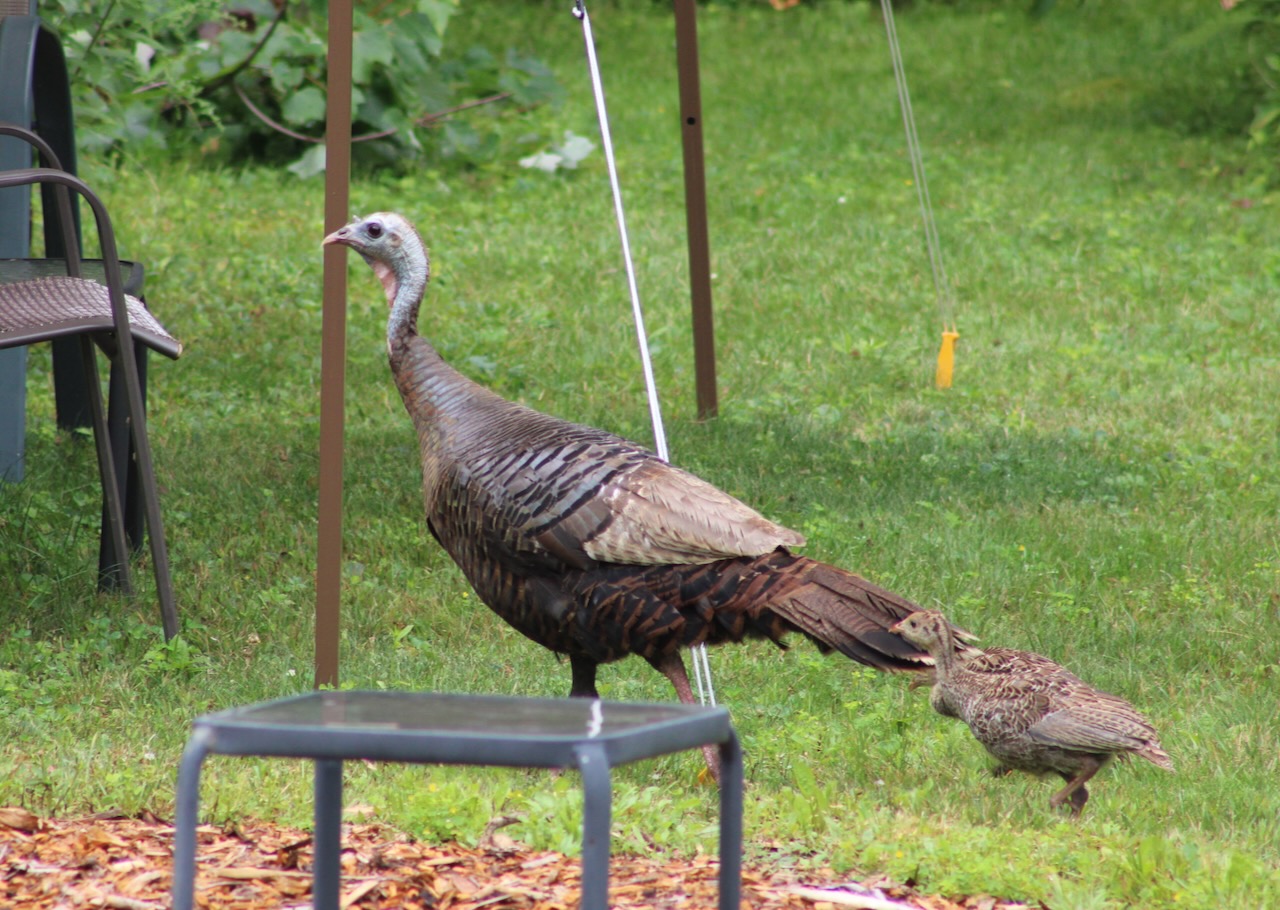
But in the midst of this discouragement, the caterpillars showed up on their own. And meanwhile, a turkey mom and her three babies have wandered through the yard a few times. Here we see them scooting under our canopy where we sit outside in some shade.

Meanwhile, the front raised bed that we didn’t plant decided to grow evening primrose on its own, and today I saw a gold finch happily checking out the yellow flowers. He was too quick to get into the photo. So I guess as a wildlife habitat, we are doing okay!

Then I saw this quote on Facebook this morning, posted by a colleague, and it was a good reminder that it isn’t really about how well we can garden. Something more magical is going on, and I must remember that.

“There was one thing I suddenly knew with absolute certainty: magic is not just something you do or make, it is something the universe does with you. It is our relationship to the Divine. There is nothing more magical than the presence of the sacred in one’s life. It changes everything. … It isn’t something one does to the universe; it’s what a living universe does with us once we have awakened to its Divinity.” Phyllis Curott in Book of Shadows

And maybe, it’s what the garden does with us once we have awakened to its Divinity.

Life in the Yard

Mallard duck visiting the pond.

Life continues to be abundant in the yard. We’ve had visits by a duck couple, who land on the pond, sometimes walk around the yard looking for food, and then take off again. When I was cleaning up old plants from the pond, I discovered strings of toad spawn, and now we have toad tadpoles swimming around.

I am suspicious that the three bullfrogs who’ve taken up residence might be eating them sometimes, but so far the tadpoles continue to survive. We’ll see.

I don’t seem to have much energy this year, so projects in the yard are moving slow. We finished stacking our firewood, and I cleaned up weeds and refreshed the wood chips around the fire circle. I resonated with something that was mentioned on television at the Chelsea flower show in Britain–gardening is often a lesson in failures. The cherry tree has some problem that causes spots on the leaves and cherries and I don’t think we’ll get any cherries despite our earlier blossoms. Probably the black cherry aphids, but I don’t have the energy to sort it out. So I am appreciating the plants that seem to take care of themselves.

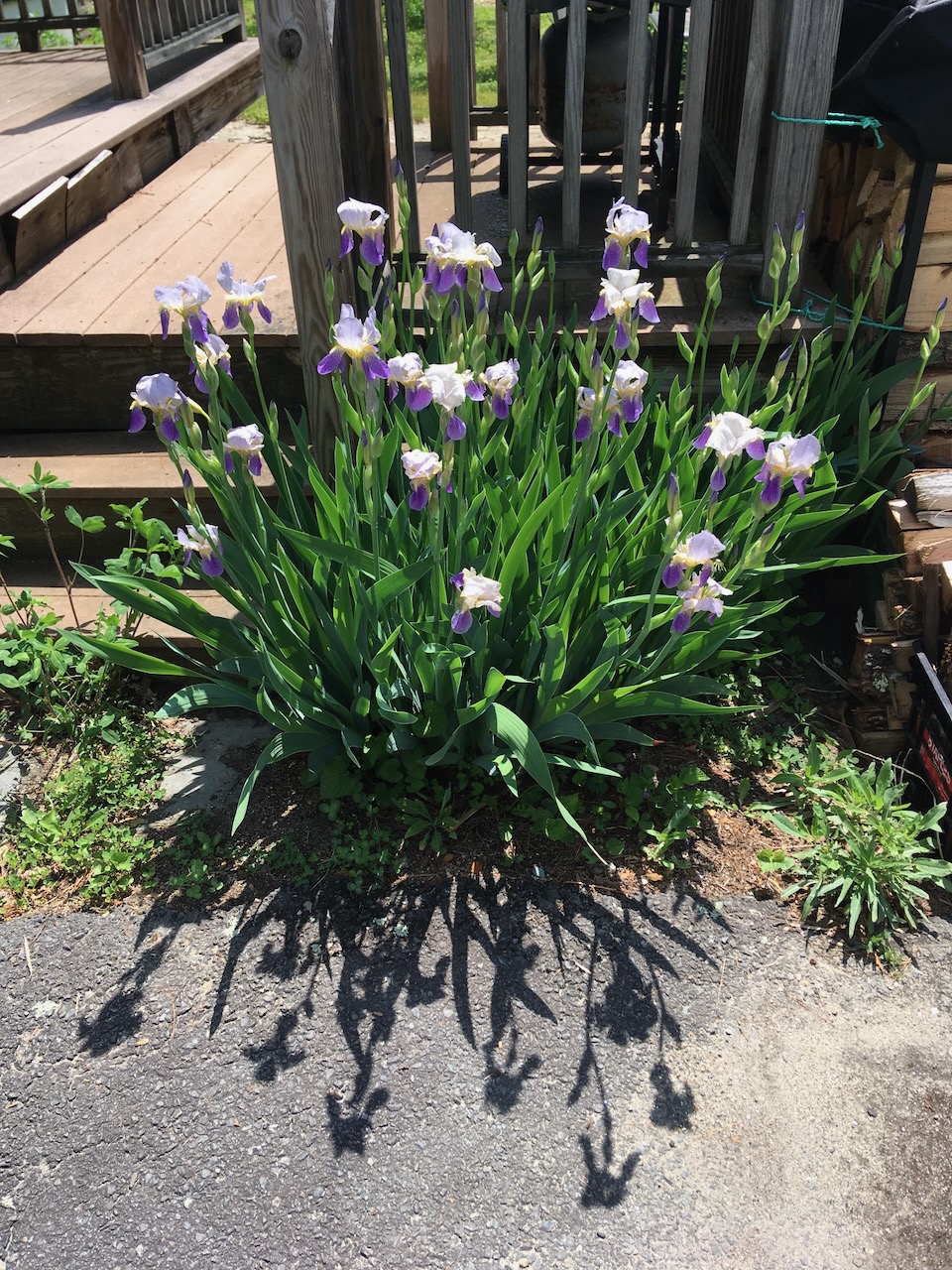
The irises by our deck are thriving this year, so happy and abundant. That sort of makes up for the lack of blue Siberian irises in our front patch–hardly any at all this year. The plants seem to move around, and I am not sure why the blue ones are not doing well. Happily, our neighbor’s are doing great, and I see them out our kitchen window.

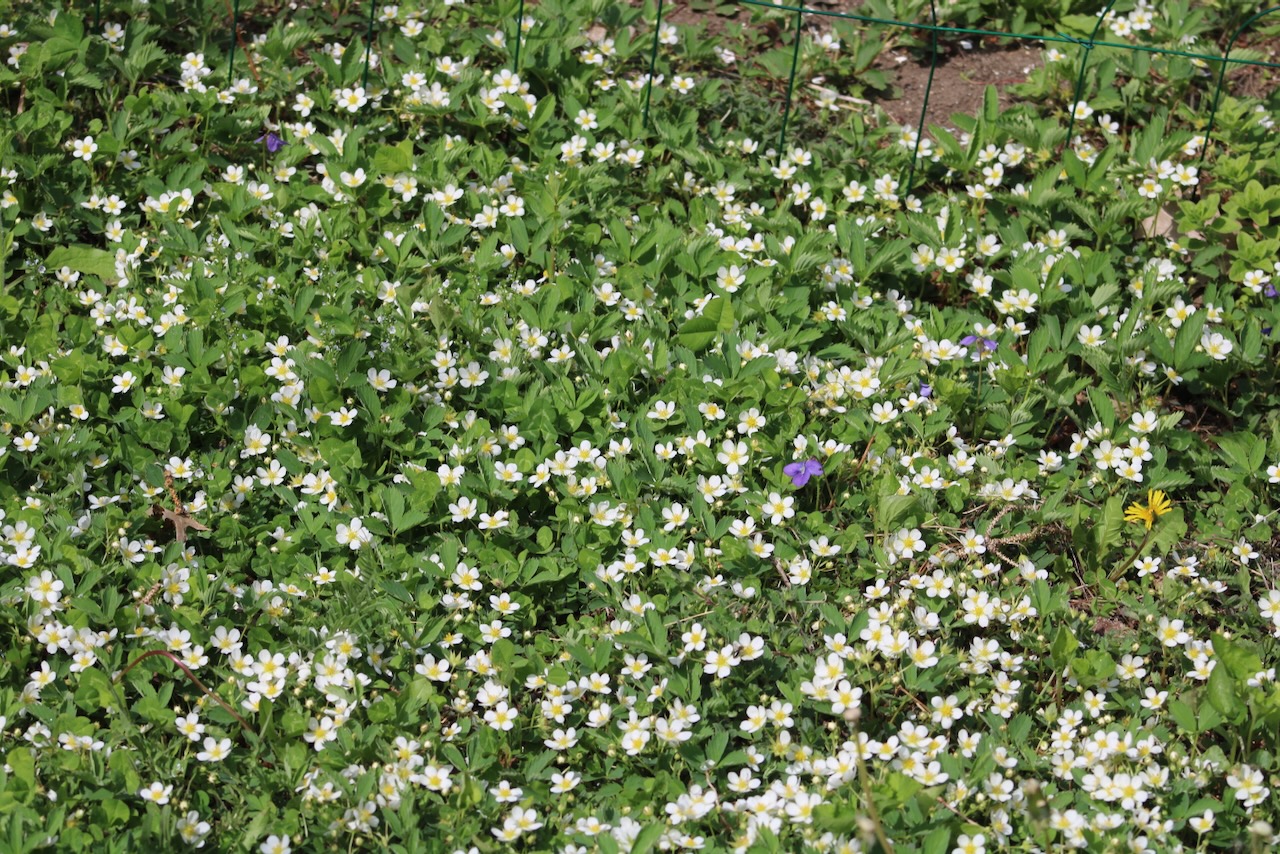
Meanwhile, the wild strawberries were blossoming and spreading everywhere, which is great–good food for birds and bugs. It is an excellent native ground cover. That makes me happy.

Empty Buds

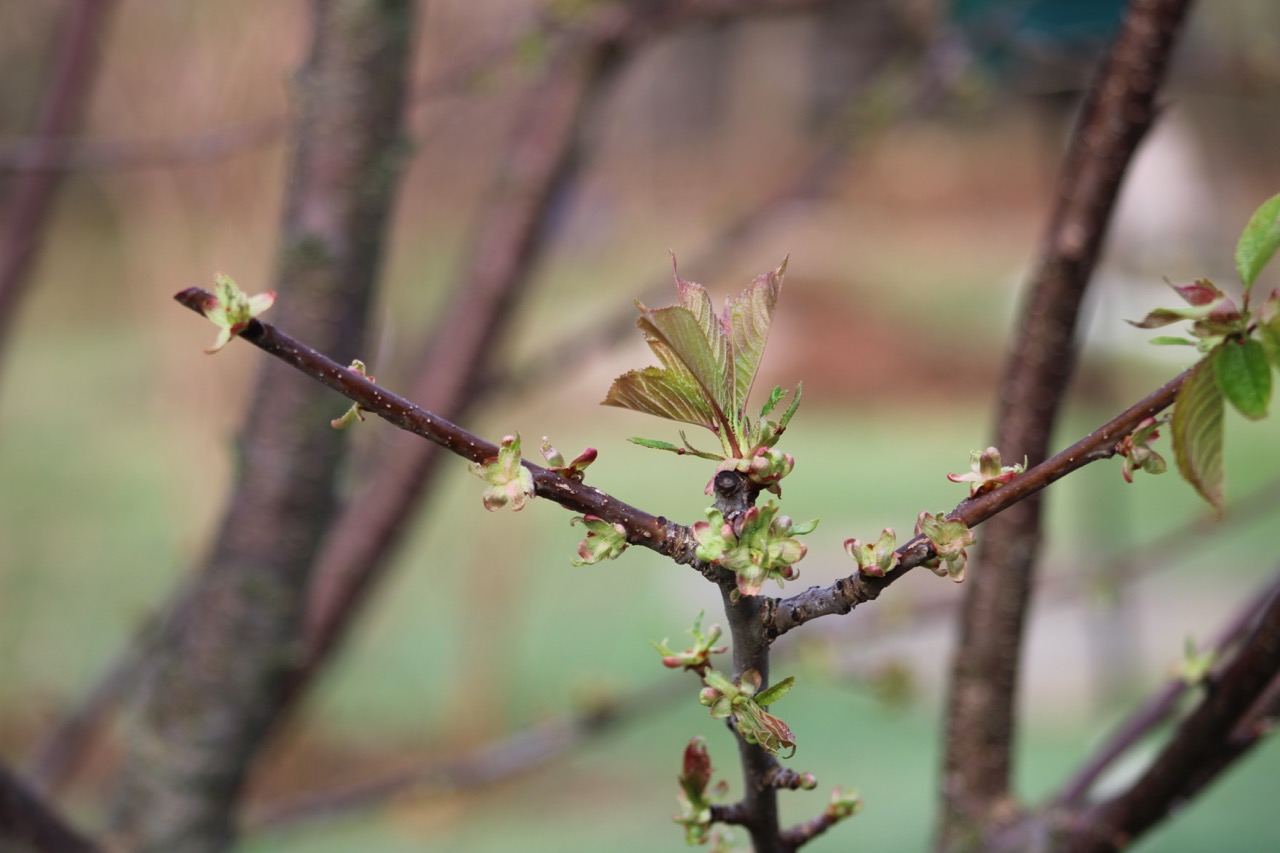
Branches against blurred green and brown background, with small leaves, and small empty buds opened.
Cherry tree open buds are empty.

The cherry trees and peach tree have no blossoms on them at all. The cherry trees had the buds that should open into blossoms, but when they opened, they were empty. At first I worried that I’d done something wrong. But on connecting with other gardeners in Maine I learned that many people are facing this problem with all their stone fruits. Apparently, the most likely cause is the weird weather over the winter, with mild times alternating with a deep freeze. They didn’t stand a chance.

I feel sad about it–there were really so many buds on the cherry trees this year. In prior years we just had a very few blossoms, and I was hopeful that this year we’d see our first real fruiting. I also feel glad that the leaves are opening–I heard that some people’s trees actually died. I am glad ours are alive. But this is a lesson about climate change. Global warming increases the unpredictability of the weather, and the temperature swings are part of that. What food we can grow becomes more unpredictable.

We don’t rely on our little garden for our food–we are really just learners in this process. When we get a harvest, it is exciting–and thankfully, we still have peaches from last year’s abundance in our freezer. It looks like the blueberries and raspberries will be fine. I’ve already eaten sea kale and some asparagus. But I can feel the vulnerability of what it means to face a shifting climate, even in these small ways. How many larger ways are unfolding all over our planet? Severe heat and drought in many places, floods in other regions. For too many people actual starvation is real. I feel so powerless in the face of these huge problems.

When we first moved to this place, our hope was to form a deeper connection to the earth and all her creatures, through our connection to this small piece of land. I have to say it isn’t easy. We know so little, and we are surrounded by challenges larger than we are. For just one example, Margy spends hours pulling and cutting invasive plants around the borders of our land–Asian bittersweet, multiflora rose, Norway maples. The way it is with invasives, that job will never be over. Plants have their own personalities, and some are very aggressive even if they are native plants or desired plants, so there is the endless pulling and pruning to keep things in some sort of balance. (Oregano and wood anemone, I’m looking at you! Everywhere!)

But maybe these are the lessons we are learning about making a deeper connection to the earth. Plant by plant is the only way we get to know them. Whole Indigenous communities were needed to foster the balance of all beings, and we are just two old non-Indigenous humans. Some of our neighbors seem to be in a similar venture to ours, and others seem just the opposite.

Still, I have to hope that the love we offer to this place can be a small seed of healing, maybe even its own “aggressive” form of healing, spreading into the broken places. I draw hope from the birds who seem to multiply and who enjoy the yard so much. I draw hope from the violets blooming everywhere they want to bloom. I draw hope from the turkey who visited the other day and made a dust bath in the patchy lawn. There is something so wonderful about a community of creatures who share one place.

Turkey sitting on patchy grass.

Pruning

Cherry tree with empty branches on brown ground with some snow patches, and a green step ladder nearby.
Sweet “Lapins” Cherry tree and ladder for pruning

Yesterday I finally got outside and pruned one of the cherry trees in our little orchard. Pruning has always baffled me. My trees never look like the trees in the pruning guides, and though they are dwarf trees, they grow quickly long and gangly. I wish I didn’t have to prune, but experts say it is part of the work of caring for fruit trees. There are differences of opinion about the best time to prune, but for me it was partly based on actually being able to get close to the tree–the snow cover has kept me away before now.

But this post is not a how-to guide, nor meant to offer any wisdom about pruning. It is about risk and relationship. Sometimes we have to risk doing it all wrong, to do anything at all. Yesterday I took that risk, and in doing so, I realized that pruning is also about relationship. I had to get up close to the tree, stand on a ladder and notice all of its branches, all of its patterns, all of the pre-buds starting to form. I talked to the tree while I worked, asking for advice or forgiveness or something like that. I had to acknowledge that I am not the wisest or best caregiver for the tree, but here I am–I am your person and you are my tree. We are here on this land together. In the task of pruning, I become closer to the tree.

Pruning is odd to me, yet it is a welcome phenomenon for many plants. They thrive with cutting back, they are energized by it, it sets their hormones racing and can spark new growth. There are many principles which vary between species, and which are hard for me to translate into action for particular trees. But I think the only way I can really learn is by doing it, taking the risk with these trees, and doing the best I can. Letting the tree be imperfect, and letting myself be imperfect in my relationship to the tree.

I guess my winter project has been a sort of pruning too, going through old papers and recycling a bunch of them, organizing the rest. I had to get close to those papers too, sifting through each document in each file folder. I had hoped to be further along with it all, as we’ve turned the corner on Spring, and the sun and warmth begin to call me outside. I am mostly all done with papers from before I moved to Maine in 2005. But I am just beginning to sort through my work in ministry at the Allen Avenue Unitarian Universalist Church and in Portland. More of these “papers” are actually documents on my laptop, rather than in boxes in the basement. (I guess I could sit outside with my laptop for that kind of pruning!) I wonder. By pruning away these “branches” from the past, might I find more energy for living in these days and moments of the present? Do I need the pruning as much as the trees do?

Robin’s Eggs

Three robin’s perfect blue eggs

Yes! The robin has been sitting on the nest more consistently and today I confirmed that she has laid three eggs! She stays in place when we go out the back door, as long as we go down the steps near the driveway, which is on the opposite side of where she is nesting. But she does occasionally go away, and in one of those moments, I lifted my phone up above my head and was able to take this photo of the eggs. Little joys in the midst of the lovely day outside.

Peach blossoms

In other developments, the peach tree blossoms are beginning to open, and many sorts of bees are hovering around the cherry tree blossoms, the violets, the pansies, and the dandelions. I’ve been slowly cutting down dead stalks of the oregano plants that have proliferated around the trees, and noticing how the low growing herbs and flowers are spreading onto former paths–but maybe it’s time to let them be the path ground covers. I’ve used wood chips for the paths, but living ground covers are actually the most ideal. Clover, pansies, oregano, thyme, violets. I’m trying to listen to the plants, to the land, to see what might be the happiest.

I didn’t have a ton of energy today, so mostly I lay in the hammock just noticing the orchard and how it is changing. I’ve been going through old blog posts to archive them as pdf files, and was looking at photos of the yard before we planted most of the trees, (the cherries were the first). So much has been transformed. It is a good feeling.

Cherry blossoms and leaves

First Frog! and other firsts

First frog in the pond sighted today!

I saw the first frog in the pond this morning! I came to sit quietly earlier, saw nothing, and then when I came back a while later, there she was, sunning herself on a stone. I almost missed seeing her. She’s a darker color than the ones from last year, but still in the green frog species. Later, I saw her in the water, with her eyes just above the surface, sitting still, as they do. Welcome little frog!

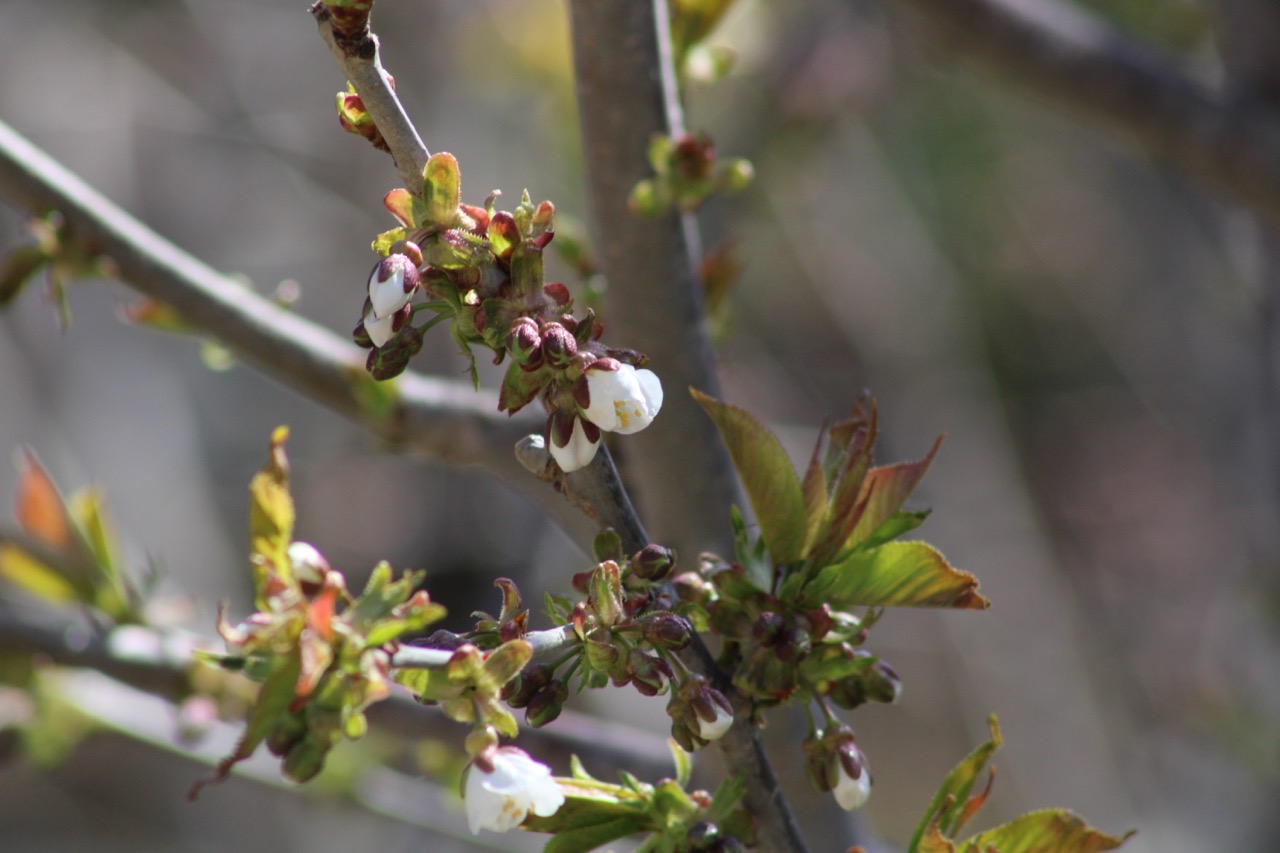
It was a day of firsts. The first cherry blossom opened on our Lapins sweet cherry.

White cherry blossom with maroon leaf edges.

As we sat at the patio table, Margy saw the first hummingbird–darting to where the feeder used to be–(there is a hanging folded paper peace dove there now). It was too quick for us to get a picture. But after lunch, I put out the feeder–not there, but on the other side of the deck, so as not to disturb the robin, who is nesting again. Yesterday morning, she was sitting with her beak open, and she kept it open for quite a long time. We wondered if by any chance that meant she was laying an egg. (It reminded me of women in labor, taking shallow breaths as they prepared to birth the baby.) They say she will lay one egg per day until she has her brood of 3 or 4. If all goes well, she will incubate them for 2 weeks, and feed babies for 2 weeks. She still comes and goes during the day. I hope she tolerates our presence. We’re trying to be quiet as we go in and out.

It feels like, with the arrival of May, all the creatures are joining us in our wonderful little back yard. My heart is smiling.

Robin with beak parted, on nest in beam.

Early Harvesting

Photo: two cherries and a bowl of raspberries

Well, after all my efforts with the sweet cherry trees, I harvested a total of three cherries. Very sad. That is all for the season. I had given them foliar sprays, compost and seaweed on the ground, and companion plants. I sprayed them with kaolin clay to guard against pests, put out yellow sticky paper for black cherry aphids, and hung about 50 red wooden fake cherries to deter birds coming round. I watered them when we were having this drought. We didn’t start out with a lot of blossoms, and I think there were only 10-20 cherries that started forming this season–not very many. But by the time they ripened, I could only find three. I ate one, and the other two are in the photo next to the raspberries.

The raspberries, on the other hand, I do hardly anything for–I pruned out the old canes in the fall, and they got a couple foliar sprays when there was some left from the trees. I watered them a couple times during the drought. But now they are producing abundant berries, and this harvest was just the one day’s worth. So frustrating. Especially since I like cherries more than raspberries. I’ve grown raspberries before, but cherries are still new. I do not seem to know the secret. If anyone can tell me, please comment!

I also harvested a big bunch of kale today. After the groundhog sighting, I covered that raised bed with netting and stakes. And a good thing I did! The next day, I caught sight of the groundhog standing up against the framing looking through the netting at the kale. I chased him off, and I haven’t seen him the last few days. I’ve also put urine liquid around the area. So far it seems to be working.

Today, I took off the netting, harvested a bunch of the lower leaves of the kale, did a bit of weeding, and finished thinning the carrots that are also growing there. With kale, I will sauté a bunch of it, and then immediately freeze, for use in winter. I eat kale almost every day! I’m so happy it is doing well. But if you know the secret for sweet cherries, please tell me!

Photo: kale harvest from today

Prayer for Pollinators

Peach and two cherry trees

If you’ve been following my work on digging the pond, I will mention that I took a little break, first to find out what to do about the water that has seeped into the bottom, and then because I twisted my ankle on Friday while I was digging. So annoying! My ankle is not so bad–after a couple days of rest, I can hobble around now, and I will be digging again soon.

In the meantime I wanted to share this photo of the flowering peach and cherry trees in our food forest. They flowered a bit earlier this year than last. In the photo, the peach blossoms are pink, and it is hard to see the white cherry blossoms amid their green leaves in the photo. But they are so beautiful! There are more cherry blossoms this year than last, when we got just a few.

However, I’ve been concerned about pollination. Our neighbor keeps honey bee hives, and usually we have lots of her bees visiting over here, drinking nectar and drinking water from our bird baths. But this year, it has been very sparse for bees. I found out that our neighbor’s hives died in a cold snap earlier in the spring and she hasn’t replenished them yet with new bees.

One day, I did see bees of all sizes in the Lapins cherry tree (on the right in the photo), but I didn’t see them in the peach tree. (Not that I sit and stare all day.) But I’ve been doing so much TLC with the trees this year, with Kaolin clay, and holistic foliar sprays. It would be a shame if we didn’t get fruit because of pollination problems. It is too late now to try to hand-pollinate. The other potential glitch is that while the Lapins cherry is self-fertile, the Black Tartarian cherry needs the Lapins to cross-pollinate. They are both sort of blooming now, but the Lapins had peak blooms earlier, and the Black Tartarian has new blooms that just came out yesterday. So we wait and see.

It reminds me of the sad danger to pollinators everywhere because of climate change, environmental pollutants, pesticides, and development. All of our human food is dependent on these little creatures who pollinate the plants. If the bees die, so do the humans.

Today I pray for the pollinators, with gratitude and humility. Part of this prayer is offering to the bees so many other plants in our food forest: daffodils, dandelions, and violets are blooming now; soon we will also have chives, oregano, clover, thyme, and many more. All of us can do more to provide food for bees and other pollinators throughout the season. Only then can they also provide food for us. May this circle of life be blessed.

“Ghost” Trees

Peach (in front) and cherry trees treated with Kaolin clay.

Yesterday, I prepared a mix of kaolin clay and water, and sprayed all the branches of the peach and cherry trees in our little orchard. This is an organic solution to curculio insect pests, among some others. Now they are totally white and look like ghost trees. The leaf buds are starting to open on the cherries, and flowers will be here soon. Last year, our peach tree produced many peaches, but they were almost all destroyed by pest bugs. We got to eat two peaches. (They were delicious by the way.) We had somehow assumed that it might take at least a year for bugs to find them, but bugs are smart. So it was a useful lesson in observation. But this year, we hope to actually eat some peaches.

I have been committed to figuring out how to protect them organically. This spring I started reading once again The Holistic Orchard by Michael Phillips, which has been my guide during my fruit-tree food forest adventure. Each spring I forget what I did the prior year, having only a few trees and a few times to do any part of this project. This time reading, a few more ideas stuck further into my brain, and I found a few new ideas too. First of all, which I didn’t forget, was to try to make sure they have all the nutrients they need in the soil. Phillips had a section about how to interpret soil tests, and last fall, Margy did a soil test for the peach tree bed. Since the fall, I have added more compost, seaweed, some rock dust and green sand which are all long-term nutrient boosters. I also ordered some potassium sulfate of potash because the soil test said the soil was low in potassium, and some alfalfa meal to add some extra nitrogen which was also low. I will add those once the trees are more in flower.

In prior years, I have done the holistic sprays that Phillips recommends, and now I am trying to create my own timeline for which ones come when, so that I don’t have to figure it out each time all over again. I love this book, but it is not well organized for beginning orchardists. Vital information is scattered across various parts of its 400 pages. It is the book of someone who knows way too much about all aspects of orchards for a beginner to have much of a chance. His primary focus has been apples, and other fruits each have their own sections. Still–re-reading it each year seems a good way to go.

I do have to laugh though, because I found the key piece of information I needed for my peach and cherry trees only in a footnote–a footnote! And that footnote said: “Massively coating stone fruits [cherry and peach are stone fruits] with multiple applications of refined kaolin clay for curculio is less than ideal once fruit begins sizing in earnest. Cherries bloom before apples, and with far less leaf showing initially. Surround [brand name of kaolin clay] applied at this critical juncture on the just-about-to-pop flower buds delivers a message to this pest to move onward to other prospects. Curculio makes its way by crawling, particularly early on when temperatures tend to be cooler. The main route to developing fruit is by way of the limb highway, and thus the reason for thorough coverage on the branch structure of the tree. Two applications going into bloom will do the trick in a warm spring, with an additional application as soon as petal fall begins probably necessary in a cooler season.

See what I mean? But yesterday, as the buds on the cherry were just starting to open, I sprayed it with kaolin clay, and then I repeated it once that had dried. Now they are white, and I hope they are protected for now.

It was lovely to be outside. In between applications I did some raking and some lying in the hammock, and eating my lunch under the patio umbrella. What a great way to celebrate Earth week.