Almost

Witch Hazel

Our bushes arrived from Fedco this week, and today we were going to plant them.  Last winter, we ordered four witch hazel bushes, five spicebushes, and two winterberries.  We wanted to expand our mini-forested edges in the back and on the side, and thus we needed species that grew well in the shade of other tall trees (which these do).  We hope they will enhance the privacy of our yard, and also provide food for pollinators, butterflies, and birds, as well as beautiful flowers and berries to see.

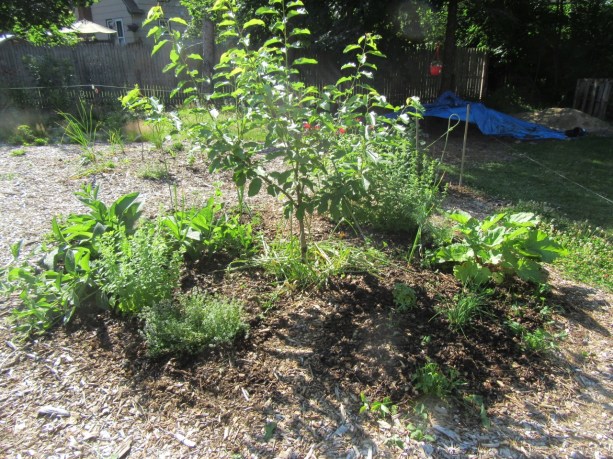
We had done some preliminary work before we ordered them, to decide where they might be planted, and today Margy and I went around to confirm the spots, to make sure each bush would have enough room when full grown.  We marked them with flagging and markers. We unpacked the box of young plants and were delighted that they were more than just sticks with roots. They looked healthy, and we stored them in dampened shredded paper.  The photo is our witch hazel bushes.

The land in our yard has been soggy and wet for the last week.  But, when I tried to dig holes, I could only go down about five or six inches before I hit a barrier of ground frozen solid.  I guess we aren’t planting these today!  Still, it was in the 60s out there, and it was marvelous to just be outside in the sun–and then it was too hot, so we pulled out our shade umbrella for our patio table.  We turned to other tasks in the garden, and listened to birds singing, and I dug up the old kale plants that had overwintered.  Before I came in, I noticed that the holes I had dug were now filled with water.  I am curious as to whether the holes I dug will thaw faster than the undug ground.  We’ll see.  We are expecting no freezes this week.
Plants and their wisdom

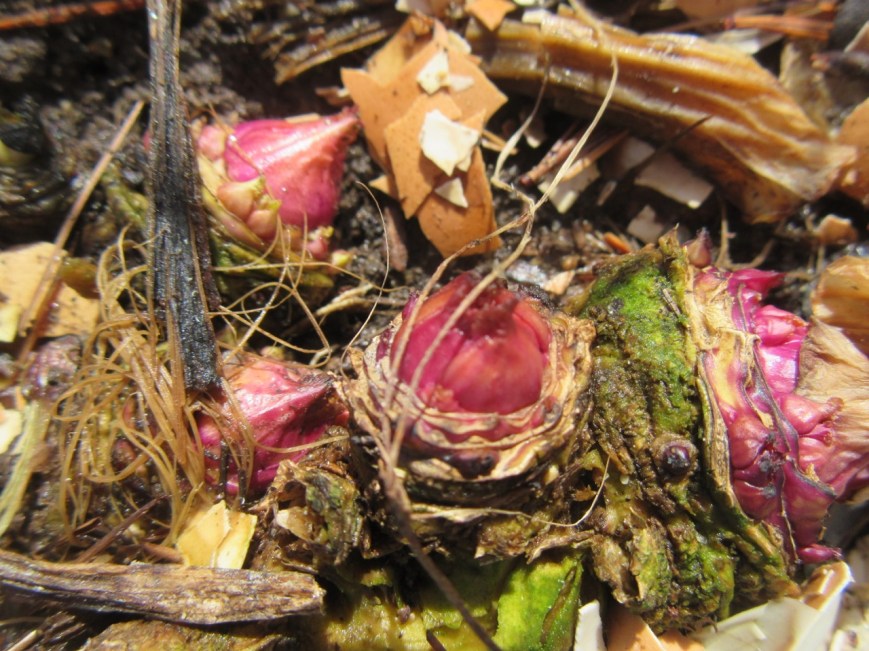
Sea Kale emerging

Sea Kale emerging in my garden, April 3rd.

This morning, I have been reading Farming While Black, by Leah Penniman. It is a marvelous book on so many levels–history lesson, gardening guide, liberation manual–and it feels a privilege to learn so much from a work that is actually focused toward Black farmers and gardeners. I knew so little about the skills of enslaved Africans who brought with them to these lands African plants and knowledge of growing them.  I knew so little about the work of George Washington Carver who was one of the first to study and promote regenerative land practices.  I know so little about multiple plants and their habits and their gifts for us.  Get this book!  

But then, after reveling in reading all morning, I find myself opening to multiple layers of deep grief underneath the joy of reading the book.  Grief for the African peoples who were stolen from their land and enslaved.  Grief for these Turtle Island lands, whose balanced ecosystems and soils were so depleted by the cutting of forests, and the plowing under of the soil, as well as by the war waged on their people.  And grief for myself and my communities–that we have lost our connection to the ecosystems, we have lost our connection to the wisdoms, we have lost our connection to the plants.

I get overwhelmed with the abundant knowledge in the book, and I remember this feeling in other wonderful books I have read, the feeling that I have no hope of learning everything I need to learn, in the limited years left to me on this planet.  I get the feeling that I have no hope of regaining access to the collective wisdom that has been cut off in so many ways.  And I realize that this too is part of colonization.

My East Frisian ancestors were some of those who plowed over the fertile prairies back in the 19th century.  Grief.  But at least they knew how to grow their own food, and provide for their families from their land.  I read online recently that in the last two generations, most Americans have lost the capacity to do that.  More grief.  I don’t know how to do that.  And I can’t envision getting to that ability before I die.  Plus, it is not really something we can learn from books.

In Farming While Black, I was reading about herbs and their healing properties, and there were too many to take in–even though it was a limited list of the herbs they grow and find to use in their community.  I feel lucky if I can learn about two or three herbs in a season.  All of us should have been learning the herbs since the early days of childhood wandering in the woods.  The plants are our elders, our guides, the wise beings who know how to feed us and heal us and care for us.  This separation from the plants is also a part of colonization.

One answer to my dilemma is about community.  No one is meant to have all the knowledge on their own.  It is okay that I can’t learn it all on my own.  But I feel grief too for the fragmentation of communities that has kept us from sharing this learning and wisdom with each other.  And I feel grateful for each person who has shared their knowledge of plants with me.  I feel grateful for organizations like the Resilience Hub, who bring people together to share so much wisdom of soil and plants and ecosystems.

But for this moment, I want to honor the pain of colonization, honor the pain of what has been lost, honor the pain of so many threads of connection that were torn apart and destroyed, never to be rewoven.  It is a long journey to healing.

Resilience in Portland

Cherry Tree and companion July

[Photo of our cherry tree with its companion plants.]

I really believe that permaculture offers a way to live in this time of ecological crisis. In Portland, we have a wonderful resource for learning permaculture skills, and offering mutual aid as we learn. The Resilience Hub helps people to regenerate the land, grow healthy food, and build community.  In that way, it also cultivates hope. In June of 2017, the Resilience Hub was the sponsor of our Permablitz when over 20 people came to help us establish our garden.

Over the last ten years, the Resilience Hub has become a thriving community organization. This past summer, its founder, Lisa Fernandes, moved on into new, but related work. Lisa’s departure prompted a series of community conversations about the future of the Hub: its assets and challenges, its goals and visions. Margy and I attended many of those meetings, and I was so committed to continue this important work that I volunteered to be on the new Board of Directors. We now have new part-time staff, Kate Wallace as Executive and Programming Director and Benjamin Roehrl as Operations Director. See more about our plans going forward at the website.

BUT–the Hub is at a critical point and needs all of us who care about permaculture in Maine to show up with financial help and renewed involvement. To that end, we created a Go Fund Me campaign, and we are trying to reach our goal in the next few days.  I’ve shared it via Facebook, but thought I would add my blog “audience” to this appeal as well.  Please check out our page, and donate what you can!  And if you are local to southern Maine, sign up to be on our active members list!

We are celebrating with a potluck and party this Thursday, January 17, from 6-9 p.m. at the Hub at 224 Anderson Street in Portland. See more about the party at https://www.meetup.com/maine-permaculture/events/257165312/

One of my favorite definitions of permaculture is “revolution disguised as gardening.”  Charles Eisenstein says, (in his recent book, Climate: A New Story,) in this time of ecological degradation, perhaps the most important work we can do is to care for and regenerate the places we live in, the places we love. (More on that later!) That’s what the Resilience Hub is all about. Thank you for helping us to keep it thriving!

I Walk in Passamaquoddy

I have had the privilege of studying Wabanaki Languages this fall, taught by Roger Paul. For me it has been a small way to begin to decolonize my mind–to begin to think differently.  Our final project was to make a short presentation to our class, and I was inspired by the words we had learned to talk about the animals I see and hear on my morning walk. I also drew on the Passamaquoddy/Maliseet (Wolastoqe) Language Portal for further help with verb and noun forms, and I learned some new words along the way.  If any speakers of the language read this, edits are welcome! Roger encouraged us to jump in with using the language, even though we will make mistakes. 

For those who do not know about Wabanaki languages, you might find it interesting that animals are not referred to as “it,” and people are not referred to by “he” or “she.”  There are “animate” and “inanimate” forms, and both people and animals are referred to by animate, non-gendered verb and noun forms.  A lot of information is encoded into one word.  So, for example, “npomuhs” means “I walk.”  “Nutuwak” means “I hear (beings plural and animate.)

Ntoliwis Mayk. Nuceyaw Portland.  (My name is Myke. I am from Portland.)

Spasuwiw npomuhs. Wolokiskot.  (In the morning I walk. It is a beautiful day.)

Nolokuhs lahtoqehsonuk.   (I walk in the direction of the north.)

Nutuwak sipsisok.   (I hear small birds.)

Nomiyak mihkuwiyik oposik.  (I see squirrels in a tree.)

Apc, nolokuhs cipenuk.   (Next, I walk in the direction of the east).

Nomiya kisuhs musqonok.  (I see the sun in the sky.)

Nutuwak kahkakuhsok. Tolewestuhtuwok.  (I hear the crows. They are talking)

Nomiyak oqomolcin kehsuwok nehmiyik awtik.  (I see eight turkeys in the street.)

Apc, nolokuhs sawonehsonuk.  (Next, I walk in the direction of the south.)

Npomuhs sipuwahkuk, naka nomiya motehehsim sipuhsisok.   (I walk along the edge of the brook, and I see a duck in the brook.)

Nutuwa pakahqaha lamatokiw.  (I hear a woodpecker a little ways into the forest.)

Wahte, nomiya qaqsoss.  (In the distance, I see a fox.)

Apc, nolokuhs skiyahsonuk, naka ntapaci nikok.   (Next, I walk in the direction of the west, and I come back to my house).

WoodchuckNomiya munimqehs kihkanok. N’ciciya wot.   (I see a woodchuck in the garden. I know this one.)

Coness, Munimqehs! Musa micihkoc kihkakonol! Wesuwess!   (Stop, Woodchuck! Don’t eat the vegetables! Go back where you came from! )

Munimqehs qasku. Qasku asit kakskusik. Qasku lamatokiw.   (Woodchuck runs. S/he runs behind the cedar. S/he runs a little ways into the forest.)

Toke, ntop qotaputik qocomok.  (Now, I sit in the chair outside.)

Komac Wolokiskot! Woliwon!   (It is a very good day. Thank you)

Squirrel Highway

Squirrel PathOne thing I love about the snow is how it reveals the lives of our animal neighbors. Here is a squirrel highway, a path between two mounds.  Now, I had actually helped to create that path the day before, before the snow.  The day before that, Margy got a call from a local arborist that he had some wood chips we could have.  For permaculture gardeners, wood chips are a boon, especially hardwood chips, especially lamial hardwood chips, which are from the small branches and leaves of the tree. They provide nutrients to help create the kind of soil that is best for fruit trees.

It seems ironic, because I don’t want trees to be cut down. But there is a circle of giving and receiving we humans have with trees, and when they are cut down, it feels so respectful to use their remains to feed other young trees and plants.  It had been a difficult year to get any wood chips.  The arborists we knew were mostly cutting diseased trees, which wouldn’t be good to introduce to the garden. So when Margy got the call, she said yes right away.

Wood ChipsSo the wood chips were delivered. The next day I noticed that where the big pile landed had kind of blocked off the pathway on the edge of the food forest.  Last winter, I had strung a small string across the edges of the food forest as a gentle deterrent to deer who might possibly wander through. We had seen deer tracks before, though we didn’t actually see any last winter.  But the idea was to leave one area free for them to traverse, hoping they’d choose that path on the way between the street and the back of the yard.
So what to do?  I went out with a shovel and cleared an area between the wood chip pile and the finished compost pile (covered with a blue tarp), shoveling compost back a little, and wood chips back a little.  That made the path.  I don’t know if any deer will use it, but it was fun to see that the squirrels got the message.

The Fox

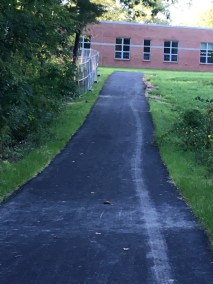
Path over the brookToday I set out on my usual walk around the neighborhood. When I got to the newly paved way that leads over Capisic Brook toward the new Rowe school, I saw a fox cross over at the other end, and slip into the path into the woods (before I could catch them in a photo). So I felt invited to walk that path along the brook as well.  I couldn’t see the fox anymore, but I could hear squirrels doing their alarm chatters, and guessed they might be warning others about the fox.
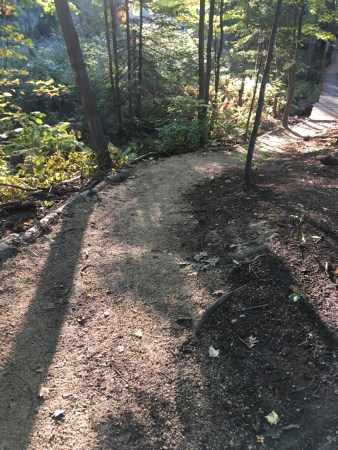
I hadn’t walked that path for at least a week, and along the way, I noticed that someone had been upgrading the trail, with logs positioned on the edges, and a gravel/sand mix spread out over the trail.Brook Trail Upgrades That made me smile. I like to see the evidence of other people caring for the trail.
It is a beautiful sunny day today and I was enjoying the trees and the shifting colors in the leaves.  We’ve learned to speak about the weather in our Wabanaki Language class.  “It’s sunny” would be “Kisuhswiw.” The word for sun is kisuhs.  It’s pronounced starting with a hard “g” sound, and a “z” sound for the first “s.”

On my walk I was thinking about Findhorn, the community in Scotland that was founded by Peter and Eileen Caddy and Dorothy Maclean. The three had been living in a caravan park, with few material resources, so Peter started a small garden. During her meditation, Dorothy began receiving instructions from the spirits of the plants, showing how best to grow them.  The plants thrived, and became so huge that they attracted international attention.  I was thinking about the possibilities for communion between myself and the plant beings.  Even as I attempt to learn about gardening, the plants are actually my best teachers. Yet, in our materialistic society, it is easy to doubt or forget that communication.

When I reached the river of rocks, I wondered if the path workers would have built a new bridge over the drainage area, but it was the same.  Then, further down the slope, I saw the fox! I think they were eating an old dead squirrel.  This time I was able to take a few photos, before they decided to move on with their day.  I felt blessed. Anytime a wild shy creature lets you spy them, you know it is a blessing. May you also be blessed today!Fox

when it seems like too much

In the midst of this intentional time of rest and healing in my life, I have been gardening, as I am able.  Sometimes even the garden needs more than I have to offer.  I have days when I feel overwhelmed by my own lack of knowledge about how to care for the trees, how to deal with challenges to them, how to help them thrive.  Margy reminds me that it is a learning experience.

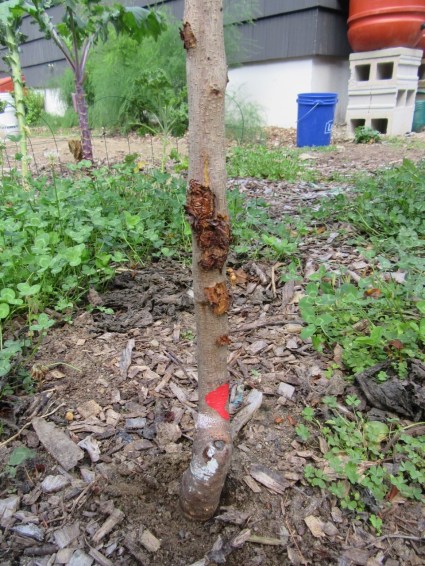
Peach Tree SoresSo the latest “too much” were these sores on the peach tree trunk.  Our friend Mihku noticed them, and suggested they were peach tree borers.  The usual remedy is to cut out the wound with a knife and poke the caterpillars manually. But I couldn’t seem to find any clear culprits, and truthfully, the trunk is so small, I was afraid to do too much.

I researched what I could on the internet, and in my Holistic Orchard book.  Sometimes that is overwhelming, too–to read about everything that can go wrong. Beneficial nematodes were mentioned as a possible solution for peach borers, but the only options for purchasing online were in sizes meant for an orchard, not a solitary tree.  I did find a product locally with Bt in it, but that was said to work better on leaf and surface eaters, rather than trunk borers.  Perhaps it is just me, or perhaps it is these times, with the overlay of such despair growing in so many realms, but this problem just felled me, sent me to my bed.

Eventually I did get up again.  I prayed for the tree. I prayed for help.  I consulted my spirit stone, a beautiful rock with a hole through its center, that I use as a pendulum for guidance when I feel uncertain or overwhelmed. I pulled out some products that we use for the orchard, and consulted the stone about whether any of them might be helpful.  Then I noticed that the very simple label on the bottle of Neem Oil mentioned the concentration to use in the case of borers.  Okay.  The stone agreed.  So I made up a small quantity–1 teaspoon Neem Oil to 2 cups water, with some dish soap added as an emulsifier.  I also felt like adding a little compost, in hopes of introducing some beneficial microorganisms.  I washed the mixture over the trunk with a rag.

Peach TreeSomehow, calling for help from the Spirit, and then taking one small step to do something got me going again.  It might not work.  The tree is so beautiful and healthy, and has grown so well this first year, that it would break my heart if it is killed by this wound.  We’re not a big orchard.  Each of our trees is precious and the only one of its kind in our yard.  I had also recently purchased some tall stakes, so I staked the tree (not yet in the photo) and also put up stakes for the mulberry tree, the apple tree, and created a border of stakes and string for the raspberry bushes, which are growing fruit now.

I know so little about how to care for the trees, the plants, the creatures of this yard, this small circle of the earth.  Meanwhile, we human beings are doing so much harm to all beings, and it may be too late to heal.  Meanwhile, the powerful seem bent on destruction and abuse and greed.  Meanwhile, so many wounds everywhere coming into the light.  I don’t seem to have any answers these days. I am trying to be quiet, to attune to the deep River of Life, to stop pushing, acting, deciding… I am trying to wait for the River to move me.  I am trying to learn how to care for the garden. I am reminded of some verses from the Tao Te Ching (translation by Stephen Mitchell.)

Do you have the patience to wait
till your mud settles and the water is clear?
Can you remain unmoving
till the right action arises by itself?

May the River of Life have mercy on us.

Bird Mystery

Northern Flicker

The other day I heard an unfamiliar racket out the window and discovered a small flock of northern flickers had come to visit the garden.  They were eating bugs in the ground, and also poking their long beaks between the pavers on our patio, so I am going to guess they were eating ants.  They settled in for a feast, and made themselves at home.

They are so distinctive and beautiful, a spotted breast with a black bib (and cheek patches on the males), red heart shape patch on the back of their head, and white rump feathers visible when they fly.  Oh, and a bit of yellow on the tail.  I also saw a plain looking smaller bird that I believed was a juvenile flicker, but then noticed it had white spots on black instead of black on white. It was clearly hanging out with the male and female flickers, but it looks more like a starling juvenile.  Does anyone know if starlings ever drop eggs with the flickers to get them to raise the young starlings?

Stranger than it first appeared.

Northern Flickers

Update on Kale

Kale choppingSo right after my last post, I went outside, and cut about 40 big leaves off my kale plants–always from the lower part of the stems.  In between making and eating breakfast and washing dishes, I washed the leaves in groups of ten (by variety), and chopped them up, then washed them again in a salad spinner, which they filled up.

Kale washAfter doing the first batch, which used a lot of water, I figured out that I should save the wash water and bring it out to the garden, where I put it on the kale plants! Then I spinned the kale pieces to dry them, and sautéed them in our big cast iron pan.  I had to start with about half of the batch, then add the second half after the first had cooked down a bit.  I had green curly kale, red or purple curly kale and a double batch of lacinato kale. After sautéing, I cooled them in a bowl in the refrigerator before putting in bags. On the recommendation of other online gardeners, I used a straw to pull out all the air in the bags.
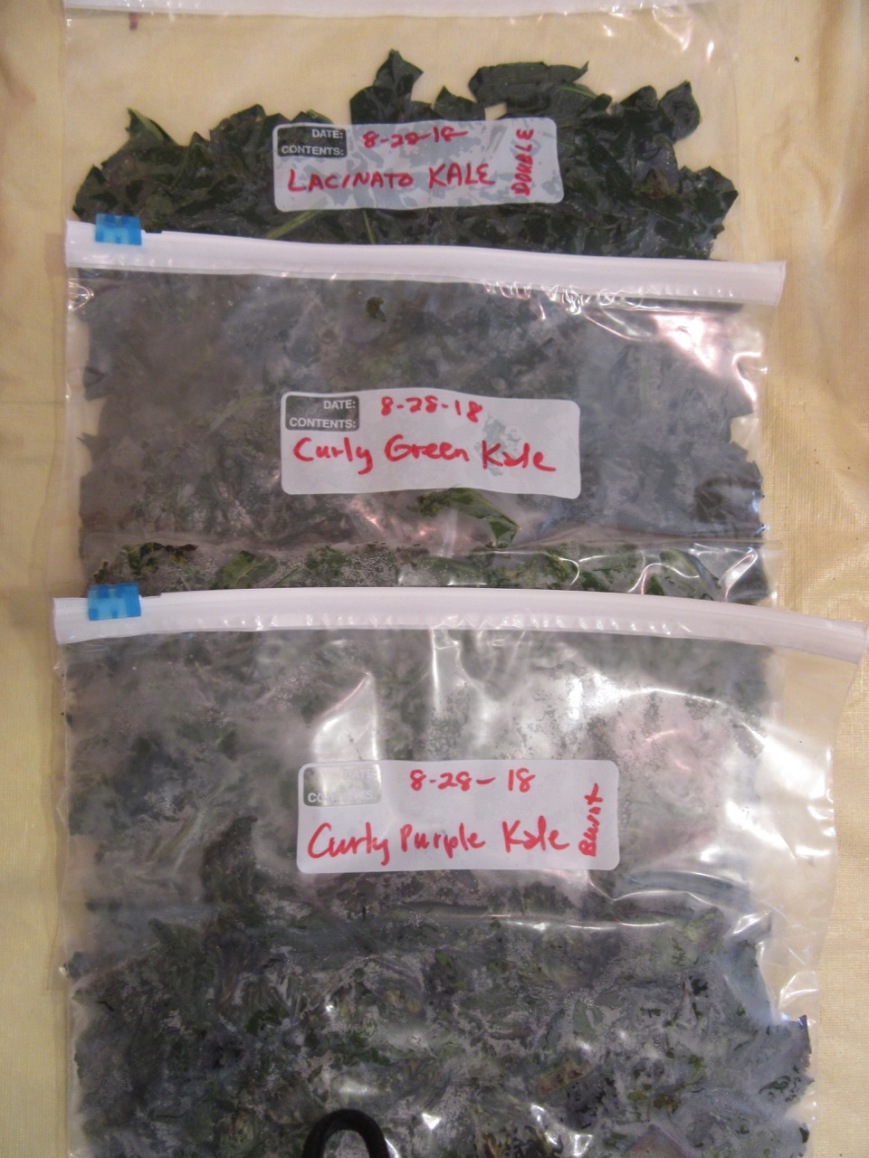
I still have plenty outside on the plants, but now I have these in the freezer.  Ten leaves only filled half a bag, at about 1/2 an inch thick.  That would be about three or four servings in our house, so this is a total of 12-16 servings.    This winter, I will see how they taste.Kale to freeze

Abundance

Myke with kale

[Photo by Margy Dowzer]

The kale has gone crazy this year! I eat some every day, and we’ve given a lot away, but it is still up to my waist in abundance. Not to mention the basil plants, also a few feet tall. Harvesting has always felt like the most challenging part of gardening–how to keep up with everything the earth is producing. I see posts of friends who are canning and drying and freezing–that is all still something I need to learn more about.  I search online for instructions, so information is not the main issue–just the time and energy to keep up with it and carry it out.

Most of our garden this year isn’t even to that stage yet–the fruit trees and bushes are still babies, the asparagus is in its first year.  And perennial herbs will keep coming back each year, whether I harvest them now or not.  In fact, I’ve got thyme drying in the basement, and will probably do some oregano after that is done.  I finally dug up the garlic that I had planted as companions to the fruit trees to help keep away pests.  But I especially feel a responsibility to the annuals like kale and basil.  This is it for them. And they are shining.

Last week, I experimented: I sautéed a dozen large leaves of kale, which cooked down quite a bit, and then I froze it–it only filled a small part of a plastic freezer bag.  I should be doing that with whole bunches of it, but it takes time to wash and cut and sauté and cool and bag.  We’ve been eating basil this week–especially yummy with an heirloom tomato we bought from the coop.  I learned not to put it in the refrigerator, but to keep cut stems in a vase with water.

For now, I just want to say thank you to the earth for creating such abundance!  Give me the strength to receive and cherish and preserve your gifts.  I’d better get outside and harvest some more!