A Kettle of Hawks

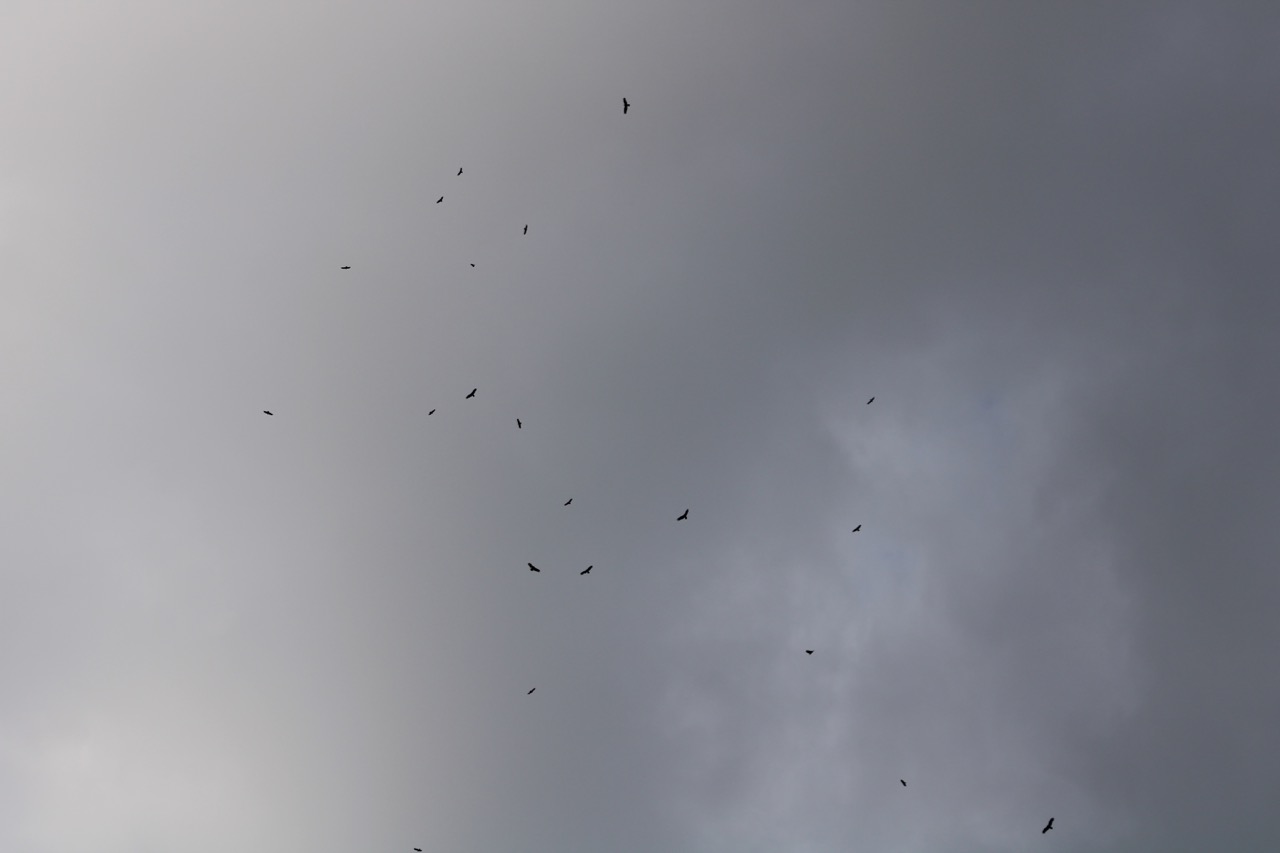
Over 20 hawks high in a cloudy sky.

I was outside lying in the hammock two days ago, when I saw a hawk flying overhead, and then more and more hawks, higher and higher. I understand that a group of hawks is called a kettle of hawks, and only occurs during migration. It was amazing to see! A reminder that the seasons are changing. I am writing this outside today on a sunny day, but wearing my winter jacket.

I think I may have found an important clue in my search for the roots of my third great-grandmother Marie Madeleine. In the record for the baptism of her son Simon, in 1833, in Jeremy Islets, she is identified as “sauvage du dit poste,” which means, translating the racist imagery, “Indian of said post.” And just above that record, Jeremy Islets is the post in question. I just want to say that it took a lot of close handwriting inspection to pull out those four words, but I am fairly confident in them now. And so it seemed to me it might be identifying her place of origin. (Now, on the other side, I know that her husband Peter McLeod was a clerk of that post in 1833. But she, along with two other Indian couples baptizing their children were all identified as Indians of that post.)

To further clarify, generally speaking the Innu went into the woods in fall, winter, and spring to hunt, and came to the posts to trade and to connect with the priests who did the baptisms, marriages, burials, and such. And they didn’t just go to one post, while necessarily avoiding others. But following the clue, of the several Marie Madeleines in my list of possibilities, one was connected to Jeremy Islets, in the right time frame. She was identified in her baptismal record as Marie Madeleine Napeteiashu, baptised June 26, 1803, when she was about 7 years old, they said, which would put her birth about 1796. Napeteiashu was actually said to be her father’s name, with no Christian name attached, and her mother was identified as Catherine Mitisku.

After searching through hundreds of other records, I found a Catherine Mistiku, born in 1773, and baptized in 1786 in Jeremy Islets. She was married to Stanislaus Mishtanapeu, baptized in 1778 in Jeremy Islets. In other records, they are identified as Catherine Mistigu or Mitigu, or Stanislas Tshiuapan (actually the name of his son Paul). I think this is likely the same couple, though in this process, one can’t be positive. I found baptism and marriage records for sons Simon (b 1794, bap 1796) and Paul (b 1798), but no other links for Marie-Madeleine. (And why would Paul be baptized in 1798, but not Marie Madeleine until 1803?) In the marriage record for Paul, in 1817, Catherine is said to be deceased.

Along with the genealogy hunt, I have also been exploring the possible meanings of their Innu names. Mistiku (likely now spelled Mishtiku) can mean, a tree (animate), or a log (inanimate), or possibly a French Canadian or white person-(though Catherine would not be French, but someone might be called this perhaps because she was hanging around the French?) (I think the French were called this because of wearing wooden clogs.) Mishtanapeu means a remarkable man. Napeteiashu was harder to decipher–“nape” refers to a male, and if I stretch the spelling, it could mean a male fox–napeiatsheshu. Spelling was not a hard science in those days. I couldn’t find any other references to Napeteiashu. The one possibility was a marriage with no details attached of Catharina Matshiskueu to Nipituashu. No dates/places/or parents. Matshiskueu means “she is an ugly woman”. So you see, it’s all very mysterious and uncertain.

By the way, several of the names I was researching seemed to have “negative” connotations. I wondered if it was some kind of internalized oppression, or if maybe there was a function of the name to protect the child by acting as if it were not valuable in some way. There was a lot of oppression by the priests. For example, when an “illegitimate” child was baptized, often they did not even name either of the parents at all in the record. Some priests took more care than others. I think the earlier Jesuits learned the Innu language and taught people to read and write in their language. Later priests did not know the language at all.

But as for me, I was so excited to find this possibility. Maybe it was really her, with a place and parents! Then today, I was slowing down to remember that this process of search will continue, and I have to pace myself, to live with each possibility as it emerges. There are hundreds of pages of records, much of it not indexed, so I go through page by page looking for names–and with new names, that means all new searches. Still, I am amazed that these ancestors feel closer to me now, even if they are still like the hawks flying in the sky so far above me that I can’t see the individuals very well. Am I related to a tree, a fox, an ugly woman, a very remarkable man? Am I related to the place called Jeremy Islets? In Innu, Ishkuamishkᵘ, which is similar to the word for a female beaver ishkuemishkᵘ. And how does this all relate to my life as a white woman in Maine, in Wabanaki territory? Still, it does feel like one part of my own journey of finding our way home into the earth community.

A fox near the Capisic brook, surround by trees and other greenery. (This photo was taken in 2018)

Magic Happens!

Yesterday, I wrote, concerning my search for my matrilineal ancestor Marie-Madeleine:

“Why do I write about it here? I’m putting some magic out into the universe, hoping that some kind of thunder might open the cloudy skies between me and the past, between me and the place my ancestors are from. … It has been my experience that when I reach out to my ancestors, they reach back—more so when I have actually traveled to Quebec, but since that is not possible, I hope they will reach across the border.”

And then some magic did happen!

After being stuck not finding people on the GénéalogieQuebec website, I meandered around some more, and some records of the Postes du Roi index of people, not related to my ancestors, linked to images from the actual Postes du Roi records. If I went to those images, I could move back and forth from page to page in the images of actual records. And by doing that, I found the baptism records of six of the Marie Madeleines or Madeleines, from the list I had, from 1800 to 1805, even though they were not “indexed.” Also, I was able to download all the images as I accessed them, to be able to look back as I needed. So now I am able to keep researching, a way opened up.

Some magic happened!

Sometimes it is easy to forget—in my intellectual research mode, in our rather secular world—that magic is alive, that ancestors reach out to us. Even though I have experienced it in the past, and believe in its power. So easy to forget.

And the intellectual research is part of the magic, not separate from it. It is a lot of work to attempt to decipher 200-year-old writing in funny penmanship, in French. But I am so thankful to be able to attempt it. And to learn as much as I can about the lives of all of these women. I also learned that for some of them, the Innu name is that of their father—at some point (1803?), the Innu names switched from being a descriptive personal name to function more like a surname. (Those are in parentheses)

Marie Madeleine Katshisheiskueit, b. 1795 in the woods, baptized 1796 Portneuf

Marie Madeleine (Napeteiashu), b. 1796, baptized in 1803 Îlets-Jérémie

Madeleine Peshmekueu, b. 1799 Sept-Iles, baptized 1800 Sept-Iles

Madeleine Pishikuskueue, b. 1801 Pointe-des-Monts, baptized Godbout

Marie Madeleine (Utsinitsiu), b. 1801, baptized 1805 Chicoutimi

Madeleine Moistashinagusiu, b. 1802 Rivière Godbout, baptized Godbout

Marie Madeleine (Arishinapeu), b. 1805, baptized Tadoussac

Magic happens! May I keep being open to the magic, and may you feel it opening where you need it too.

Close up of hazelnut leaves in full color.

Thunder Magic

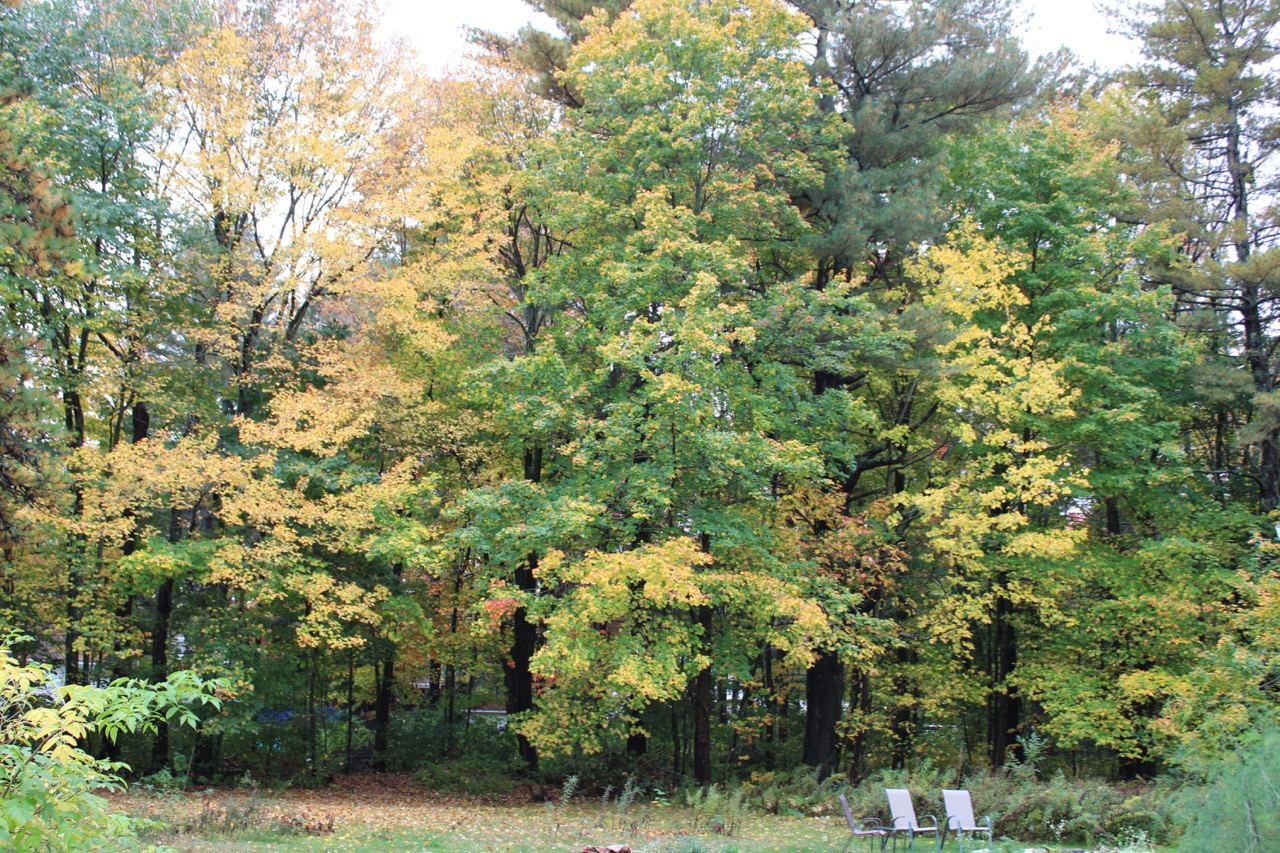
Trees at the back of our yard in fall colors

I woke to a crash of thunder about 7 a.m. this morning, with a driving rain pounding against the wall and window near the head of my bed. What a beautiful sound to start the day! The rain only lasted about an hour, and then the skies were gray, but the air was lit by leaves of gold and orange encircling our back yard. We’ve had no frost yet, and the October transformations are unfolding with beauty and grace.  

I’ve been surprised by how low in the sky the sun travels at this time of year—even at noon it is lurking behind the tree canopy shading the back half of the yard. You’d think after all these years I would be used to it by now. I’ve also been surprised by new raspberries ripening fat and delicious. Usually our “everbearing” raspberries don’t ripen in the fall—there is not enough sun and warmth in their spot to bring them to completion—but perhaps taking out the (invasive) Norway maples near the fence helped them to get more morning light. They taste better than any of the summer raspberries.

October is also a month for ancestors, leading up to Samhain on the 31st. I have continued to search for more information about Marie-Madeleine, my Innu great-great-great grandmother. I’ve been lucky that I emailed two people who seemed to have some resources, and they both replied and sent information. Magic! One told me that, from looking at his records, Marie Madeleine Manitukueu could not be my ancestor, because she married someone else in 1815, and then that person remarried in 1825 after her death. So that was incredibly helpful. Most of the work will be eliminating the women who cannot be my ancestor.

Then he also sent me a list of 17 “Marie Madeleines” or “Madeleines” recorded births from 1790 to 1818 at the Postes du Roi, from the databases he had access to, and agreed with me that it seemed most likely that she would be born closer to 1800, rather than 1789, since her last child (Marie Sylvie) was born in 1846. (The 1789 date is based on her death record stating that she was about 60 years of age at her death in 1849.)

I believe that going by child-bearing years is the best guide. A late baby in her 40s is more possible than in her 50s. The child before the one in 1846 was born several years earlier in 1839 (Sophie)—so it seems also more likely that 1846 was a late baby. Her prior children were about 3 years apart. Her first documented child was born around 1828, but it is possible that she was the mother of earlier-born children of her spouse Peter McLeod.  (Most sources say that he had an earlier Montagnais woman spouse, but there is less agreement about which children had which mother.) To go by a childbearing age of about 16 to 50, it seems like her own birth would be between 1796 and 1812.

This leaves 11 women on the chart—stretching slightly to include Marie Madeleine Katshisheiskuet (born 11/11/1795). So, the next thing I did was explore GénéalogieQuebec.com, to see if I could do research on each of the women. But I ran into a problem immediately. The records of the Postes du roi included on that site seem to be missing many of these vital years, not yet indexed, and none were available in direct images. I could not seem to find access to the databases to which my email correspondent had access. To complicate things a bit more, the parents listed for Marie Madeleine Katshisheiskuet in GénéologieQuebec are different from my earlier resource, and I think the only way to clear that up would be to look at an original record.

So, I feel stuck again—there is such a distance between Quebec and the United States—so much knowledge does not cross the border. I would like nothing better than to pore over these old records looking for the lives of these 11 women, seeing if I could find other marriage and death records that would steer me away from some, and toward my own ancestors. I don’t know why I think I can succeed where prior genealogists have not found a link. But maybe they didn’t have the same motivation. I’ve sent an email to the GénéologieQuebec site asking about the Postes du roi records. I also think I found some at the Catholic Archdiocese of Quebec, but not published or indexed.

It’s like the detective stories I’ve been reading—so many mysteries, so many clues. Why do I write about it here? I’m putting some magic out into the universe, hoping that some kind of thunder might open the cloudy skies between me and the past, between me and the place my ancestors are from. I’ve learned a lot in the process. It has been my experience that when I reach out to my ancestors, they reach back—more so when I have actually traveled to Quebec, but since that is not possible, I hope they will reach across the border.

Ancestor Yearnings

My great grandmother Claudia Tremblay

Today, September 29, is my great grandmother Claudia’s birthday–she was born in 1865. I never got to meet her, but I was named for her (my middle name) and so I have felt a connection to her for quite a while. This week I was once again caught in the throes of this strange yearning obsession to try to understand the lives of my matrilineal forbears. I happened to be looking at a document about Claudia that I compiled a few years ago, and it mentioned a resource–the “General Catalogue of the Entire Montagnais Nation.” [Except the title was in Latin and the book was in French. Denis Brassard, Catalogus generalis totius Montanensium Gentis of Father Jean-Joseph Roy, 1785-1795 ]

It was a record of baptisms and other religious rites at the King’s Posts (Postes du Roi) in the Saguenay River area and North Shore of the St. Lawrence River of Quebec, in the 18th century. The Postes du Roi were the site of trading between the Innu/Montagnais and the French/British. They were also the site of missionary priests coming round to offer religious instruction and ceremonies to the Innu people. (The French called the Indigenous people of this region Montagnais, but since then, the people have reclaimed their own word, Innu.)

Claudia’s mother was Angele McLeod, and her mother was Marie-Madeleine, who was identified as “Montagnaise” in any records I had been able to find. But I had been unable to go any further back in her family, and only had estimates of her birth to be about 1789, perhaps linked to a Post du Roi. So I went looking for that book, which was available in a digital format for not so much expense. And it had a built-in translation function, which helped a lot since my French is shaky. The first half of the book was a description of how things were at the Postes du Roi. The Innu generally spent fall/winter/spring in the inland forests, hunting and gathering, and then came to the shores of the Saguenay or St. Lawrence in the summer, to fish and gather with each other. The Posts were built at these established summer gathering places to foster the fur trade, and the conversion of Innu people to Catholicism by the priests.

By searching record by record through the hundreds in the chart, I was able to find two Marie-Madeleines (Maria Magdalena) whose births were within 10 years of 1789: 1795, 1797. The Innu people did not use surnames, but rather single descriptive names, so each record included a Christian name (in Latin) and a personal name for the child in the Innu language. I found Marie Madeleine Katshisheiskueit (record #1065), and Marie Madeleine Manitukueu (record #1079). I don’t know that I will ever be able to establish a definite link between one of them and my Marie Madeleine, but one of them could be related to me. My Marie Madeleine eventually was married to Peter McLeod who worked for the King’s Posts in many places. And she was identified as Catholic, so it would be likely for her to be in these records.

Finding these names is touching a deep place in my spirit. I can’t even describe it. And deeper still, was searching out the meanings of the Innu names in the language. I was able to determine that Katshisheiskueit likely means “Hard-working/female” and her parents’ names were Antonius/ Tshinusheu which means “Northern Pike”, and Anna/ Kukuminau, which means “old woman” or “wife.” (Now the parents were only about 16 then, so likely it was an endearment, or Tshinusheu just said–“that’s my wife.”)

Manitukueu has something to do with Spirit–Manitu is the Innu word for Spirit. But I couldn’t find an exact reference. Manitushiu means someone who uses spiritual or mental power. “kueu” seems to be a common verb ending signifying something being or having. It is like detective work–and I wouldn’t be able to do any of it if I hadn’t been studying Passamaquoddy, which is related to the Innu language. Words are formed polysynthetically, with smaller parts joined together to create long descriptive concepts in one word. So I search the online Innu dictionary, with my framework of Passamaquoddy, and try to recreate what they might mean.

Manitukueu’s parent’s names were also challenging. Her father was Simeon Tshinapesuan, and the closest word I could find was something meaning “slips on a rock”, or “slippery.” Her mother was Marie Madeleine Tshuamiskuskueu, part of which meant “finding it by detecting it with body or feet.” But then I lucked out because her own birth record called it Iskamiskuskueu–which means “from Jeremy Islets,” and she was from Jeremy Islets. According to another source, this Innu name of that place meant “where you can see polar bears.” (Where you can find polar bears?) I guess I was rather far off.

So, it’s hard to trace “family trees” without surnames, but each child was listed with their parents, and by going through again searching for the parents’ names, I could find their parents too. And in fact, there were a few generations in each of their families to be found in the charts, with a lot of holding a magnifying glass over my computer screen so I could read the small letters in the charts. Much more still to do.

It is a whole world uncovered to me. And whether or not one of these women is my actual relation, this is the world she lived in, the world she came out from to enter a path that eventually would lead her daughters and granddaughters into other worlds. I never imagined that I might learn the Innu name of my great, great, great grandmother… and now there are all these names dancing in my mind, trying to form in my mouth, bringing much depth to my heart. I feel such gratitude and curiosity.

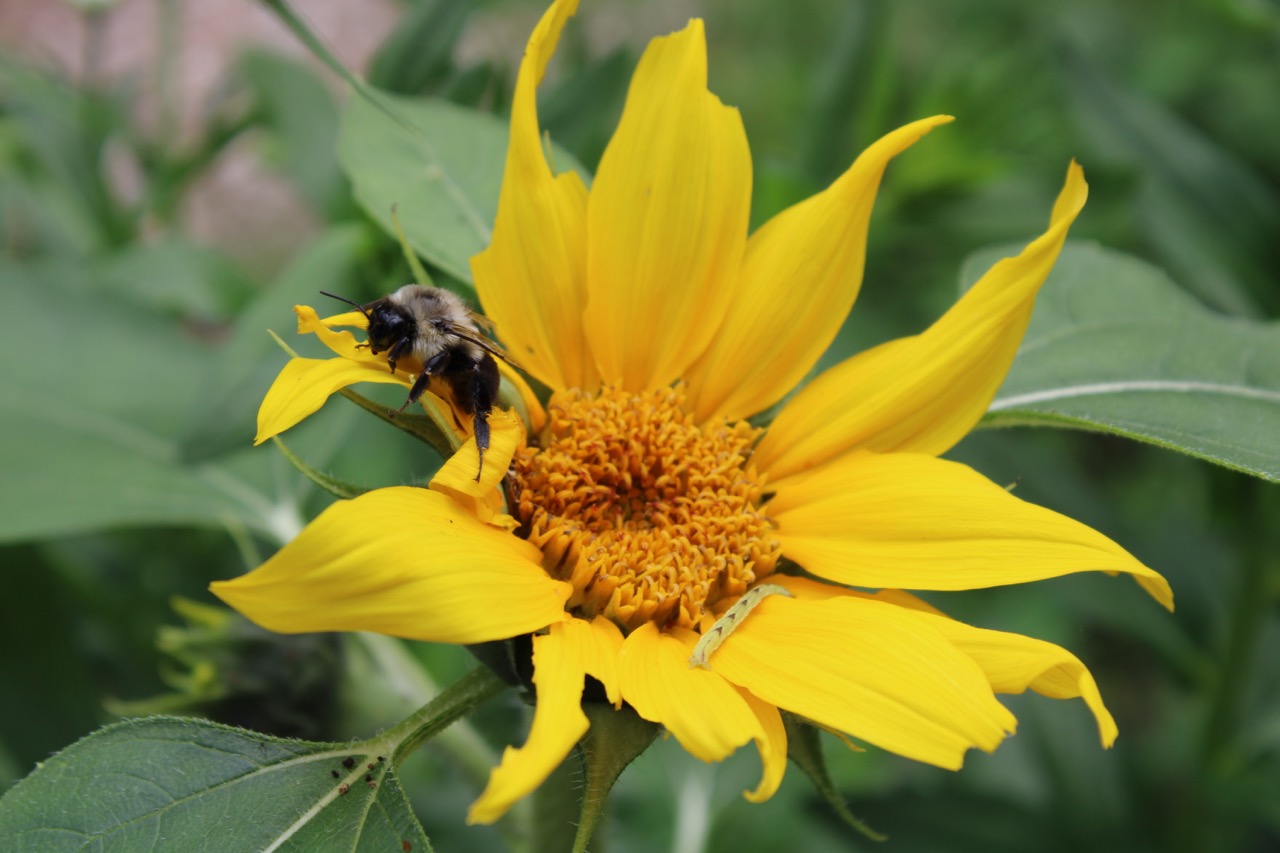
Yellow sunflower planted by squirrels, with a bee inside.

Magic in the midst of illness

Woke up to a misty morning on this new moon day, and started reading my journal from the last new moon until today. It is a ceremony I honor each new moon, and it is a way for my life to teach me.

I was struck by some passages from the time of Halloween/Samhain, that special time of connections to the ancestors. Because of chronic illness and its deep fatigue, I haven’t felt very spiritually focused lately, not much energy for deep ritual. Plus in COVID times, we don’t have our seasonal gatherings either. But it seems like the ancestors and spirits are reaching out to me nonetheless.

I did manage to cook salmon and potatoes for dinner on Samhain to honor some of Margy’s and my various ancestors. I listened to Quebecois music while doing dishes, and drank East Frisian tea. During the night of the full moon/blue moon I suddenly woke at 4 a.m. and saw the moon shining brightly outside my window. The next day, I saw a cardinal–my healing messenger bird–at the bird-feeder–the only time I’ve seen one there all this season. I was watching TV a couple days later and stumbled upon the movie Coco, which (despite its flaws) got me into the mood of Dia de los Muertos.

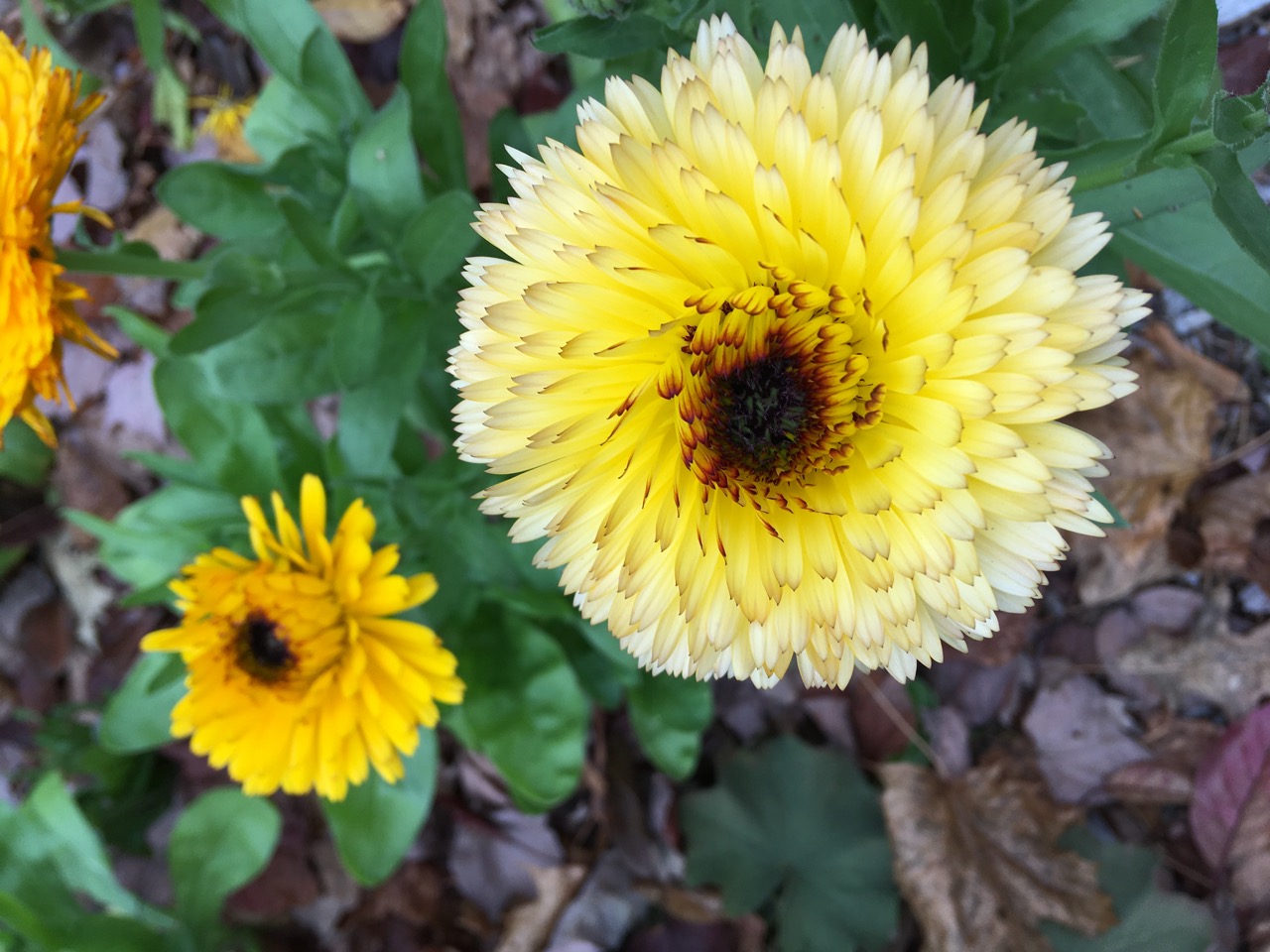
Marigolds growing self-seeded in our garden strip near the road.

I was looking for things to watch on our Roku and stumbled upon a series on Canadian Rivers. The best episode was on the Moisie River, or Mishtashipu in the Innu language. I had first learned about this river from Innu people who were fighting to protect it from a hydrodam planned by Hydroquebec. They won that fight, partly because there were also rich white people trying to protect their own salmon fishing. It was beautiful to see the river, and to listen to the Innu people who call it home. (And by the way, the word-segment “ship” in Mishtashipu is a cognate to “sip” in Passamaquoddy, which means river. I feel happy to know that.)

All these little threads meandering unexpected through my days, pulled from me this prayer: “Ancestors, are you reaching out to me from the other side of the veil? Even though I have so little spiritual concentration or focus right now? I open my heart to your presence.” I remembered magical moments of other times when I felt the presence of spirit close by. When my Innu ancient-grandmother, Nukum, first appeared, holding a bowl full of the universe. When I was able, despite all odds, to find the grave of my great-grandmother Claudia in Ottawa. When I was sitting right next to my dad as he took his final breath on this earth.

At the tiny headstone of my great-grandmother Claudia.

During those Samhain days, I was also working on a testimony about my family’s role in colonization. I was feeling the weight of the ancestors–the migrations, the wars, so much. I was feeling overwhelmed by that weight, I was feeling that I could not carry that weight, or imagine ways to find healing for this aspect of my heritage. I feel weary even from the weight of my many living relatives who seem trapped in a cult of lies, there is much estrangement between us. And so once again I reach back to spirit kin.

Finally, I hear: “You don’t have to carry the weight. Let go. Remember trust. I am here even when you cannot hear me, in this dark night of the mind and body. You are already in my hands. It was never a question of guilt or innocence. It was always about love. It is okay to trust my love. Breathe in love.”

And so, today, day of the new moon–this new moon which is also considered part of the time of closeness to the ancestors and spirits–I let myself hear those words again. There is room for magic to intervene, even in the midst of illness and fatigue, even when I cannot dance or sing or build a fire. And I am filled with gratitude.

Language Roots

Some presenters at Healing Turtle Island this summer suggested that we all, colonizers included, should seek to uncover our own distant Indigenous languages. I had the idea then to learn to introduce myself in the Innu language, the language of my matrilineal ancestors, and then to mark their transitions to other languages. (Three of my grandparents have Germanic roots, but in this exercise, I limited myself to my matrilineal line.)

I want to thank Roger Paul, my teacher of Passamaquoddy/Wolastaqey, because I could not have approached the Innu language without having learned so much about Passamaquoddy. From what I can tell, the structures of these languages are the same, the grammar, the animacy, even some of the words are cognates. So with this foundation, I was able to use the Innu dictionary online to shape sentences that might bear some resemblance to how the language is spoken, though no doubt I have made errors.

After I was deep into it, I laughed at myself, because to whom could I speak these words, since I am not in touch with any Innu people right now? But then it seemed that perhaps they were for my ancestors in the spirit world. And so this is dedicated to them. I also want to acknowledge that though I have studied French, Google translate was my helper in the French language parts of this exercise, and unfortunately there is no Quebecois French in that translation program, so some subtleties have not been included. I have heard it said that Quebec French is closer to ancient French ways of speaking. I begin with a photo of my great-grandmother, since she is at the heart of the story.

Claudia Tremblay

My great-grandmother Claudia Tremblay.

Mishen Claudia nitishinikashun.
My name is Mykel Claudia.

Claudia iapit nitanishkutapanukum ishinikashu.
Claudia is also the name of my great grandmother.

Shekutimit utshiu, ińnu-assit.
She is from Chicoutimi, in Innu territory.

Ukuma ińnushkueuńua, Mańi-Matińin ishinikashuńua.
Her grandmother is an Innu woman, whose name is Marie-Madeleine.

Ińnu-aimińua.
She speaks the Innu language.

Eukuannu nui ińnu-aimin.
That is why I want to speak the Innu language.

Mańi-Matińin uitshimeu Pień McLeod, kie mitshetusheu.
Marie-Madeleine marries Peter McLeod and she has many children.

Utanishu, Anisheń ishinikashuńua.
She has a daughter, named Angele.

Ashku Anisheń kutuńnuepipuneshit ashu nishtᵘ, ukauia Mańi-Matińin nipińua.
When Angele is thirteen years old, her mother Marie-Madeleine dies.

Natshe uitshimeu Anisheń kakussesht. Shushep Tremblay, kie mitshetusheu.
Later, Angele marries a French-Canadian, Joseph Tremblay, and she has many children.

Anisheń utanishu Claudia, nitanishkutapanukum an.
Angele has a daughter Claudia, that’s my great-grandmother.

Kakusseshiu-aimu.
She speaks the French-Canadian language.

Mon arrière-grand-mère Claudia parle la langue canadienne-française, comme son père Joseph Tremblay.
My great-grandmother
Claudia speaks the French-Canadian language, like her father Joseph Tremblay.

Très probablement, Marie-Madeleine et Angele parlaient aussi la langue canadienne-française, ainsi que leur langue maternelle.
Most likely Marie-Madeleine and Angele also spoke the French-Canadian language, along with their mother tongue.

Mes ancêtres canadiens-français sont au Canada depuis le début de la colonisation, depuis l’an seize vingt.
My French-Canadian ancestors have been in Canada from the beginning of colonization, since the year 1620.

Je ne peux pas compter le nombre d’ancêtres français qui se sont installés au Québec, atteignant onze générations en arrière.
I cannot count the number of French ancestors who settled in Quebec, reaching eleven generations back.

Ils ont abattu de très nombreux arbres et cultivé la terre dans un climat difficile.
They cut down many, many trees and farmed the land in the difficult climate.

Malheureusement, leur arrivée a entraîné la maladie et la mort de nombreux Innus.
Sadly, their arrival brought disease and death to many Innu people.

Les Innus vivent dans leur terre depuis des temps immémoriaux, et y vivent encore aujourd’hui.
The Innu have lived in their land since time immemorial, and still live there today.

Claudia a une fille Yvonne, c’est ma grand-mère.
Claudia utanishu Ipuan, nukum an.
Claudia has a daughter Yvonne, that’s my grandmother.

Par ma grand-mère Yvonne, j’ai l’héritage des colonisateurs mais aussi, dans ma descendance matrilinéaire, l’héritage des colonisés.
Through my grandmother Yvonne, I have the heritage of the colonizers but also, in my matrilineal descent, the heritage of the colonized.

Yvonne a déménagé aux États-Unis à l’âge de dix-huit ans, où elle parlait anglais.
Yvonne moved to the United States when she was eighteen, where she spoke English.
Ipuan atutsheu Upashtuneu-assit ashku kutuńnuepipuneshit ashu nishuaush, tanite akańeshau-aimit.

Yvonne has a daughter Carol, that’s my mother.
Yvonne a une fille Carol, c’est ma mère.
Ipuan utanishu Kańań, nikaui an.

English is my first language.
L’anglais est ma première langue.
Nitakańeshau-aimin ńishtam.

Kci Woliwon/Thank you very much

I feel such gratitude that I was able to participate in the 4th gathering for Healing Turtle Island, this year held online via Zoom and Facebook Live. Healing Turtle Island is a 21-year ceremony, born through a vision of Penobscot Sherri Mitchell, bringing together Indigenous spiritual leaders from around this land and around the world, to share teachings and ceremony for the healing we need for our times. I am grateful that those of us descended from colonizers have also been welcomed into the circle, that we too might listen and participate in this healing.

I was present for the first year’s ceremonies in 2017 at Nibezun in Passadumkeag, and though I have held its intentions close to my heart, my health has prevented me from attending the last two years. Being online this year, while a disappointment in some ways, enabled me and thousands of other people to participate from all over the world. (You can participate too, by viewing the recordings made of most of the sessions on Sherri’s Facebook page.)

Healing Turtle Island 2020

Poster announcing the schedule, from Healing Turtle Island page.

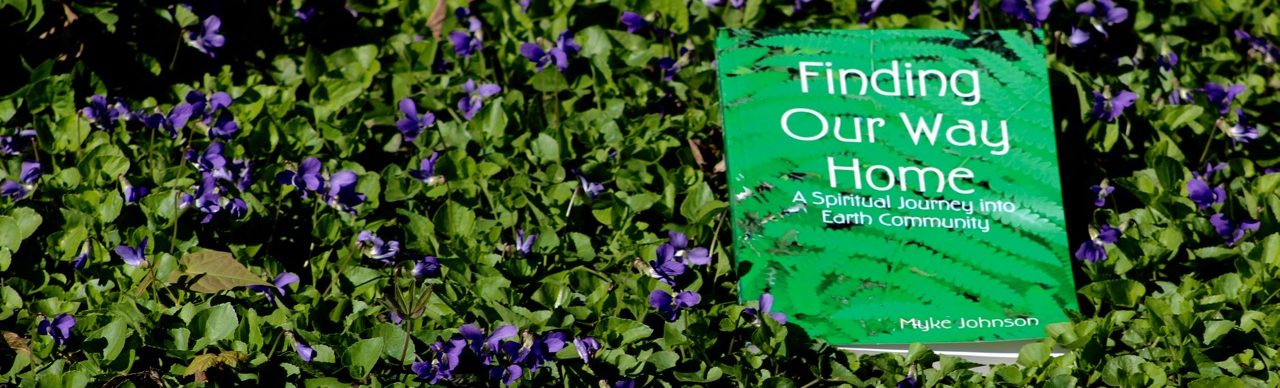
I am sitting in the silence now, after the closing ceremonies from this morning, thinking about what I have learned, what I carry with me going forward. First of all, it was grounding to hear so many people talk about the need to restore our connection with the land, with the spirit, with each other. It helps me to remember that that has been a guiding principle for me for the last several years, (as well as the theme of this blog and of my book .) By seeing this expressed so passionately by so many people, I felt renewed in my own spiritual journey into earth community.

Secondly, I was struck by how many people spoke of the importance of Indigenous languages for the healing and decolonization of the land and the peoples of the land. Over and over people reminded us that the spirituality and guiding principles of Indigenous peoples are found in their languages. Many people spoke in their native languages, offered prayers, offered songs, and then sharing partial translations, acknowledging that so much cannot be translated into the violence of the colonizer languages. They also spoke of how colonization disrupted the languages, how a whole generation of children were punished for speaking their languages, how difficult it is to bring back the languages, decolonize the languages, but how utterly necessary.

This touched me deeply, especially now that I have been studying a Wabanaki language for the past two years. On the one hand, I was so happy to understand a modest percentage of what Passamaquoddy and Wolostaqi elders were sharing in their language, especially in the prayers and songs and personal introductions. On the other hand, it has sometimes been bewildering to me that I find myself on the path of learning this language. A door opened so fortuitously just after I retired, and I walked through it into Roger Paul’s class at USM. I often ask myself, what is this about?

I feel glad that I helped to increase the numbers to enable the class to continue for its mostly Wabanaki participants through four semesters. I am glad that Roger got permission from his elders to share the language beyond the community. I have said that I want to decolonize my mind, I want to think differently: nkoti-piluwitahas. During the weekend another thought came to me, that any of us who come to live in Wabanaki land should learn the original language of this land. It is only appropriate as respectful visitors. And I remember someone saying, years ago, if you really want to understand our spirituality, you must learn our language.

But I still wonder what my responsibility might be, as a white person learning to speak a Wabanaki language. I am very sensitive to how much pain there is, in the loss of the language, and the slow revitalization that is happening now. Who am I to be learning, while so many Wabanaki people have not been able to do so? So I go forward with carefulness and respect and humility.

One other thing that was shared over the weekend lit a spark in me: that we all, colonizers included, should be seeking to uncover our own distant Indigenous languages. I had this idea to learn to introduce myself in the Innu language, the language of my matrilineal ancestors, and then a few lines in the language of my French and Scottish colonizer ancestors, and then a few lines in the language of my Germanic-speaking immigrant ancestors who came later, but who form the largest part of my inheritance.

The thing is, the Innu language is in the same family as Wabanaki languages, and structured in the same ways, so I feel like I am learning so much about those Innu ancestors by this process. That has been one of the very great personal gifts for me of learning a Wabanaki language. So I say kci-woliwon, thank you very much, for the blessings of this Healing Turtle Island gathering, and to all the language teachers, and especially to the Spirits of my ancestors who lead me into paths I could not have foreseen or chosen on my own.

Mothers and Grandmothers

In the early days of my feminist awakening, I began to trace the ancestry of my mother line, to learn who my grandmothers might be, and what land we originally came from. I learned this: my matrilineal great-great-great-grandmother was an Innu woman, identified in the records as Marie Madeleine, Montagnaise. She married a Scottish trapper who worked for the Hudson Bay Company in Quebec. His name was Peter Macleod, and he called her Marie de Terres Rompues, after the place where they came to live on the Saguenay River. Her name might be translated, Marie of Broken Lands, which resonates with what came later.

When I have been able to travel to Quebec, to the place the Innu call Nitasinnan [our land], I have felt the presence of the ghosts of my ancestors in the land. The very first time I drove into Chicoutimi on the Saguenay River, I came upon a book on the shelves of the Welcome Center in the rest area—it was about my ancestor Peter Macleod and his family. There have been other encounters over the years, a feeling of my ancestors reaching out to me as I reach out to them.

Learning about their stories has been an important part of my journey. I discovered many dislocations and relocations that occurred for my grandmothers, ways they were separated daughter from mother, separated from the land and the people from which they came. Marie de Terres Rompues bore several children with Peter MacLeod. Her daughter, Angele, was only twelve when her mother died, and Peter married another wife; Angele’s stepmother was a white woman. I wonder if Angele kept a connection to her Innu relatives? She was married at the age of twenty to a French Quebecois farmer, Joseph Tremblay, and they lived in the area of Peribonka near Lac St. Jean. I only know one story about them, from a census report. One year, all their grain burned in May, and they replanted with fresh grain but all of it was frozen and “not fit to be threshed.”

Her daughter Claudia was only eighteen when Angele died. At twenty-two, Claudia married Ferdinand, and during an economic downturn in their region, they moved over four hundred miles away to the town of Hull in the suburbs of Ottawa. Later, they traveled over seventeen hundred miles to the Black Hills of South Dakota, where Ferdinand worked in the mica mines for five years, during the boom years when Westinghouse Electric was producing over $100,000 per year in mica. Then the mines closed.

Their daughter, my grandmother Yvonne, was born in Hull in 1897; she was nine when they moved to the Black Hills, and fourteen when they returned to Quebec. She became a chamber maid in a hotel in the Canadian capital city of Ottawa, where she met Johann, an Austrian immigrant working as a waiter. At seventeen, she followed him five hundred miles to the United States, marrying at the border in Detroit Michigan.

My mother tells me Yvonne and her sisters worried that someone might think they looked Indian. Did she fear prejudice learned in Quebec, or in South Dakota? In Detroit, she became fully assimilated into the white and English-speaking world. Most of the stories were lost, but she did tell my mother they were part-Indian, and my mom grew up feeling proud of that heritage. There were occasional visits to family in Canada. When my mother was a four years old, the news came of Claudia’s death at the age of seventy-three.

Claudia Tremblay

My great-grandmother, Claudia Tremblay, age/date unknown

My mother was not quite twenty-one when her mother, Yvonne, died. I was a baby then. I have a picture [below] of my grandmother holding me in her arms. When I ponder this story of my mothers and grandmothers, I am struck by how most of these women lost their mothers before, or just as they were entering, adulthood. None of them had a chance to be with their grandmothers. They each turned to the life and the culture of their husbands. And I am struck by the many miles each generation traveled away from the place in which they might have felt a sense of belonging to the land. My mother, too, followed her husband on his travels across the United States. I grew up during those travels and none of those places ever truly felt like home. I didn’t know any other way.

Grandmother Yvonne with Myke

My grandmother Yvonne holding me as a baby.

It has been a long and important process for me to reclaim these stories and reweave a connection to my grandmothers.

[This story first appeared in my book, Finding Our Way Home: A Spiritual Journey into Earth Community.]

Ancestors: Clearing the Forests

I just finished reading Barkskins by Annie Proulx. It is a 300-year-plus epic novel, beginning with the stories of two French settlers who arrive in Quebec in 1693, who become involved in cutting down the trees of the forest. One runs away to make a fortune starting with the beaver pelt trade, and the other ends up marrying a Mi’kmaw woman.  We then encounter the lives of the descendants of these two men, through a relentless series of clear-cutting the forests of this continent and beyond, partly from the perspective of lumber company entrepreneurs trying to get wealthy, and Mi’kmaw logging laborers risking their lives and health working for the lumber companies, when they can no longer live in their traditional ways because the forests are being destroyed.

Any attempt to summarize does an injustice to the complex multi-generational stories Proulx weaves from the characters she creates, and the overarching sense of doom one feels, looking at it from our current perspective. I was glad to see that she consulted with Roger Lewis, a Mi’kmaw scholar, ethnologist and curator of the Nova Scotia Museum of Natural History. I would be curious what my Mi’kmaw friends think of the stories she wove of their histories.

While I was reading the early chapters, I also was researching my Scottish ancestor, (great-great-great grandfather) Peter MacLeod (sometimes spelled McLeod), who came to Quebec in the late 18th century. He too was involved in the beaver pelt trade, and then in the logging industry, and married a Montagnais (Innu) woman, (or possibly two.)

Peter MacLeod

Peter MacLeod, senior

I found this excerpt about his activities, loosely translated from the French by Google:

The Simard-McLeod tandem is behind the construction of the first sawmill on the Riviere Noire, whose work began in 1834. Thomas Simard, assisted by Charles Dufour, Peter McLeod Sr., who was responsible for the construction of the building, worked with the merchant Hubert Simon to build the Port-au-Saumon, Port-au-Persil and Riviere Noire mills.

“[…] Many of these characters employed by the lessees of the king’s posts will later participate in the early days of the Saguenay colonization. The best known are the brothers Thomas and Michel Simard, Peter McLeod father and son, Cyriac Buckell, Alexandre Murdock, Simon Ross and the Verreau family. Associates in several Charlevoix companies, Thomas Simard and Peter McLeod Jr. represent the pivotal era of the opening of the Saguenay to colonization, at the time of the transfer of an economy based on the fur trade to that of logging. “

Peter MacLeod Jr., my great-great-great uncle, was half-Scottish, and half-Montagnais/Innu. He was the founder of the city of Chicoutimi, and he is more well known than his father.  But the Dictionary of Canadian Biography under his entry, says this about his father:

Engineer, surveyor, and officer in the British army, he entered the service of the North West Company, and on its merger with the Hudson’s Bay Company in 1821 he became the confidential agent of William Lampson, the lessee of the king’s posts. He occupied this position until 1831, when the HBC secured the leasing rights.

It was during his time as Lampson’s agent that McLeod Sr became interested in lumbering in the Charlevoix region. Acting virtually as a timber contractor, he built sawmills for rental in La Malbaie, served as a timber supplier, and obtained felling rights. From 1827 to 1836 he became one of the principal sources of timber for William Price, who was then established at La Malbaie. In September 1836 he entrusted his eldest son with the responsibility for his facilities and commitments. But Peter’s assumption of control evidently did not produce very satisfactory results. From 1837 to 1842 the McLeods’ debts to Price continued to grow, and by the end of the latter year had reached £2,200. It is in the context of indebtedness, and also of Price’s desire to be the first timber contractor established as far up the Saguenay as Chicoutimi, that the partnership between Price and the McLeods must be seen.

Price could not himself acquire the felling rights and the letters patent on mill sites or on land in the region because of the prerogatives over this territory granted to the HBC until 2 Oct. 1842, and its antagonism towards him. He therefore proposed to use McLeod Jr to push farther inland along the Saguenay. With the help of the Société des Vingt et Un, McLeod had established himself between Tadoussac and Grande-Baie by 1837. Since, as a Montagnais on his mother’s side, he had natural rights to circulate freely among the king’s posts and to settle there, Price would be able, through him, to thwart the HBC and achieve his goal of exploiting the region’s rich pine stands. This prospect prompted the agreement between Price and the McLeods.

It is probably true that most of the settlers were engaging in the logging industry, if they were not clearing land for farming.  But learning this information while reading the novel Barkskins made it really come alive for me, in such a sad way.  These men who were trying to make their fortunes, these men who were caught between two worlds, these forests that were thought to be never-ending, but weren’t.

So much was lost, so much was invisible to the settlers, who saw trees as merely a way to sell lumber and make money, and saw the rivers as a way to power the sawmills and transport the lumber. My ancestors in Quebec were a part of all of that. It feels heavy. But I am grateful for the novel Barkskins that revealed so much what it must have been like for those who lived it.


First Quote from:  UNIVERSITÉ DU QUÉBEC, MÉMOIRE PRÉSENTÉ À L’UNIVERSITÉ DU QUÉBEC À CHICOUTIMI COMME EXIGENCE PARTIELLE DE LA MAÎTRISE EN ÉTUDES ET INTERVENTIONS RÉGIONALES PAR ÉRIC TREMBLAY , L’OUVERTURE DU SAGUENAY À LA COLONISATION (1821-1842), JUILLET 2015

Conflicting Survival Strategies in early Quebec

(More reflections on colonization in Quebec, jumping off from the book Helene’s World.)  Author Susan McNelley writes:

Summer days for the French settlers were long and filled with hard work. This was not the case for the indigenous people. Life was much less demanding in the summer. Fish, fowl, and small game were readily available in the river and nearby forest. The indigenous peoples along the St. Lawrence didn’t worry about storing food to last the winter. To the consternation of their French neighbors, the natives spent much of their time sleeping and socializing with their friends. There were games, story-telling, feasting and opportunities for young people to meet and court.  Summer was a time of replenishment and fortification for the rigors of winter.

A common factor for both Montagnais/Innu people and French settlers in early Quebec was surviving the long hard winter.  But they had quite different strategies for doing that. The French worked very hard in the summer to clear fields, and plant and harvest crops. Bread was their primary food. They were agricultural people, and in the early years were also reliant on ships arriving in summer with new supplies, to replenish their stores of wine and oil and spices and grains. They preserved food and stored it for surviving the long winter. Winter included much less activity, so in some ways it was an easier time, but they were on their own, and their strategy for survival was to carefully ration what food they had among the people in their families.

For the Montagnais, on the other hand, summer was the easy time–they camped by the river, fished & hunted, gathered fruits and nuts, feasted and celebrated with each other, and generally felt a sense of abundance in all sorts of food. As the fall came, they caught and dried eel, and then they left the summer encampment and began to hunt small game in the nearby woods. In winter, they traveled in small family groups into the interior, where they relied on heavy snow cover to slow down the big game: moose, caribou, deer, and bear. When they were successful in the hunt, they shared their feast with nearby families.

hiver_transports_11

Susan McNelley describes a winter incident recounted by Champlain when some of the Montagnais/Innu came to the early French settlement, because they were starving, and asked for food.

Although the French did try to be generous, they rationed the distribution of provisions to the aborigines out of necessity. Otherwise, the food would not have lasted a month.

The French believed that the Innu were irresponsible because they didn’t store food, and because when they acquired food in the hunt, they ate all of it, or shared with their neighbors.  But if you are traveling to follow big game, it wouldn’t be practical to carry large quantities of preserved food.  It would be practical to share the abundance that came sporadically depending on who had a good hunt.  Reading between the lines of this incident, I could imagine the Innu noticing that the French had food while they had none, and expecting, according to their own values, that of course the French would be willing to share with them. Their strategy for survival was sharing what became available, as it became available. The French strategy was about storing up and rationing.

And isn’t that just like capitalism, really, and how our modern mainstream society works.  “Save what you don’t need now, to use later. Try to accumulate as much as possible. That is the definition of wealth.”  (But perhaps rampant consumerism and planned obsolescence have superseded that model too.  Some things to think about.)

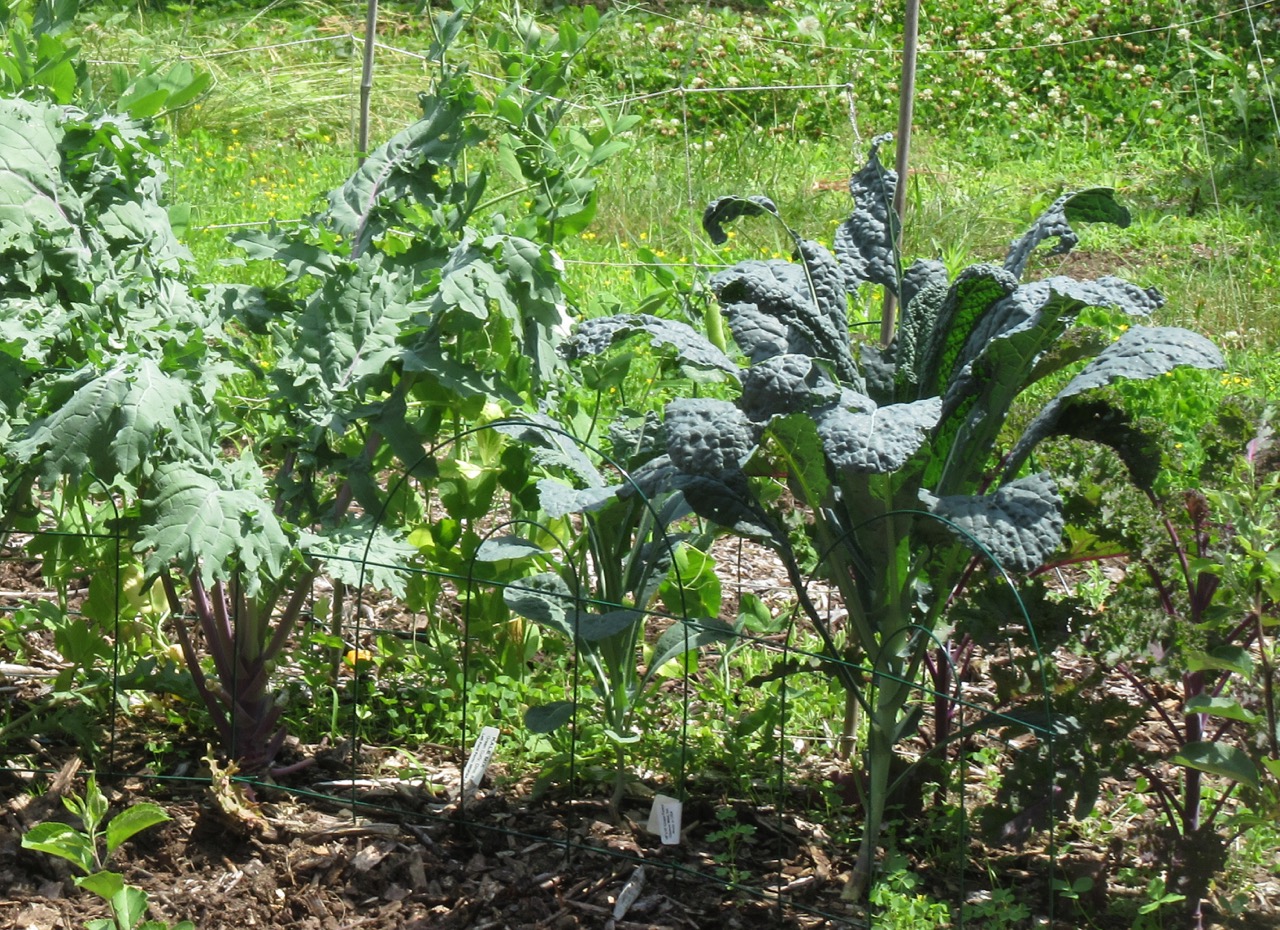
I feel the pressure of this time of year to preserve what we can from our garden, small as it is–making pesto from basil and chives and parsley, freezing kale, drying herbs–in our own way getting ready for the long Maine winters. We certainly wouldn’t know how to survive on our own, without being able to go to the Food Coop or grocery store. So perhaps both the French settlers and the Innu had better survival skills than we have now.Kale