
Bearing Witness

Heart Candle Flame DSC01573

As most people know by now, on May 25th, George Floyd, a 46-year-old African-American man, was killed by a white police officer, Derek Chauvin, who pressed his knee into Floyd’s neck for 8 minutes and 46 seconds, despite him begging for help, and saying “I can’t breathe.”  It was one more brutal death in a seemingly never-ending series of deaths inflicted on African-American men and women by police brutality enforcing systemic racism and white supremacy in the United States.

Because of the courageous video taken by 17-year-old Darnella Frazier, people all over the world actually witnessed the horror of this murder. Thousands of people, in every state, and all around the world have taken to the streets to protest, day after day, night after night, to demand a change. The four officers involved at the scene have been fired from the force and charged with his murder, or the aiding and abetting of his murder. A first step.

It has been difficult for me to write during this. I asked myself–was there anything I could add to the condemnations of white supremacy that have already been said by so many others? And as a white woman–should I be speaking at all? This is a time to center the voices of people of color. But also, how can any of us remain silent? On a very personal level, initially I also felt very discouraged. I have been an activist for my entire adult life. I am not taking credit for anything, this has been my calling in the world. But these days, I have wondered, did anything change? How could we have struggled so long with so little progress?

Bernice Johnson Reagon wrote a song, released in 1988, about activist Ella Baker, using her words to express deep truths about the long journey of activism for racial justice. These excerpts especially move me:

We who believe in freedom cannot rest until it comes…

Until the killing of Black men, Black mother’s sons/ Is as important as the killing of white men, white mother’s sons.

To me young people come first, they have the courage where we fail/ and if I can but shed some light as they carry us through the gale.

The older I get the better I know that the secret of my going on/ Is when the reins are in the hands of the young who dare to run against the storm.

These days, the irony of Baker’s words–we cannot rest–is not lost on me as I deal with a chronic illness that demands that I rest every day, that robs me of my capacity to show up to protest in the streets, or do very much of any other kind of activism. But her words also helped me to articulate one thing I could do. On Wednesday, I lit a red candle at 4 p.m., as a protest at Portland (Maine) City Hall was beginning, led by young activists of color. I offered my prayers and watched a live video feed for the two hour protest, and bore witness to the young people with such courage who dare to run against the storm. Maybe today, all I can do is bear witness in support of these young people, and in that way, “to be one in the number, as we stand against tyranny.”

As the protests began to multiply, in big cities and small towns, in countries all around the world, I felt a glimmer of hope. Sometimes, something breaks open.  Rebecca Solnit, author of Hope in the Dark: Untold Histories, Wild Possibilities, reminds us that the future is unknowable – and that’s a good thing. Why? Because it creates space for creative intervention. The lessons of history teach us that change happens in unexpected ways, and often in seemingly sudden, non-linear ways.

May the words of George Floyd’s six-year-old daughter Gigi prove to be prophetic:  “My daddy changed the world.” #blacklivesmatter


Small Days & Big Thoughts

Tending a garden focuses our attention on the here and now, the daily patterns and seasonal patterns. We have already begun to gather food–this from my lunch the other day: sea kale, asparagus, and wine cap mushrooms which sprang up near the carrots seeds I had planted in the food forest. (We had inoculated the wood chips with mushroom spore a year ago so we knew how to identify them.)

Food from Garden

But while I was not in the garden, I decided to re-read Octavia Butler’s Parable of the Sower and Parable of the Talents. I was inspired by watching an online presentation of  Toshi Reagon’s concert production inspired by Parable of the Sower.  A powerful dystopia first published back in 1993, Parable of the Sower follows the story of Lauren Oya Olamina, as she faces the destruction of society all around her from environmental devastation and a widening divide between rich and poor. Eerily, the novel begins in the year “2024.” Eerily, in the second novel, there is a dangerous president who is going to “Make America Great Again.”

For those who don’t know her, get to know her!  Octavia Butler is an African American feminist sci-fi writer, who died in 2006.  I think I have read and loved all of her novels.  Her own experience of oppression shapes the way she tackles complex issues, painful realities, and paradoxical truths. These two books fit into that realm of sci-fi which asks the question, “What if things keep going the way they are?”  When her family’s neighborhood is destroyed, Lauren Olamina sets out on a journey north, and creates a new religion, gathering a few followers as she goes. She calls it Earthseed, and there are excerpts of her Earthseed writings within the novel, starting with these words:

All that you touch, You Change

All that you Change, Changes you

The only lasting truth Is Change.

God Is Change.

When I finished Parable of the Talents, I wondered whether Octavia actually believed the Earthseed ideas, or whether it was a fictional exercise in imagining a modern founder of a new religion. I found an article that suggested that her journals reveal Earthseed did align with her own beliefs. I can find much inspiration in Earthseed, though parts of it don’t work for me. I’ve always experienced the divine as more personal and loving, rather than the impersonal force of change that Lauren Olamina elucidates.  But if I had had the experiences that Lauren had, that Octavia had, might I experience a different sort of divinity as well? Still, never to leave it simple, Octavia has another major character–Lauren’s brother–raise the same criticism and choose a personal God.

I cannot say enough how much I love Octavia’s writing, but it is also devastating to read. Somehow when the writing is beautiful enough, I can bear the challenge.  (Spoiler alert!) For example, in Parable of the Talents, Acorn, the first community of Earthseed, is attacked and the children are all taken from their families, and adopted away into “Christian” families. Later, when the adults in the community finally escape from their captivity, they search for the children, but mostly cannot find them. Parable of the Talents is narrated by Lauren’s daughter who was taken when she was only a baby–and she doesn’t meet her mother until many years later when she has become an adult. However, they never recover from everything that has happened in between. Devastating.

I think about the children of the Disappeared in Argentina who were stolen and adopted by the murderers of their parents. I think about Indigenous children taken from their families over many decades, losing their language and culture, traumatized. I think about enslaved African-Americans whose children were sold away, and how much they struggled to reunite when slavery finally ended.  I think about the migrant children at the border right now being separated from their families and locked in cages, deported alone, or adopted to others.

In this way, the dystopia of the Parables isn’t really a future danger, but a present reality.  Just as in the novel many people were walking along the highway trying to find a way to survive, migrant people are right now walking along the roads north, facing danger from robbers, murderers, rapists, and smugglers, and then at the U.S. border being locked in cages, their children taken.  Undocumented people have no protections other than what they can give to each other in communities.  All the while a semblance of “ordinary life” goes on for other people like myself (except for COVID 19–but we are safe in homes with food).  I find myself wanting to talk with others about all the ideas that Octavia Butler raises, so many more than I can even hint at.

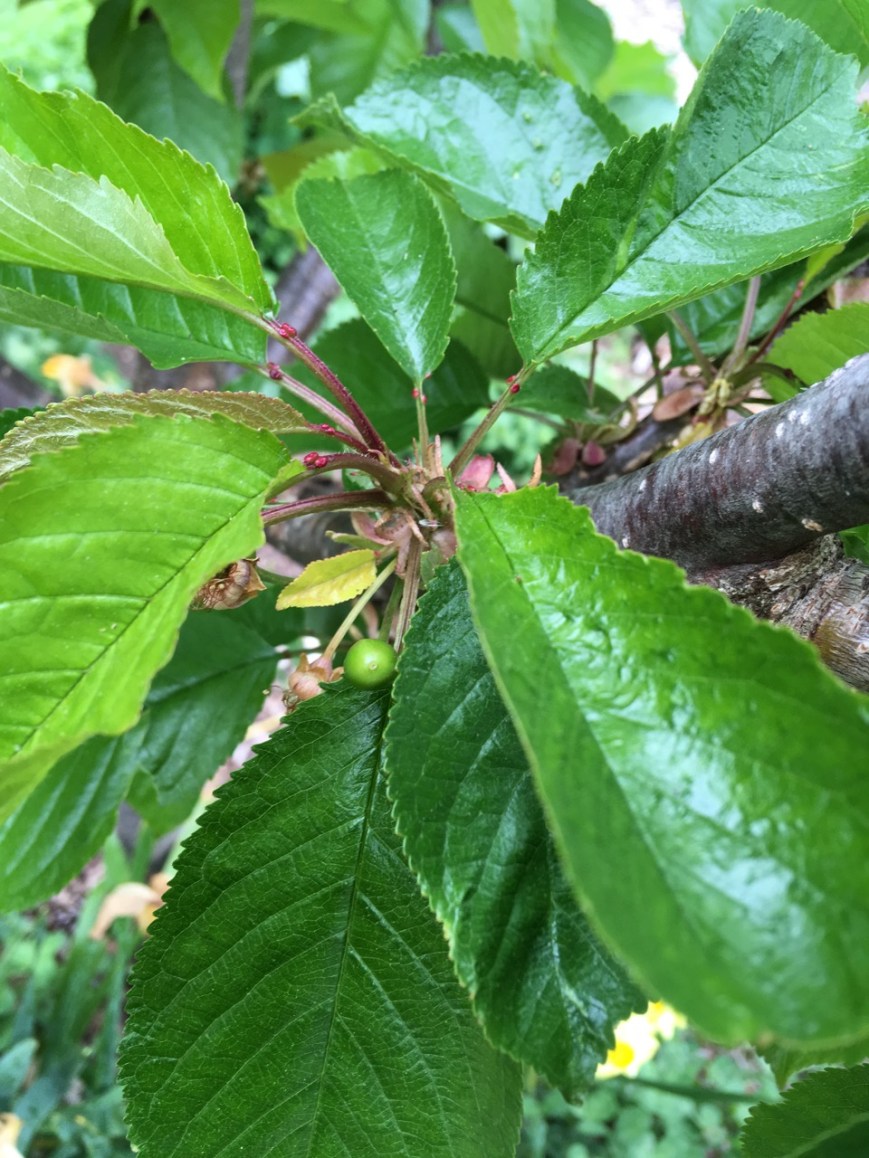
In the story, the Acorn community for a while was able to live by the work of their hands. They plant a garden and harvest the fruit of the trees. They go day by day until they no longer can. Meanwhile, our cherry trees are forming their first few little green cherry starts. I am so awed by it. Day by day, we are learning to partner with the earth for food.

Cherry start

Hugelkultur Planting!

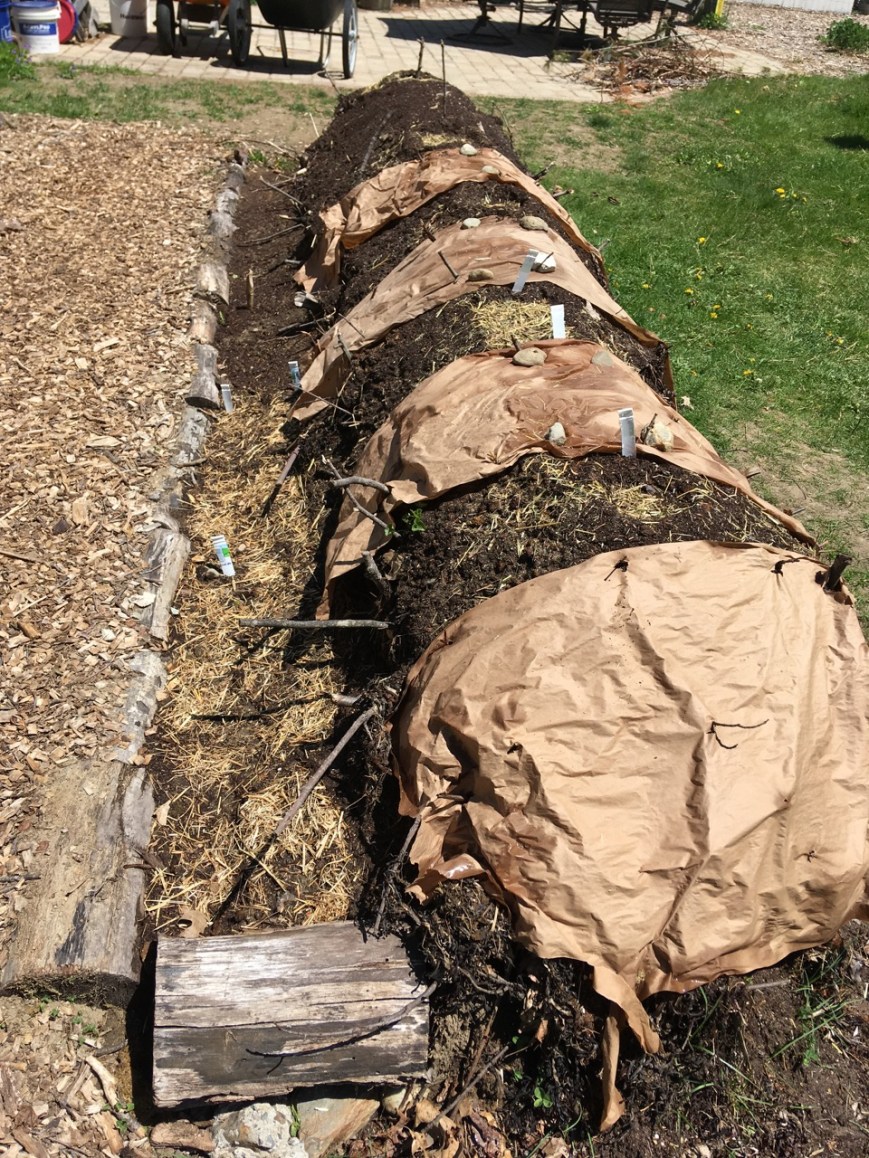
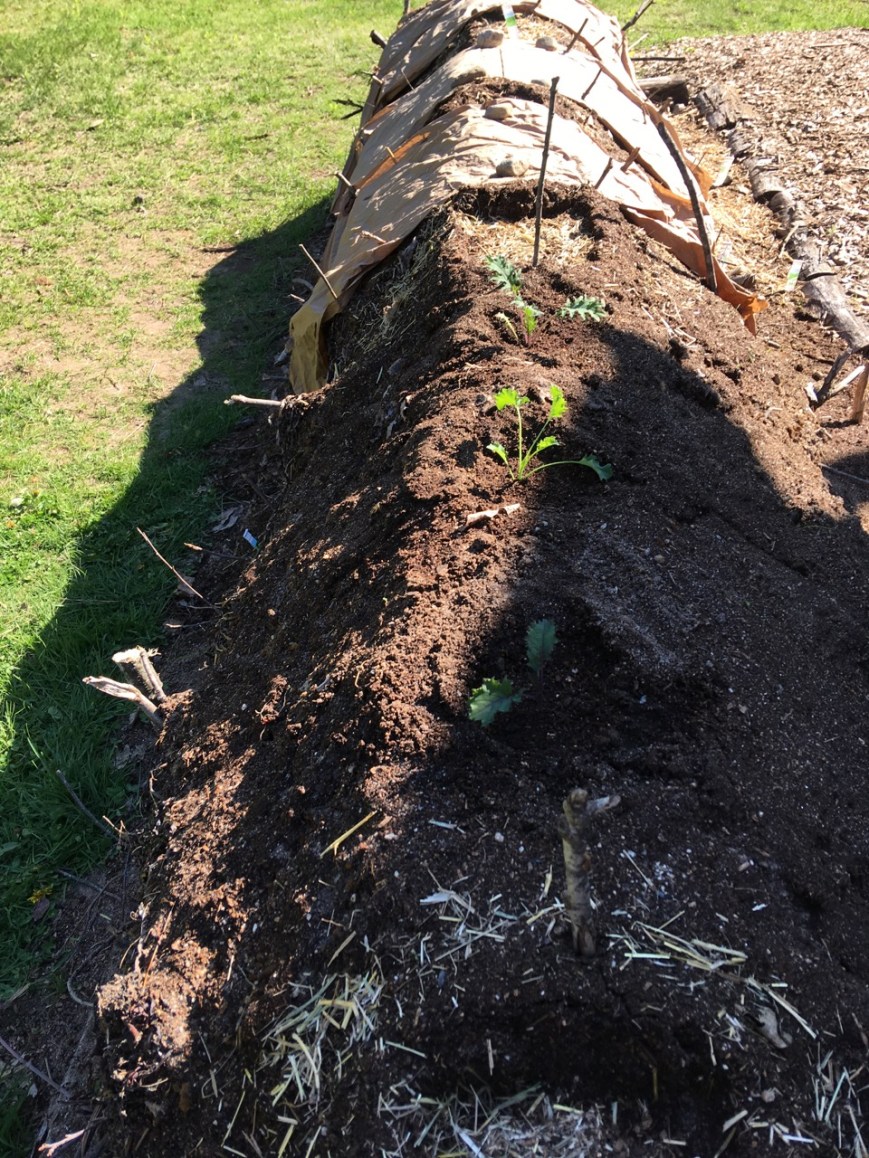
Yesterday, I finished planting my hugelkultur bed!  I learned some things in the process.  It is very hard to water the whole mound–the water stays on the surface and slides down the sides.  So I made small indented areas along the top of the mound in which to plant seeds so they could hold water: a round bowl-like indentation for a zucchini “hill,” and a square indentation for some bush beans.  I put the first zucchini “bowl” near one end, so that the plant could drape over the edge. I alternated zucchini, then beans, then zucchini, then beans. I found some brown packing paper to use to help block weeds between the plantings, and put some straw in my seed areas for mulch. I used little twigs and stones to hold down the paper.

Hugelkulture planting

I planted three kale seedlings in the next area, then a “bowl” for cucumber seeds at the other end.  I really could only plant in the very top across the mound, because nothing else was stable enough to water and keep the soil.  I did tuck a couple of borage seeds lower into the side, in case they might grow there, since they are good companion plants for all of these. I tried to pick spots that had some support, and under where the beans would be. But it is very hard to water the sides without the soil sliding down. I imagine that if someone made a hugelkultur mound in the autumn, it might settle enough over the winter to be more usable on all of its surface area.  But that idea of planting up both sides didn’t really seem feasible to me, though it was part of what appealed to me in the first place. Right now, planting the squash and cukes which like to spread out with a lot of vines seems the best idea.

hugelkultur Kale

Meanwhile, I planted other kale seedlings tucked into spots around the peach and cherry trees circles in the orchard, along with some lettuce and carrots.  I love the polyculture feel of the food forest.  I now have a total of 13 kale plants thanks to friends Mihku and Sylvia.  I think of them as my tried and true veggie for the year–easy to grow, pick and eat, and freeze for the winter. So far, they have grown really well in our food forest.

Meanwhile, we also have sea kale, a lovely perennial kale that we have already been harvesting in early spring, along with our chives and oregano and thyme. The asparagus has been disappointedly spindly this spring so far. I had been hoping I might get a bunch to eat since this is its third year, but I only had a few spears worthy of snacking on. I guess they need more compost to keep them well fed.  However, I am excited about these new zucchini, bush bean and cucumber plantings.  Wish me luck!

Sea kale

Sea Kale–a bit more pungent than annual kale, so I often mix the two for my own taste–plus sea kale also has little “broccoli” florets that can be eaten as well. This picture is from May 11th. It is best when very new, so we are almost already at the end of its season.


Hugelkultur 5 & Peach Blossoms

Wow, it has been a month since Hugelkultur 4 when I last devoted a post to progress on our hugelkultur garden bed. I am happy to say that yesterday I planted the first seeds! It has been a slow process of adding more soil and compost, a little bit each day, plus another layer of seaweed to help keep some of it in place. I also added soil and compost to the area between the mound and the logs marking the path, so there is a lower level on that side as well as a higher level. That in turn provided support for something like a slope of soil on that side. We planted lettuce and broccoli and spinach in that lower area, which will get a little more shade than other parts of the mound. It is a bit late in the season for all of those, so we’ll have to see how they do.

Hugelkultur done for now

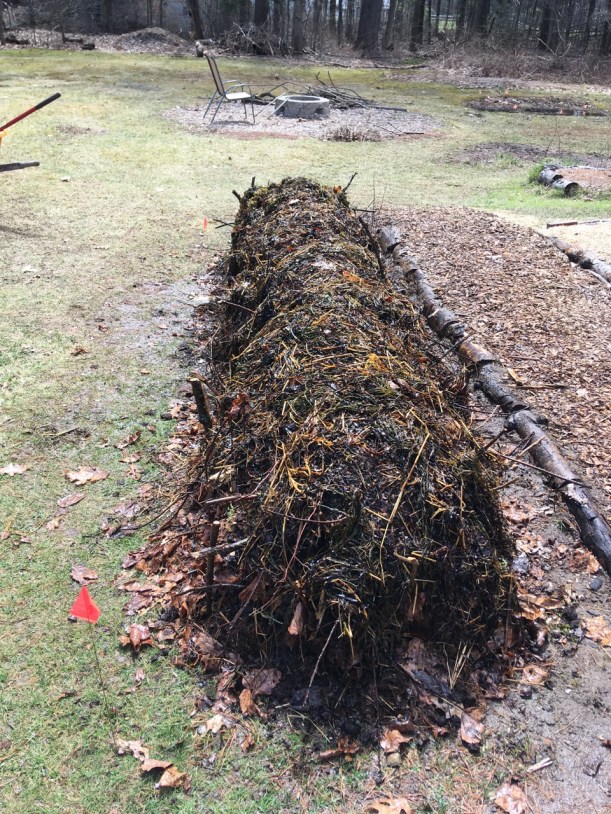
I finally decided that it wasn’t really possible to get enough soil to stick to the other side to use that as a planting surface, at least for this year. I’m calling it done for now! But as the mound ages and settles year to year, I think it will continue to evolve and we can keep shaping it and adding to it. For now, I intend to plant zucchini and bush beans and maybe some cucumber and kale on the top of the mound, and the zucchini and cukes can cascade down the sides. Our last average frost date in Portland is May 24, so those will get planted soon.

Hugelkultur May

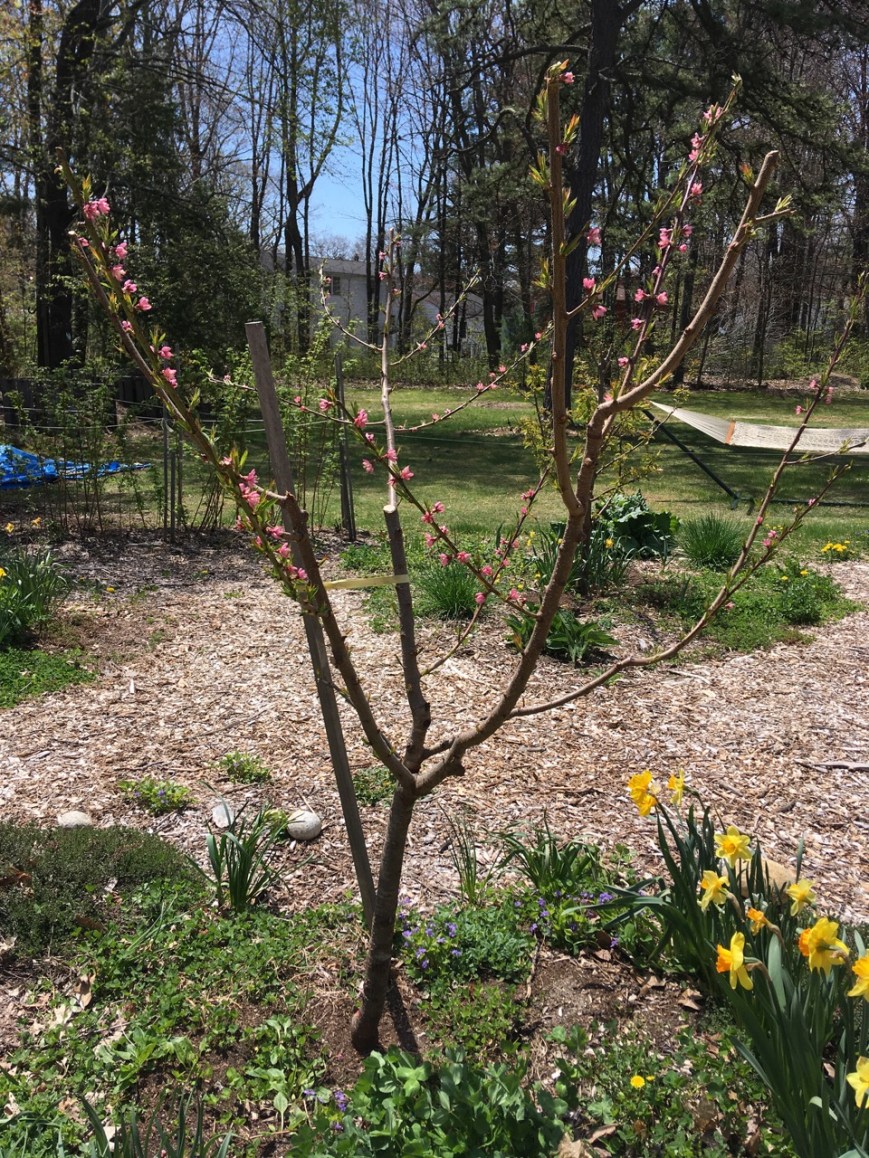
Meanwhile, speaking of frost, we had three freeze-warning nights this past week, and we covered our blooming peach tree with a tarp each night. But yesterday, I witnessed the best thing ever. I was sitting in my chair and saw a flash of something out the window, so I looked up. There was a tiny hummingbird, the first of the season, visiting each of the peach blossoms looking for nectar. I can’t explain why it moved me so.  All of the care given to the tree, all of the natural beauty of the tiny hummer. No way to capture it in a photo, but here is the peach tree in bloom.

Peach tree in bloom

I mentioned in an earlier post that an annual activity in the spring is pruning the cherry and peach  trees–each year relearning it all over again and steeling myself to the task which seems so harsh. The peach had produced an abundance of branches, but I took out all of the ones growing toward the center, and those that were smaller than pencil size, in order to preserve a vase shape and to build a strong scaffold for future years. I was happy that I was able to leave some branches that were budding, and if all goes well we might get our first peaches this year.

Peach blossoms

Fear: A Pile of Stones

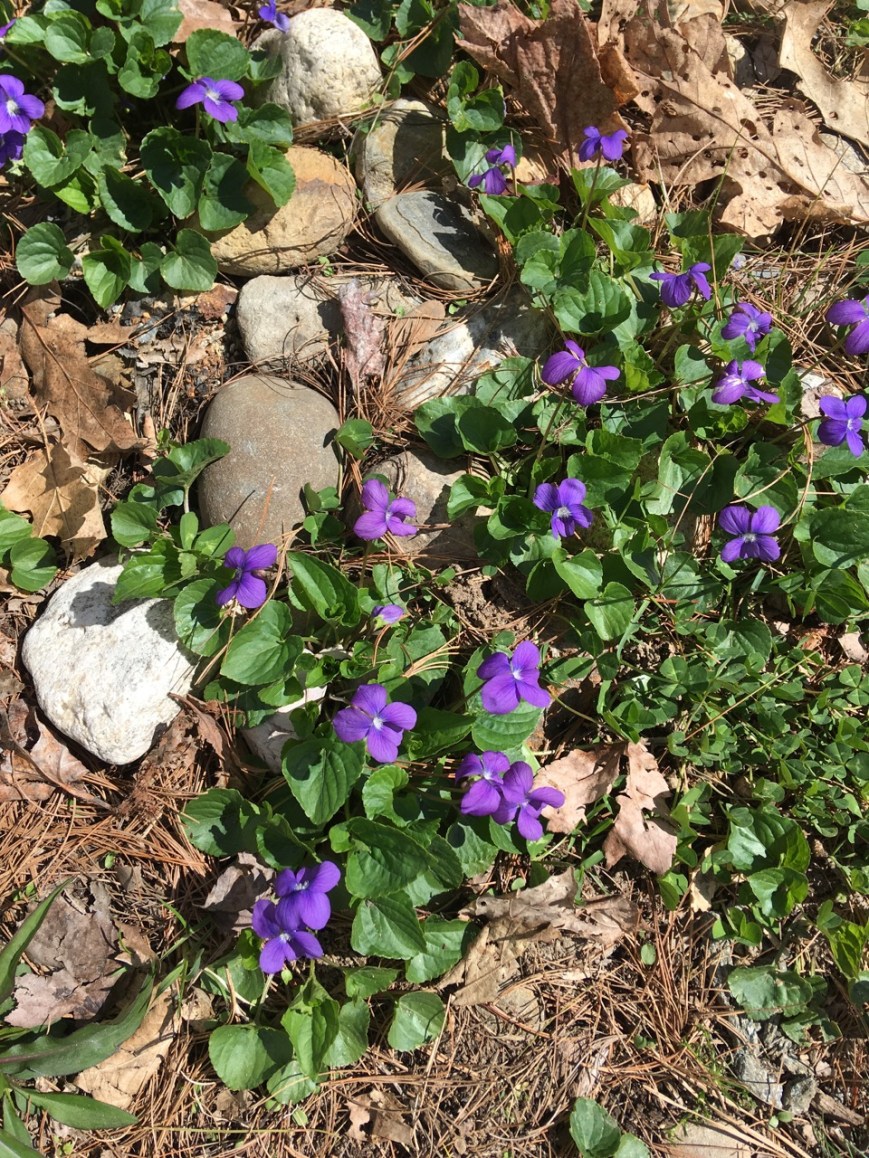
Stones & violetsTwo years ago, when I found any stones in the asparagus bed I was creating, I threw them over to a place next to the garage, until there was a pile of stones there. Then, later, as I found more stones, I added them to the pile. This spring, the violets decided they loved the microclimate it created. So now this pile of stones has become a beautiful violet rock garden.
I woke today feeling so much fear that I was immobilized. If fear is heavy like a stone, if we accumulate all the fears and toss them into a pile, might something beautiful yet emerge? It was a particular kind of fear that arose in me, or it seemed particular to this society. It was triggered by my no longer being able to work. For me, this is not about social distancing and a closed economy, though it helps me to understand the people who are worried about that. For me, it is about chronic illness taking away my energy capacity to work.

Working signifies our ability to take care of ourselves. All our lives we have learned the American “gospel” of individualism–everything is on the individual. In some ways, this individualism freed people to become that which our families could not comprehend. Feminist. Lesbian. Activist. When women were free to work, we were free to make our own decisions about our lives.

But in other ways, it has meant we are flying without a net. If we can no longer work, what happens then? Despite its limitations, I am immensely grateful for the safety net that was created in the cauldron of the great depression–Social Security. In the midst of the heavy burden of individualism, it became a bright light of collective care for all of us. We each contribute and we all can benefit. It enables Margy and I to have our basic necessities in retirement. But this net is now in the hands of robbers and thieves, who would like nothing more to do away with it. And so I feel afraid, my heart heavy with stones.

When I read about how some countries are giving their citizens a monthly income during the pandemic–countries which also, by the way, have free universal health care–when I see what might be done, it makes me feel so sad and so afraid for all of the working people in our country. If people had a guaranteed monthly income, they might not need to clamor for businesses to reopen before this can be done safely. But instead, they are caught between a rock and a hard place–stay home and risk starvation, or go to work and risk death. It is that stark. And the fear becomes a trigger for violence, and the threats of violence. More stones.

I’m not at the stage of seeing any violets yet. I don’t know what beauty might come out of this. I am just throwing stones into a pile.

Garden work & rest

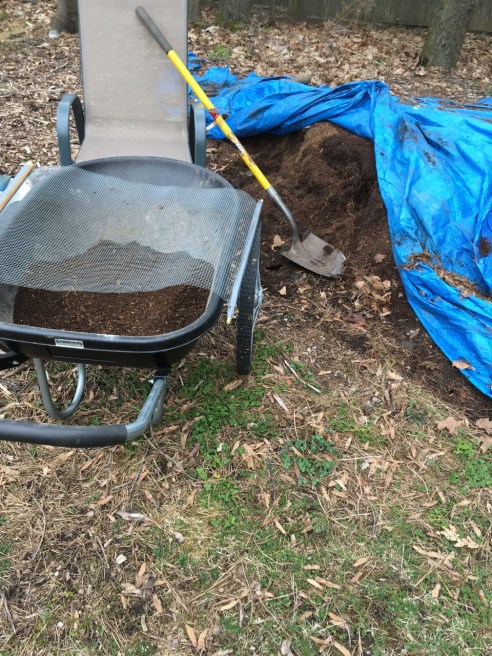
The last few weeks I have been outside a lot, but not writing a lot. I have been adding soil and compost to the hugelkultur mound little by little, and stuffing sod into the sides, but in photos it doesn’t change much. I created a new tool–a screen to sift compost that has become inundated with small roots. It is just two dowels, with a metal screen attached with staples and duct tape, but it fits over the top of the wheelbarrow, and makes it so much easier: I shovel compost from the pile onto the screen, then rub it back and forth with gloved hands to sift out the roots, and the usable compost falls through.Compost sifter

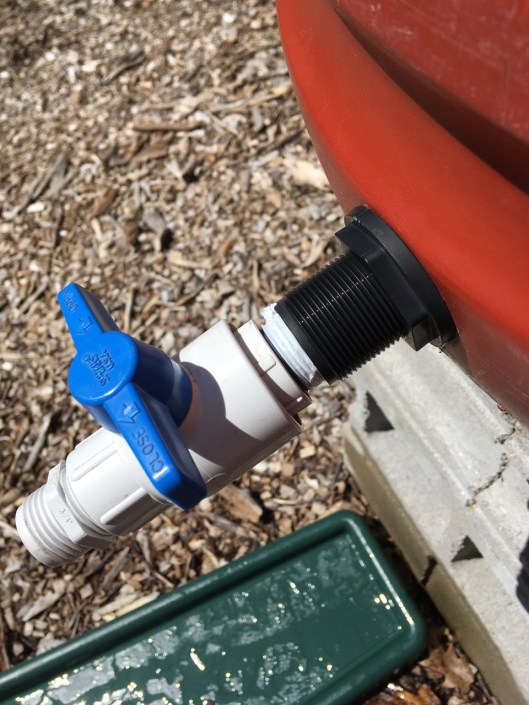
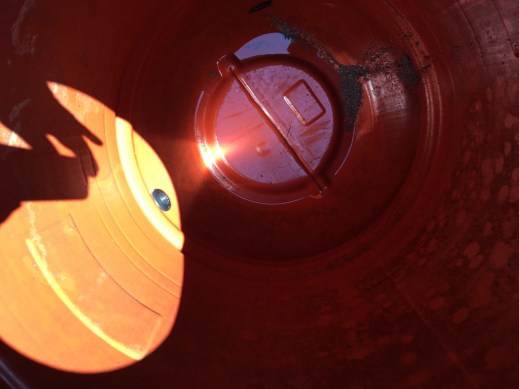
I also put spigots and drain hoses back into six of our rain barrels. They are designed to capture rain from the gutters, fill one barrel, and then overflow into the second barrel, and then overflow through a drain away from the house. The joy of these rain barrels is they can stay out through the winter as long as we remove the spigots and any long hoses. I had to go through the plastic drain hoses and cut off sections that had cracked, but luckily we had enough left to make it work. So I thought they were ready for rain again, but then yesterday as I checked them during our rainstorm, I discovered that one fitting had cracked–we’ll see if I can figure out how to fix that.

Rain barrels setup

Our new mulberry tree from Fedco arrived on Wednesday. Our old one didn’t do well where we had first planted it–too much shade, and then after I transplanted it last year, sadly it didn’t survive. But most of the work was done, because I had prepared such a great bed for it last year–so all I had to do was pull back the mulch, dig a small hole, and place the new baby tree inside. Baby trees aren’t that photogenic, a brown stick with a brown mulch background, so here is a photo of her roots all tangled up and gnarly before I placed her in the hole filled with water. May our tree be blessed in her new home, and provide food for birds and us too!

mulberry roots

Two springs ago, as I was preparing for retirement due to chronic illness, Margy bought me an early retirement gift–a hammock. Lately, after working for a while in the garden, I climb into that hammock and rest–so perfect! It feels a bit like laying on the beach in the sun, or floating on the ocean water. I can relax deeply, let go of trying to carry anything or do anything.  It has been so healing in this time of existential stress and grief for our world. I rock as if held in the arms of the air, the birds singing, blue sky and greening trees surrounding me, sun warming me.  It reminds me that we are held in the embrace of a larger Love, even when we feel so helpless in the face of the troubles that plague our country. May you also find ways to rest your spirit in this beautiful earth!

hammock

Hugelkultur 4–Moments

I haven’t forgotten about the hugelkultur bed we are creating (mostly me at this stage, since Margy’s back won’t let her dig or carry.) At times I wonder if it will ever be ready for planting, but then my spirit reminds me to stay in the process, enjoy the moments, rather than being attached to outcomes.  So the other day, I came out and dug some shovels full of sod and wet soil from the center of the future pond, put them in a wheelbarrow, then brought it over to a chair in our fire circle. There I sat and I painstakingly pulled out all the tiny bittersweet starts. It helps that they are like hard little red sticks with orange roots, and very easy to differentiate from the soft moss and grass and other growth. I couldn’t get very much “accomplished,” but I loved sitting in the sun with my hands in the soil. What could be better than that?

Today I couldn’t continue doing that process because the future pond was actually full of water from the big rain.  I don’t know if we will ever finish the pond, but days like this remind us what it might be like. I saw a bird drinking from it later.

future pond with rain

Instead, I shifted to opening up one of our compost bins that has been sitting for a year, and adding more compost to the mound.  I also had a little bit of sod from another spot that I turned inside out and added to crevices on the side.  When the compost was piled high, I layered seaweed over the top–which also helped to stabilize it.

Here are the stages. First with compost.

hugelkultur compost

Then, seaweed, which we had gathered from Winslow Park.

hugelkultur seaweed

If it seems hard to see the difference from earlier photos, that is because it expands only by millimeters. But it is so beautiful out here today–in the 50s, sunny, birds singing, and one can feel the surging of green life that is almost ready to burst forth. I have observed that there is one week in spring when everything wakes up–maybe we are about to enter that week. I walked along the strip near our street that I had planted in perennials two years ago, and look!–the lupine planted from seed last year is already poking through the dead leaves. This year we will get flowers. I am trying to remember–notice the beauty, be present to the moment, be filled with gratitude for this very day.

lupine coming up


“I don’t know how to love him…”

I was watching Jesus Christ Superstar this evening, starring John Legend as Jesus. He is a wonderful Jesus! Each time I see it, it pulls me back to a time in my life that was so deep, so intense. I think of Lori and Tom, the best friends I met in my first week of college, and how the three of us were so in love with Jesus, and all he represented–a life beyond the ambition and greed of our society, something radical, something full of love, a life that let go of material things and chose a different kind of joy. We three were in love with all that. But we often asked each other, how can we follow Jesus’ way in this day and age? And so the song, “I don’t know how to love him,” touched something of that powerful confusion and desire in our hearts.

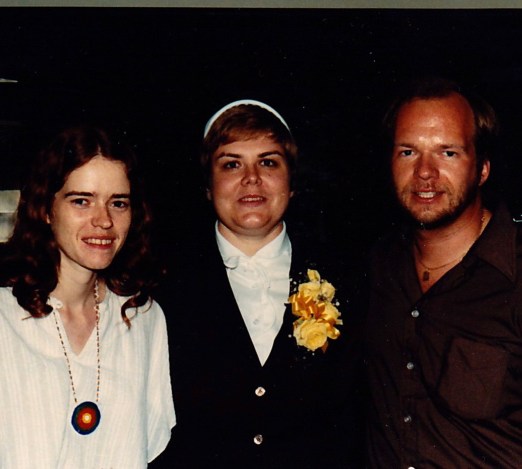
Now, Lori and Tom are gone, dying too soon, so I have no one with whom to reminisce; but the music calls to mind the idealism and passion we inspired in each other.  I have very few pictures of us, maybe none from college. We were so young then. This picture was taken about a year or two after graduation I think, when Lori was making her vows as a Franciscan sister. (Francis of Assisi was another one who inspired our best dreams.) That was how she tried to love Jesus.

Lori, Tom, and I

Me, Lori & Tom, 1977 or so?

Jesus Christ Superstar had debuted on Broadway the year of my high school graduation. We were lucky enough at Aquinas College to have as a professor a Catholic priest, Fr. Philip Hanley, who brought it into our theology class. He said that Jesus Christ Superstar asked all the questions that people had been asking for centuries about Jesus. And that was what theology was all about. Fr. Hanley is dead now, too, but I still remember how he encouraged us to ask all the questions, how he opened up our minds and hearts.

Lori was a nun for most of her life. Tom worked for the church–it was complicated because he was gay. But eventually he was working for the church and living with a long time partner, so that was a blessing. A few years after that photo, I found the Catholic Worker movement, the best example I knew of people trying to actually live the values of the gospel in our day and age. Radical, and a different kind of joy.

Then, in the midst of our peace activism, I found feminism and needed to launch on an even more radical journey that brought me out of the Catholic church, and into a spiritual movement with women becoming free. I came out as a lesbian, and named myself a witch, and eventually became a Unitarian Universalist minister. All of that brought me far from the paths that Lori and Tom had traveled, so we were not as close in later years, though I visited Lori when she was dying from cancer, and our love for each other went beyond all those differences.

The thing is, that idealistic and passionate young woman is still inside, however the years have transformed me. And listening to the musical this time, when Jesus/John Legend sang, “then, I was inspired; now, I’m sad and tired…” it resonated. We had such hope for changing the world, back then. It is hard to see the fruits of our labor as the backlash against social change movements rocks our nation. I don’t know if my life has lived up to the hopes and dreams I held in those days. Did it all mean anything? Yet Jesus asked those questions too, in Jesus Christ Superstar.

And it is complicated for me now, sorting out where Jesus fits into my life as a witch. But he hasn’t gone away. I remember him encouraging me as I set out on my feminist journey.  I am still wondering how to love him.  Still wondering about that radical way of living and loving. It brings tears to my eyes, even as an old tired woman.