After being away for a day, I have a new realization to share in my hunt for MarieMadeleine. Because, after 1802 or so, priests started recording names using the father’s Innu name like a surname, it occurred to me to look for Marie Madeleine Katshisheskueit as Marie Madeleine Tshinushiu, using her father Antoine Tshinushiu’s name.
Then I noticed that I had already made note of a marriage of a Marie Madeleine Tshinushiu on the 26th of July, 1815, father listed as Antoine Tshinushiu. However, the mother was not listed as Anne Kukuminau, her actual mother, but rather Genevieve Matshiskueu. Coming back to that, I realized that Marie Madeleine might be living with her aunt Genevieve, and that could be a reason for her name mistakenly appearing, albeit with a different Innu name, as her mother. In fact, it made sense that this was her: right name, right father. Also, it took place in Ilêts Jérémie, where so many other events have taken place.
She was married to Protais Atikurnu, widower of Catherine Kaskamisku. The day before, there was a marriage for Christophe Atikurnu, Protais and Catherine’s son, with Elizabeth Prituttekan. I also found listings on the same page of the deaths of two children of Protais and Catherine, at Tadoussac, Martin age 8 and Angelique age 5. Many losses that year, but life goes on.
So then I started searching for records after that time for any of those names. In 1817, there was a child Dominique, age 10 months, son of Protais Atikuriniu and Marie Madeleine Uashbanukueu. I had read that sometimes Innu people changed their Innu names, and though I hadn’t seen many examples of that, I think it is reasonable to conclude that this was the same Marie Madeleine, since her husband was the same. In 1818, Protais Atikuiniu & Marie Madeleine Pashabanukueu are listed as godparents for a child’s baptism in Portneuf. Again, that is a very slight difference in the name, that might even be a misspelling. In 1820, there was a child Prisque, age 9 months, son of Protais Attikurnu and Marie Madeleine (no Innu name given), and that same day, a child of Christophe and Elizabeth was also baptized at Portneuf. That might indicate that they were all living together as an extended family group. Continuing through the records through 1833, I didn’t happen to see any further mention.
Since she has this husband and these children, I think what it means is that I need to let go of Marie Madeleine Katshisheskueit/ Tshinushiu/Pashabanukueu in my hunt for my own great-great-great-grandmother. The process of elimination is the path forward, so this is a big step. Still, it is a bit hard to let go, after spending so much time and energy learning about her and her family. She has a big family! I guess that is why I wanted to blog about her today, to share this path of clues, to feel gratitude for the life she lived, and all of her relatives. And to remember the message I felt a while back, that all of these ancestors are my ancestors in some way.
And thank you to all of you who read these musings–these last several posts have been so personal to my own life, to my search for my own matrilineal ancestors. I don’t know for sure why I feel so pulled to do all of this searching, but I am trying to follow the path that my heart leads me, to trust the intuition that guides me through these days of our COVID solitude. I am remembering a line from one of my favorite authors, Linda Hogan, from her book, Dwellings, [p. 40], “The ceremony is a point of return. It takes us toward the place of balance, our place in the community of all things.” Finding my ancestors helps me to understand my place in the community of all things.
In the search for my matrilineal ancestor Marie Madeleine, I am feeling the need to summarize where I’ve come to so far. If you’ve been following along, you know that I’ve been searching through hundreds of images of records from the Postes du Roi on the north coast of the St. Lawrence River in Quebec. With all of those names and dates, I believe now that there are two women who are the most likely to be my own Marie Madeleine. The first characteristic that I am counting on is the year of her birth, and her age at the birth of her last child. In her death record of 1849 she was described as about 60 years of age, but those estimates are notorious for being inaccurate. (Her last child was born in 1846, which would give her the impossible age of 57.) Assuming that her child-bearing years could not realistically go much past 50, that would put the earliest year of her birth at about 1796. But also assuming that she would likely not be younger than 50 at her death, the latest year of her birth would be about 1799.
One of my frustrations these last several days has been how as the years moved along, the priests who were keeping the records were writing less and less, until in the 1820s and 30s, for example, they would often record marriages with first Christian names only, no parents listed, and baptisms with first names only. For example, in 1820 at Rivière Godbout, there was a death listed as “Marie-Madeleine” with no further information. The racism seemed to increase as the years went by. Instead of an Innu name, they started attaching the word “sauvage” to the names, “savage.” So it has become increasingly difficult to hunt for clues. At least the earlier priests took the care to spell out both Christian and Innu names, and parents full names.
But with all of that, these are two women who have emerged as the most likely to be my ancestor.
1. Marie Madeleine Katshisheskueit was born in the forest either Nov 11, 1795 or April 18, 1796. (Today could be her birthday!) In Feb 1846, she would have been either 50 or close to it. At her baptism on 6/28/1796 at PortNeuf, her records were mixed up with Anastasie Kamatshiskueuit. Because of later records for Anastasie, I determined that Marie Madeleine’s parents could only be Antoine Tshinusheu, born 11/20/1778, baptized in Chicoutimi 7/4/1779, and Anne Kukuminau, born and baptized in 1779 in Manicouagan. (They were listed as Anastasie’s parents but see my last post for untangling all that.)
I can’t determine for sure which parts of the baptism record went to which child, so her godparents were most likely Simon Tshinapesuan & Marie Madeleine Iskuamiskuskueu, or possibly Jean Baptiste Assini (sibling to Anastasie’s mother Veronique) & Marguerite Tematseu. Both families have interrelationships through the years.
She had two younger brothers I could find: Ambroise Kanatsheshiu, baptized Jul 2, 1801 in Chicoutimi, born in the forest around 3 years prior, 1798. And Thomas Mishtapeu, baptized Jul 2, 1801, born in the forest around April 1801, who died and had a burial ceremony at PortNeuf, 23 July 1803, age 2 year, 3 months and 27 days. Both Ambroise and Thomas’s Christian names were after their godfathers, so it is possible that Marie Madeleine’s was after her godmother, another reason to point to those godparents.
There are records going back to her great-great grandparents in certain lines, meaning that her relatives had become Christian and were regular frequenters of the trading posts, in Chicoutimi, Manicouagan, and Îlets-Jérémie for many years previously. Her grandparents were Ignace Pikuruish & M. Jeanne Menastatshiku on her father’s side, and Pierre Rene Mishtapeu & AnneMok on her mother’s side.
In the summer of 1805, sadly, her parents had burial ceremonies in PortNeuf, having died in August and October of 1804, when she was 8 or almost 9, and Ambroise was 4 or 5. After her parents’ deaths, all her grandparents had already died, but each came from large families, as did her parents. I looked for aunts and uncles she and her brother might have lived with. The one I found listed the most was Antoine’s sister Genevieve Ushitasku who was married to Francis Xavier Uabushuian. They are in the records for the births/baptisms of six children. It is likely that Marie Madeleine and Ambroise would have lived with their relatives, though I can’t determine who that would have been, but maybe it was these two.
2. Marie Madeleine Napeteiashu was baptized June 6, 1803 at Îlets-Jérémie. By that time, the priests started recording the father’s Innu name as a surname for the children, so she does not have her own Innu name listed. She was at that time about 7 years old, “or even more,” so her birth would have been 1796 or perhaps a bit earlier. Her brother Simon Napeteiashu was also baptized at the same time, and said to be about 4 ½ years old, so born in late 1798 or early 1799. Their parents were Napeteiashu, who did not have a Christian name, and Catherine Mitiskue. Their godparents were Simon Tshinapesuan & Marie Madeleine Iskuamiskuskueu, (the same as for the other Marie-Madeleine!) and both brother and sister were named for their godparents.
(Note: for a while I thought these parents might be the same as Stanislas Mishtanapeu and Catherine Mistiku, but further records made that not possible.)
I was able to find an older brother as well–Jacques Nahabanueskum (later also called Jacques Napeteiashu with several spellings), who was baptized 6/19/1786, at 2 years old, at Îlets-Jérémie. In May 14, 1804 he was married to Monique Peshabanukueu at Îlets-Jérémie. They had several children baptized through the following years from 1809 to 1822, most at Îlets-Jérémie and two at Riviere Godbout. Jacques died before 1824, when his widow remarried. I did not see any further identifiable records for Marie-Madeleine’s parents or brother Simon.
This family’s connection to the trading posts was more tenuous prior to Jacques, with the father Napeteiashu unbaptized, and the children not baptized until they were 2, 4, or 7 years old. There weren’t records of their prior generations in the baptism accounts. There might have been more children between Jacques 1784 and Marie Madeleine 1796, but I could find no record of them. Perhaps this family might have been more tied to their own Innu culture in the forest, and more recently come to the trading posts.
So here I am with these two. It was a major breakthrough for me to search for family members along with the Marie Madeleines. No one was isolated outside of community. I have discovered parents and siblings, aunts and uncles. I have also been drawn to the godparents Simon Tshinapesuan and Marie Madeleine Iskuamiskuskueu. Their names reappear again and again like wise elders to their community, along with the records of many of their own children. I am not finished going through records, but I have reached 1833, in which the birth of my own Marie-Madeleine’s son Simon is recorded at Îlets-Jérémie, with her spouse Peter McLeod.
Today I feel the need to reach out in a spiritual way once again, not that I will find THE ANSWER, but that I find a way forward in this search. I feel the grief of the racism that hides their names and details from those of us who search for them. I have grown to love all of these people whose names I have learned. I made some more bannock, and burned cedar. As I reach out to them I listen for them reaching out to me.
Someone said that the New Moon in Scorpio has an energy for revealing secrets. During yesterday’s New Moon, a secret emerged in my search for my ancestor Marie Madeleine. I found a marriage record for Anastasie Matshiskueuit, with parents listed as Jean Pierre Utshinitsiu and the deceased Veronique Kaskaneshtshish. These last two were listed as Marie Madeleine Katshisheiskueit’s parents on her baptism record, so at first I thought I had discovered a sister to Marie Madeleine.
Image of original record of Anastasie’s marriage, handwritten in French. [Image from Genealogie Quebec, c. The Drouin Institute]
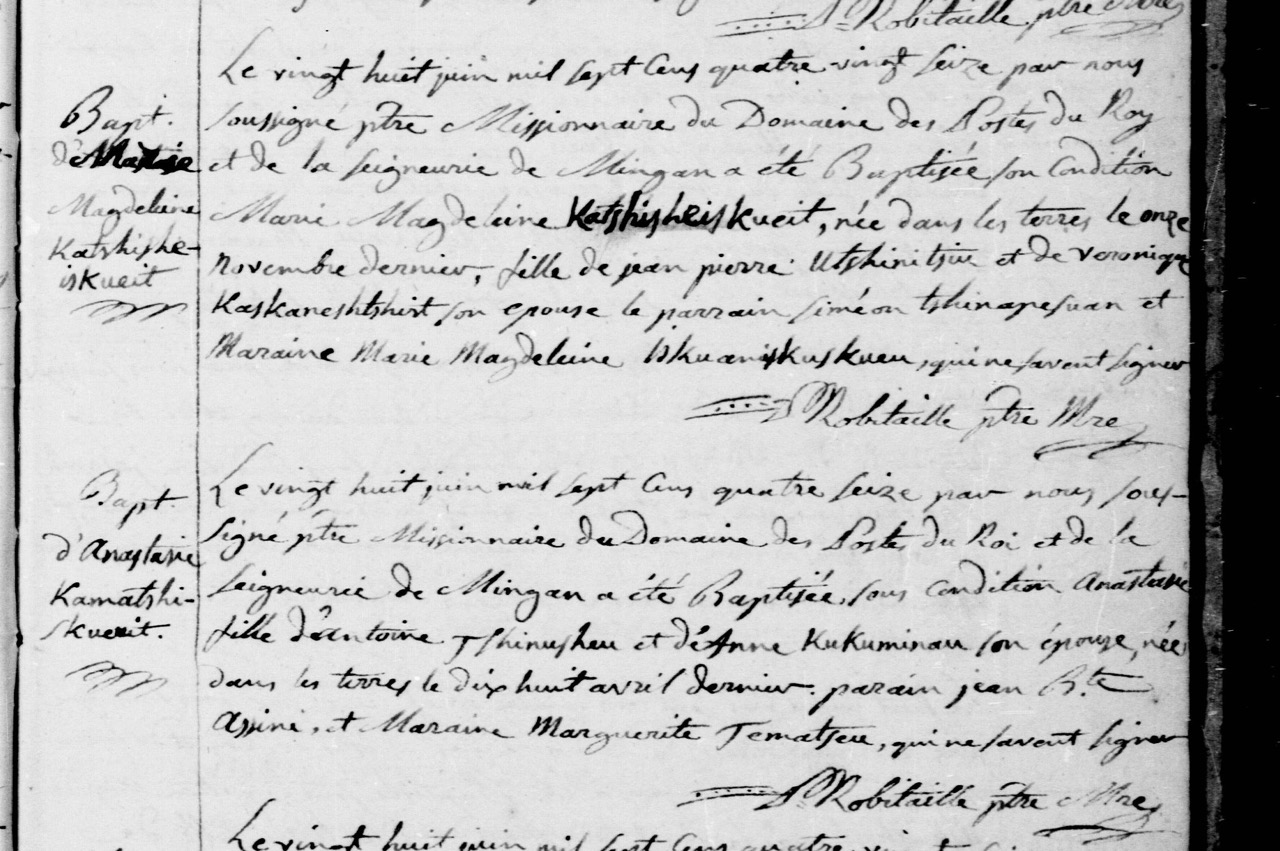
But as much as I searched, I couldn’t find a baptism record for this Anastasie. Except. Right after Marie Madeleine Katshisheiskueit’s baptism record was the record for Anastasie Kamatshiskueuit, with parents listed as Antoine Tshinusheu and Anne Kukuminau.
Image of baptism records of Marie Madeleine and Anastasie, handwritten in French. [Drouin Institute]
This morning, a realization dawned. The most likely scenario is that the priest who originally recorded the baptisms had made a mistake. He had assigned the wrong child’s name to each set of parents. They were baptized together on the same day. And in fact, in the record, you can almost see that he started to write “Anastasie” where he later wrote “Marie.” It is the marriage record that is more likely to be correct—only Anastasie’s father, Jean Pierre Utshinitsiu, and the parents of the groom—who were her godparents, Simon Tshinapesuan & Marie Madeleine Iskuamiskuskueu, were present for that ceremony.
So the new moon in Scorpio revealed a probable mistake in the original baptism record, and shifted my search back again to Antoine Tshinusheu and Anne Kukuminau as Marie Madeleine Katshisheiskueit’s parents. Ironically, I had started there, because Jean Joseph Roy, or the person following him, had recorded her parents as Antoine and Anne in his Catalogus. Maybe his account had not been an error, but a correction, because he knew the people involved. Or maybe what is revealed is a whole series of mistakes. But the hunt continues, with correction.
Screen shot of the page in the Catalogus generalis totius Montanensium Gentis, with Marie Madeleine and Anastasie [names are in Latin]
Each time something changes in this search, I feel a bit of grief—for the people I thought I had discovered, possible relatives that turn out not to be related to me at all.
But the other night, even before this latest revelation, a small intuition crept into my consciousness about all these Marie Madeleines I am searching. It was like they whispered in my ear, “We are all your relatives! As you search for us, and find our stories, we are pleased, and take you under our wings. We are all your relatives.” That is what I hold onto now, in this search. “We are all your relatives.” And that it pleases them when I search out their stories.
Fresh cedar sprigs under a pair of cardinals welcome sign on our white front door.
Today we welcome the ancestors with special foods, with herbal incense, and with a fire in our fire circle! For herbal incense I use cedar–I’ll use a dried bundle I made before, and burn it in our fire circle. Cedar was widely used by my Innu ancestors, and so I think their spirits will especially appreciate it. We also have a cedar tree right on the edge of our own yard, so I ask the cedar tree for permission to cut some sprigs to make more cedar bundles, and also to put cedar on our front and back doors for protection from harm, and welcome to benevolent spirits.
The special food I made is bannock, a traditional Innu bread, called ińnu-pakueshikan, which they adapted from the Scottish. Since I can’t eat wheat bread, I used 1/2 oatmeal flour (which is actually what the Scottish used) and 1/2 almond flour. Here is my recipe, adapted from several I found online. It is a very simple bread with many variations. Mix all ingredients together.
1 1/2 cup oat flour (made in a blender from GF rolled oats)
1 1/2 cup almond flour
1 Tablespoon baking powder
1/2 tablespoon salt
1 1/3 cup water (this might have been more than I needed)
1 cup frozen blueberries.
I put it in a greased skillet, and let it bake in a 375 degree oven for 55 minutes. After about 40 minutes, I cut it in four, and turned the sections over in the pan. A small dish is all set to go outside for the spirits, for when we have our fire. It is crusty on the outside, and a bit mushy on the inside. Tasty with butter.
Blueberry bannock in cast iron pan, cut.
I have been continuing my search for my Innu ancestor Marie Madeleine’s family. Lately this has been by hunting for as many details as I can about Marie Madeleine Katshisheskueit, which means “hard-working-woman”, who was born 11/11/1795, and baptised in Portneuf 6/28/1796. I was finally able to see an actual image of her baptism record, and discovered her actual parents, Jean-Pierre Utshinitsiu (Utshinishkushu=whirlpool?) and Veronique Kaskanieshtshist. (Kashkanatshish=rock ptarmigan) (The earlier source had directed me to another set of parents entirely.) So I began hunting for the rest of their family and found a few more generations, and many cousins.
This was a relief to me because I also discovered that Marie Madeleine Katshisheskueit’s mother died in 1797, when she was only two years old. I was filled with grief for this toddler, and wondered how she would be able to survive such a loss. Then I remembered that my Passamaquoddy teacher Roger Paul said that the whole community always cared for all the children. They didn’t divide into small nuclear families, but rather in extended families. I saw that her godmother, Marie Madeleine Iskuamiskuskueu, was the cousin of her father (and also the mother of another Marie Madeleine that is not my ancestor). So she was likely taken care of and loved by all these relatives.
I haven’t been able to find other records of her life after 1800, so far, which means there is nothing to rule her out. It might mean that she disappeared somewhere, or it might possibly mean that she is my own ancestor, showing up in 1830 without any surname or Innu name that would clarify her identity to me. The hunt continues, only now I am looking at her family members, to get a picture of their relatedness.
Finally, another update: I had been wondering what to do about the frogs in the pond, as winter approaches. Well, it turns out they are doing it for themselves. The last time we saw frogs in the pond was a week ago, and just two small ones remaining. We don’t know where they went, but they must know how to take care of themselves, perhaps find some mud to bury in, or someplace protected for the winter. Our pond is probably too shallow, with too little mud for that purpose, I assume. So the pond is getting colder, and the frogs are gone. Hopefully, we’ll see them again in the spring.
May the blessings of this season be with you, may your ancestors bring you blessings when you open your heart to them, and may we survive the coming cold with grace and peace! Blessed Samhain! Now I’m going outside to the fire circle.
Two small frogs on a rock near iris stalks, with fallen leaves in the water.
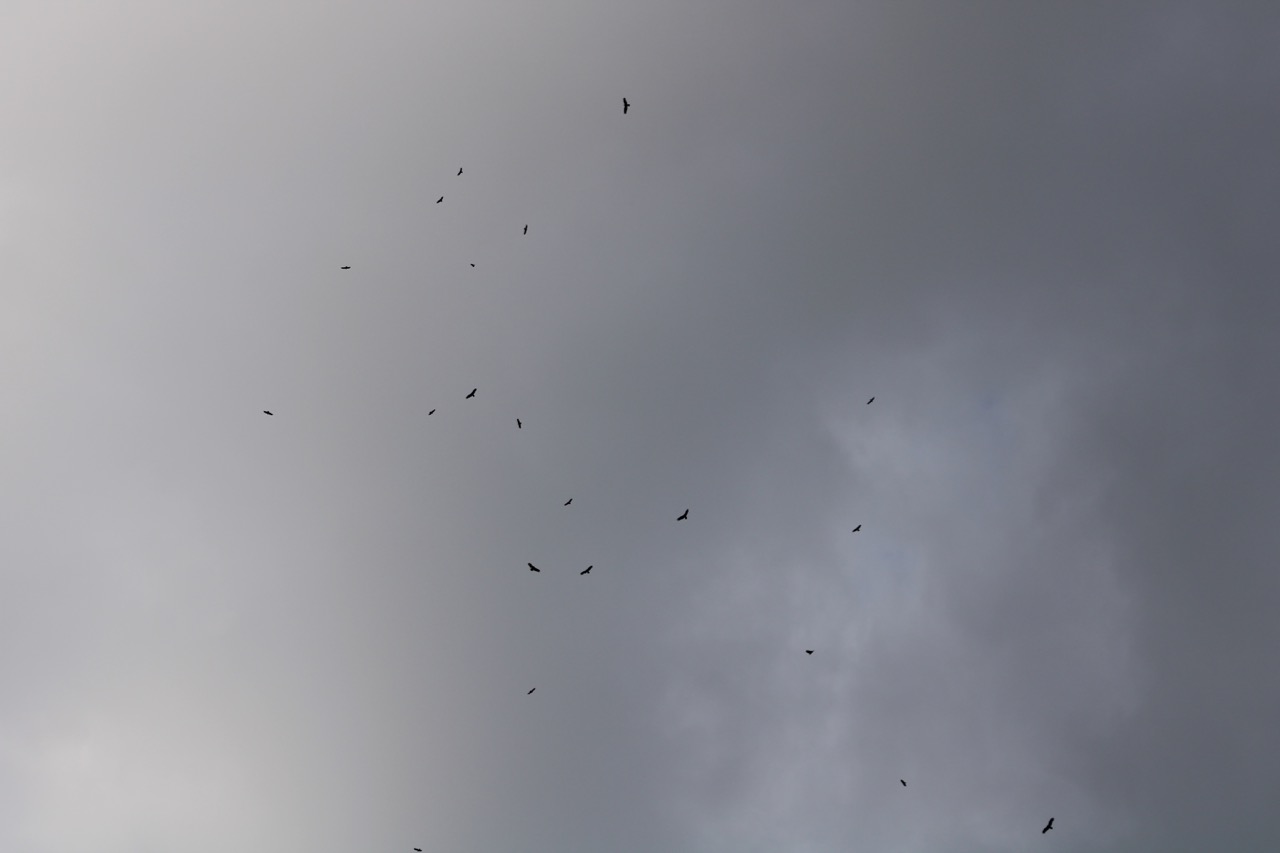
I was outside lying in the hammock two days ago, when I saw a hawk flying overhead, and then more and more hawks, higher and higher. I understand that a group of hawks is called a kettle of hawks, and only occurs during migration. It was amazing to see! A reminder that the seasons are changing. I am writing this outside today on a sunny day, but wearing my winter jacket.
I think I may have found an important clue in my search for the roots of my third great-grandmother Marie Madeleine. In the record for the baptism of her son Simon, in 1833, in Jeremy Islets, she is identified as “sauvage du dit poste,” which means, translating the racist imagery, “Indian of said post.” And just above that record, Jeremy Islets is the post in question. I just want to say that it took a lot of close handwriting inspection to pull out those four words, but I am fairly confident in them now. And so it seemed to me it might be identifying her place of origin. (Now, on the other side, I know that her husband Peter McLeod was a clerk of that post in 1833. But she, along with two other Indian couples baptizing their children were all identified as Indians of that post.)
To further clarify, generally speaking the Innu went into the woods in fall, winter, and spring to hunt, and came to the posts to trade and to connect with the priests who did the baptisms, marriages, burials, and such. And they didn’t just go to one post, while necessarily avoiding others. But following the clue, of the several Marie Madeleines in my list of possibilities, one was connected to Jeremy Islets, in the right time frame. She was identified in her baptismal record as Marie Madeleine Napeteiashu, baptised June 26, 1803, when she was about 7 years old, they said, which would put her birth about 1796. Napeteiashu was actually said to be her father’s name, with no Christian name attached, and her mother was identified as Catherine Mitisku.
After searching through hundreds of other records, I found a Catherine Mistiku, born in 1773, and baptized in 1786 in Jeremy Islets. She was married to Stanislaus Mishtanapeu, baptized in 1778 in Jeremy Islets. In other records, they are identified as Catherine Mistigu or Mitigu, or Stanislas Tshiuapan (actually the name of his son Paul). I think this is likely the same couple, though in this process, one can’t be positive. I found baptism and marriage records for sons Simon (b 1794, bap 1796) and Paul (b 1798), but no other links for Marie-Madeleine. (And why would Paul be baptized in 1798, but not Marie Madeleine until 1803?) In the marriage record for Paul, in 1817, Catherine is said to be deceased.
Along with the genealogy hunt, I have also been exploring the possible meanings of their Innu names. Mistiku (likely now spelled Mishtiku) can mean, a tree (animate), or a log (inanimate), or possibly a French Canadian or white person-(though Catherine would not be French, but someone might be called this perhaps because she was hanging around the French?) (I think the French were called this because of wearing wooden clogs.) Mishtanapeu means a remarkable man. Napeteiashu was harder to decipher–“nape” refers to a male, and if I stretch the spelling, it could mean a male fox–napeiatsheshu. Spelling was not a hard science in those days. I couldn’t find any other references to Napeteiashu. The one possibility was a marriage with no details attached of Catharina Matshiskueu to Nipituashu. No dates/places/or parents. Matshiskueu means “she is an ugly woman”. So you see, it’s all very mysterious and uncertain.
By the way, several of the names I was researching seemed to have “negative” connotations. I wondered if it was some kind of internalized oppression, or if maybe there was a function of the name to protect the child by acting as if it were not valuable in some way. There was a lot of oppression by the priests. For example, when an “illegitimate” child was baptized, often they did not even name either of the parents at all in the record. Some priests took more care than others. I think the earlier Jesuits learned the Innu language and taught people to read and write in their language. Later priests did not know the language at all.
But as for me, I was so excited to find this possibility. Maybe it was really her, with a place and parents! Then today, I was slowing down to remember that this process of search will continue, and I have to pace myself, to live with each possibility as it emerges. There are hundreds of pages of records, much of it not indexed, so I go through page by page looking for names–and with new names, that means all new searches. Still, I am amazed that these ancestors feel closer to me now, even if they are still like the hawks flying in the sky so far above me that I can’t see the individuals very well. Am I related to a tree, a fox, an ugly woman, a very remarkable man? Am I related to the place called Jeremy Islets? In Innu, Ishkuamishkᵘ, which is similar to the word for a female beaver ishkuemishkᵘ. And how does this all relate to my life as a white woman in Maine, in Wabanaki territory? Still, it does feel like one part of my own journey of finding our way home into the earth community.
A fox near the Capisic brook, surround by trees and other greenery. (This photo was taken in 2018)
“Why do I write about it here? I’m putting some magic out into the universe, hoping that some kind of thunder might open the cloudy skies between me and the past, between me and the place my ancestors are from. … It has been my experience that when I reach out to my ancestors, they reach back—more so when I have actually traveled to Quebec, but since that is not possible, I hope they will reach across the border.”
And then some magic did happen!
After being stuck not finding people on the GénéalogieQuebec website, I meandered around some more, and some records of the Postes du Roi index of people, not related to my ancestors, linked to images from the actual Postes du Roi records. If I went to those images, I could move back and forth from page to page in the images of actual records. And by doing that, I found the baptism records of six of the Marie Madeleines or Madeleines, from the list I had, from 1800 to 1805, even though they were not “indexed.” Also, I was able to download all the images as I accessed them, to be able to look back as I needed. So now I am able to keep researching, a way opened up.
Some magic happened!
Sometimes it is easy to forget—in my intellectual research mode, in our rather secular world—that magic is alive, that ancestors reach out to us. Even though I have experienced it in the past, and believe in its power. So easy to forget.
And the intellectual research is part of the magic, not separate from it. It is a lot of work to attempt to decipher 200-year-old writing in funny penmanship, in French. But I am so thankful to be able to attempt it. And to learn as much as I can about the lives of all of these women. I also learned that for some of them, the Innu name is that of their father—at some point (1803?), the Innu names switched from being a descriptive personal name to function more like a surname. (Those are in parentheses)
Marie Madeleine Katshisheiskueit, b. 1795 in the woods, baptized 1796 Portneuf
Marie Madeleine (Napeteiashu), b. 1796, baptized in 1803 Îlets-Jérémie
Madeleine Peshmekueu, b. 1799 Sept-Iles, baptized 1800 Sept-Iles
Madeleine Pishikuskueue, b. 1801 Pointe-des-Monts, baptized Godbout
Marie Madeleine (Utsinitsiu), b. 1801, baptized 1805 Chicoutimi
Madeleine Moistashinagusiu, b. 1802 Rivière Godbout, baptized Godbout
Marie Madeleine (Arishinapeu), b. 1805, baptized Tadoussac
Magic happens! May I keep being open to the magic, and may you feel it opening where you need it too.
Today, September 29, is my great grandmother Claudia’s birthday–she was born in 1865. I never got to meet her, but I was named for her (my middle name) and so I have felt a connection to her for quite a while. This week I was once again caught in the throes of this strange yearning obsession to try to understand the lives of my matrilineal forbears. I happened to be looking at a document about Claudia that I compiled a few years ago, and it mentioned a resource–the “General Catalogue of the Entire Montagnais Nation.” [Except the title was in Latin and the book was in French. Denis Brassard, Catalogus generalis totius Montanensium Gentis of Father Jean-Joseph Roy, 1785-1795 ]
It was a record of baptisms and other religious rites at the King’s Posts (Postes du Roi) in the Saguenay River area and North Shore of the St. Lawrence River of Quebec, in the 18th century. The Postes du Roi were the site of trading between the Innu/Montagnais and the French/British. They were also the site of missionary priests coming round to offer religious instruction and ceremonies to the Innu people. (The French called the Indigenous people of this region Montagnais, but since then, the people have reclaimed their own word, Innu.)
Claudia’s mother was Angele McLeod, and her mother was Marie-Madeleine, who was identified as “Montagnaise” in any records I had been able to find. But I had been unable to go any further back in her family, and only had estimates of her birth to be about 1789, perhaps linked to a Post du Roi. So I went looking for that book, which was available in a digital format for not so much expense. And it had a built-in translation function, which helped a lot since my French is shaky. The first half of the book was a description of how things were at the Postes du Roi. The Innu generally spent fall/winter/spring in the inland forests, hunting and gathering, and then came to the shores of the Saguenay or St. Lawrence in the summer, to fish and gather with each other. The Posts were built at these established summer gathering places to foster the fur trade, and the conversion of Innu people to Catholicism by the priests.
By searching record by record through the hundreds in the chart, I was able to find two Marie-Madeleines (Maria Magdalena) whose births were within 10 years of 1789: 1795, 1797. The Innu people did not use surnames, but rather single descriptive names, so each record included a Christian name (in Latin) and a personal name for the child in the Innu language. I found Marie Madeleine Katshisheiskueit (record #1065), and Marie Madeleine Manitukueu (record #1079). I don’t know that I will ever be able to establish a definite link between one of them and my Marie Madeleine, but one of them could be related to me. My Marie Madeleine eventually was married to Peter McLeod who worked for the King’s Posts in many places. And she was identified as Catholic, so it would be likely for her to be in these records.
Finding these names is touching a deep place in my spirit. I can’t even describe it. And deeper still, was searching out the meanings of the Innu names in the language. I was able to determine that Katshisheiskueit likely means “Hard-working/female” and her parents’ names were Antonius/ Tshinusheu which means “Northern Pike”, and Anna/ Kukuminau, which means “old woman” or “wife.” (Now the parents were only about 16 then, so likely it was an endearment, or Tshinusheu just said–“that’s my wife.”)
Manitukueu has something to do with Spirit–Manitu is the Innu word for Spirit. But I couldn’t find an exact reference. Manitushiu means someone who uses spiritual or mental power. “kueu” seems to be a common verb ending signifying something being or having. It is like detective work–and I wouldn’t be able to do any of it if I hadn’t been studying Passamaquoddy, which is related to the Innu language. Words are formed polysynthetically, with smaller parts joined together to create long descriptive concepts in one word. So I search the online Innu dictionary, with my framework of Passamaquoddy, and try to recreate what they might mean.
Manitukueu’s parent’s names were also challenging. Her father was Simeon Tshinapesuan, and the closest word I could find was something meaning “slips on a rock”, or “slippery.” Her mother was Marie Madeleine Tshuamiskuskueu, part of which meant “finding it by detecting it with body or feet.” But then I lucked out because her own birth record called it Iskamiskuskueu–which means “from Jeremy Islets,” and she was from Jeremy Islets. According to another source, this Innu name of that place meant “where you can see polar bears.” (Where you can find polar bears?) I guess I was rather far off.
So, it’s hard to trace “family trees” without surnames, but each child was listed with their parents, and by going through again searching for the parents’ names, I could find their parents too. And in fact, there were a few generations in each of their families to be found in the charts, with a lot of holding a magnifying glass over my computer screen so I could read the small letters in the charts. Much more still to do.
It is a whole world uncovered to me. And whether or not one of these women is my actual relation, this is the world she lived in, the world she came out from to enter a path that eventually would lead her daughters and granddaughters into other worlds. I never imagined that I might learn the Innu name of my great, great, great grandmother… and now there are all these names dancing in my mind, trying to form in my mouth, bringing much depth to my heart. I feel such gratitude and curiosity.
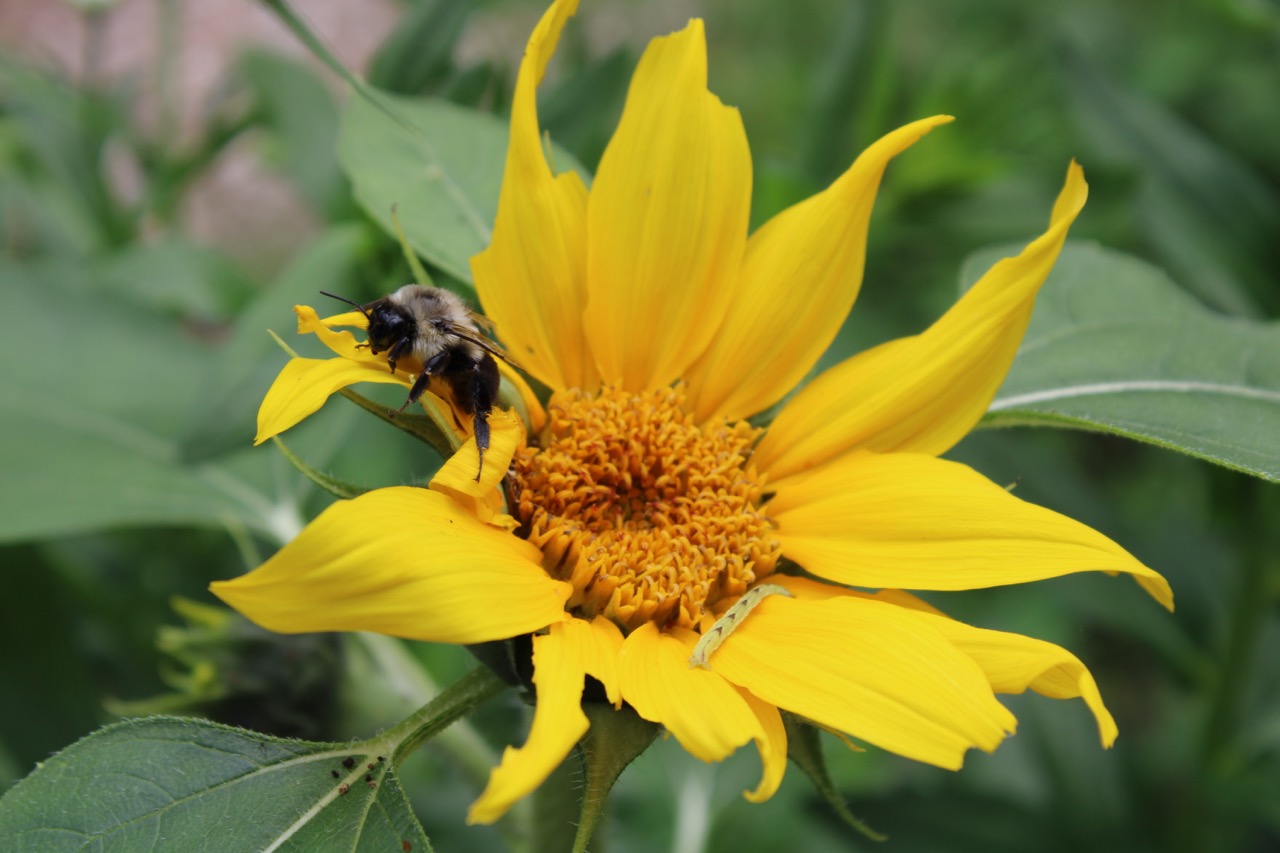
Yellow sunflower planted by squirrels, with a bee inside.
Juvenile female cardinal near Joe Pye Weed and flea-bane
I have been at a loss for words these past few weeks. But sitting quietly in the back yard–often next to the frog pond–has enabled me to see some beautiful birds. I’ll start with this cardinal, cardinals being for a long time my favorite bird. I saw this rather scraggly (like all juveniles) female while I was lying in the hammock reading. I love their little chirps.
I saw the cardinal just as I started reading a new book, Carnival Lights, by Chris Stark. It has taken me several weeks to finish because it was so painful. I had to stop and start, stop and start. This novel should have all the trigger warnings. It brings to life the theme of missing and murdered Indigenous women, and it also weaves the past into the near present (1969) with the long history of land theft, murder, and oppression. I grew to love cousins Sher and Kris, two teenage Ojibwe girls, running away in Minnesota. But I am not even sure to whom I might recommend the book? I felt like I was plunged into vicarious trauma as a reader, and I wouldn’t want to re-trigger that kind of trauma for my Native friends, one of whom already mentioned that, yeah, she’d never be able to read it.
Yet there were also threads of beauty and resilience interwoven into the tapestry of the story that fed my spirit too. Such powerful gorgeous writing, such depth of expression, such love. It is a brilliant book. I first found it because it was recommended by a Native author I love–Mona Susan Power. So perhaps for some Native women, the trauma is well known and understood, and the beauty and love in this story is a healing balm.
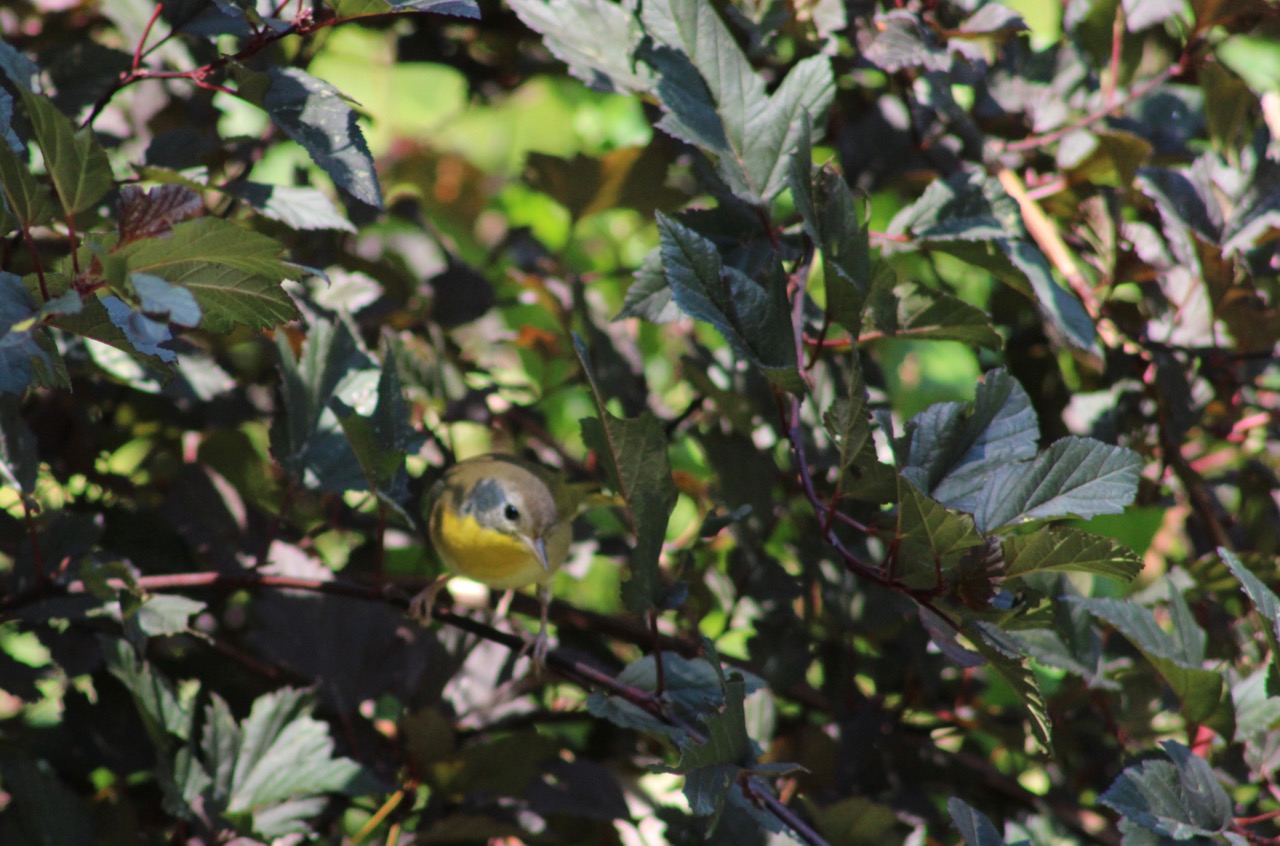
For me, in between reading, I had to go to my own backyard to find the grounding and fortitude to be able to continue. I was sitting near the pond watching the frogs when two yellow warblers (I think that’s who they are) started flitting about in the bushes, trying to attract my attention–perhaps away from something else? It seems too late for there to be a nest, but who knows? It must be almost time for their migration south. They were definitely letting me see them, and then flying to another bush close by. I saw them on two or three separate days, and caught these photos.
I think this is a yellow warbler in the nine-bark bush near the pond.
I think this is a yellow warbler female, seen on a different day in the same nine-bark bush, with a summer sweet bush in the background.
What do we do with the obscene brutality and violence that our whole society is built upon? What do we do with the exquisite beauty of a bird on a summer day?
A hummingbird hovering while drinking at the feeder
Margy and I were chatting in the coolness of our kitchen, when suddenly I thought I saw a squirrel on our back deck, running right under the plastic “owl” that I had bought, supposedly to scare squirrels away from the orchard. That’s what caught my attention. But looking closer, we realized it wasn’t a squirrel, it was a groundhog! I ran outside onto the deck, and it ran too, but I managed to catch this slightly blurry picture to confirm our suspicions. It ran across the patio, through the back yard and over to the trees on the edge.
Photo: Groundhog running across the patio, in the shadow of the bird bath, near a chair.
Margy and I are often torn between totally loving the critters that come into the yard, but also wanting to eat the food we are growing. Munimqehs is the Passamaquoddy word for groundhog, which I learned in the fall of 2018. In Wabanaki stories, Munimqehs is the wise grandmother who has many lessons to teach us about how to be good human beings. How desolate we would be without our animal neighbors!
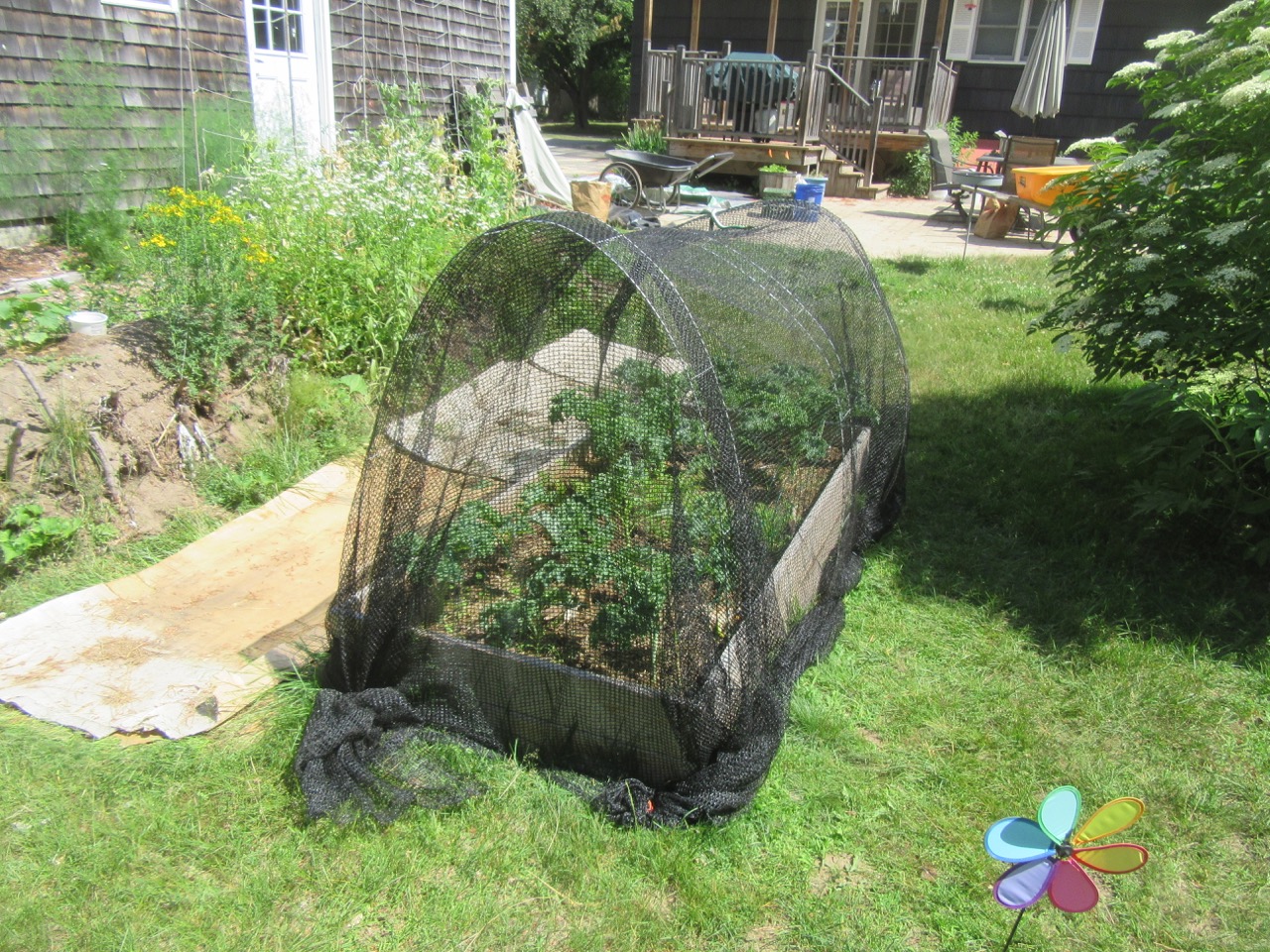
We haven’t had any groundhogs in the yard for the last few summers. The last one disappeared, we believe due to the intervention of a neighbor. With a groundhog in the yard, however, it is a whole new ballgame for gardening. I immediately went out in the heat, and put together a netting contraption to try to protect our bed of kale, from which I had harvested the first leaves earlier this morning. I happened to have these metal arches and nylon netting, and fastened the netting to the ground with metal stakes. There is already a wire mesh under the raised bed, so no animals should be able to dig up from underneath. We’ll see if this deters our little friend. I might have to also go back to the pee protection scheme that I used to partial success a few years ago.
Raised bed with kale, covered by metal arches and nylon netting
Meanwhile, today I am grateful for the excitement of a critter on the deck, a young one it seems. Let’s see what lessons she/he will have to teach us. We have lots of clover that we’re happy to put on her table. Let’s see if we can be good neighbors.
I had a helper yesterday for digging the pond. My friend Sylvia came by in the afternoon and the very first thing we did was drag the pond-liner in its box from near the house to back closer to the pond. (You can see it in the picture, behind the wheelbarrow.) That would have been enough help all by itself–so heavy! But then we took turns digging, hauling, and resting nearby. We got a lot done, and also enjoyed a rare COVID-time visit, walking around the yard and in the woods, looking at birds and plants.
Sylvia standing on the planting shelf, while digging in the pond!
So here is what the pond looks like now, in layers. The first layer down, about 8-10 inches, is for the planting layer. The next layer down, maybe 18 inches, is for a step layer–part of that I might take away as we go along, but some will remain to be a step into the pond going forward. In the middle, we dug to about 2 feet down, as measured with this string set-up I created. My aim is to go three feet down in the middle.
Pond layers dug out.
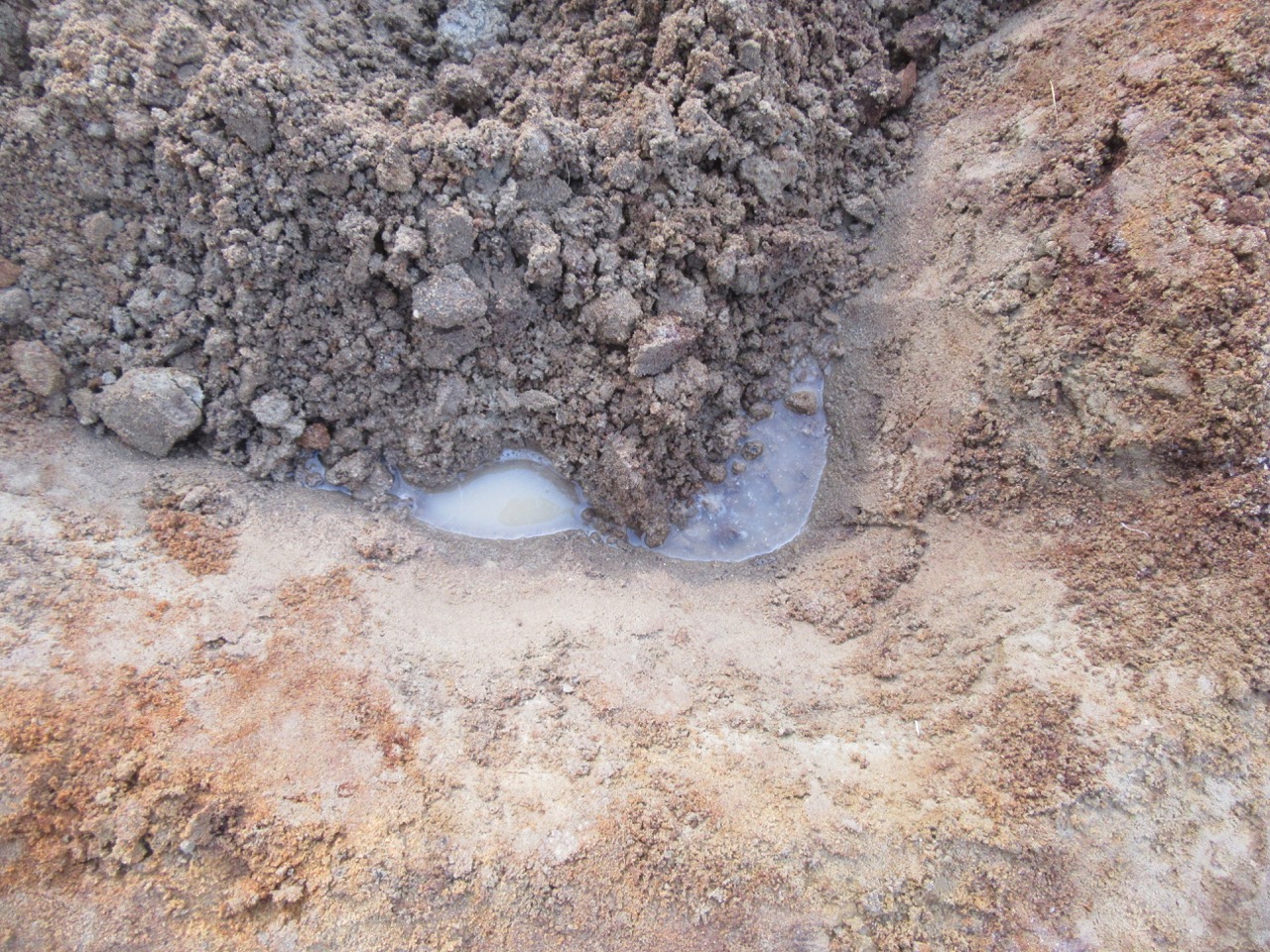
But then we came upon a problem that wasn’t mentioned in the Building Natural Ponds book by Robert Pavlis. Water started to seep up from the sandy soil. We are actually at the time of year when vernal pools abound here in Maine. We have a ditch way back behind the edge of our property and the properties next door that fills during spring rains. And we had an inch of rain last week, though generally it has been a dry winter. Does this mean we can’t go any deeper for a lined pond? Or do we need to wait until it is a bit dryer as the days go by? Will it mess up the pond to have water under the liner at the bottom? Or does it not matter at all? I am going to ask my questions in the Facebook group Building Natural Ponds, and see whether I might find some answers.
Water seeping from the soil in the bottom of the pond.
Maybe the pond just wants to be a pond so badly, that it doesn’t want to wait, lol. Meanwhile, I am going to rest today from digging, and more rain is coming tomorrow. So we will see. If you have any wisdom about this, I’d love to hear from you.