Two Marie Madeleines

Cedar bundles from our cedar tree.

In the search for my matrilineal ancestor Marie Madeleine, I am feeling the need to summarize where I’ve come to so far. If you’ve been following along, you know that I’ve been searching through hundreds of images of records from the Postes du Roi on the north coast of the St. Lawrence River in Quebec. With all of those names and dates, I believe now that there are two women who are the most likely to be my own Marie Madeleine. The first characteristic that I am counting on is the year of her birth, and her age at the birth of her last child. In her death record of 1849 she was described as about 60 years of age, but those estimates are notorious for being inaccurate. (Her last child was born in 1846, which would give her the impossible age of 57.) Assuming that her child-bearing years could not realistically go much past 50, that would put the earliest year of her birth at about 1796. But also assuming that she would likely not be younger than 50 at her death, the latest year of her birth would be about 1799.

One of my frustrations these last several days has been how as the years moved along, the priests who were keeping the records were writing less and less, until in the 1820s and 30s, for example, they would often record marriages with first Christian names only, no parents listed, and baptisms with first names only. For example, in 1820 at Rivière Godbout, there was a death listed as “Marie-Madeleine” with no further information. The racism seemed to increase as the years went by. Instead of an Innu name, they started attaching the word “sauvage” to the names, “savage.” So it has become increasingly difficult to hunt for clues. At least the earlier priests took the care to spell out both Christian and Innu names, and parents full names.

But with all of that, these are two women who have emerged as the most likely to be my ancestor.

1. Marie Madeleine Katshisheskueit was born in the forest either Nov 11, 1795 or April 18, 1796. (Today could be her birthday!) In Feb 1846, she would have been either 50 or close to it. At her baptism on 6/28/1796 at PortNeuf, her records were mixed up with Anastasie Kamatshiskueuit. Because of later records for Anastasie, I determined that Marie Madeleine’s parents could only be Antoine Tshinusheu, born 11/20/1778, baptized in Chicoutimi 7/4/1779, and Anne Kukuminau, born and baptized in 1779 in Manicouagan. (They were listed as Anastasie’s parents but see my last post for untangling all that.)

I can’t determine for sure which parts of the baptism record went to which child, so her godparents were most likely Simon Tshinapesuan & Marie Madeleine Iskuamiskuskueu, or possibly Jean Baptiste Assini (sibling to Anastasie’s mother Veronique) & Marguerite Tematseu. Both families have interrelationships through the years.

She had two younger brothers I could find:  Ambroise Kanatsheshiu, baptized Jul 2, 1801 in Chicoutimi, born in the forest around 3 years prior, 1798. And Thomas Mishtapeu, baptized Jul 2, 1801, born in the forest around April 1801, who died and had a burial ceremony at PortNeuf, 23 July 1803, age 2 year, 3 months and 27 days. Both Ambroise and Thomas’s Christian names were after their godfathers, so it is possible that Marie Madeleine’s was after her godmother, another reason to point to those godparents.

There are records going back to her great-great grandparents in certain lines, meaning that her relatives had become Christian and were regular frequenters of the trading posts, in Chicoutimi, Manicouagan, and Îlets-Jérémie for many years previously. Her grandparents were Ignace Pikuruish & M. Jeanne Menastatshiku on her father’s side, and Pierre Rene Mishtapeu & Anne Mok on her mother’s side.

In the summer of 1805, sadly, her parents had burial ceremonies in PortNeuf, having died in August and October of 1804, when she was 8 or almost 9, and Ambroise was 4 or 5. After her parents’ deaths, all her grandparents had already died, but each came from large families, as did her parents.  I looked for aunts and uncles she and her brother might have lived with. The one I found listed the most was Antoine’s sister Genevieve Ushitasku who was married to Francis Xavier Uabushuian. They are in the records for the births/baptisms of six children. It is likely that Marie Madeleine and Ambroise would have lived with their relatives, though I can’t determine who that would have been, but maybe it was these two.

2. Marie Madeleine Napeteiashu was baptized June 6, 1803 at Îlets-Jérémie. By that time, the priests started recording the father’s Innu name as a surname for the children, so she does not have her own Innu name listed. She was at that time about 7 years old, “or even more,” so her birth would have been 1796 or perhaps a bit earlier. Her brother Simon Napeteiashu was also baptized at the same time, and said to be about 4 ½ years old, so born in late 1798 or early 1799. Their parents were Napeteiashu, who did not have a Christian name, and Catherine Mitiskue. Their godparents were Simon Tshinapesuan & Marie Madeleine Iskuamiskuskueu, (the same as for the other Marie-Madeleine!) and both brother and sister were named for their godparents.

(Note: for a while I thought these parents might be the same as Stanislas Mishtanapeu and Catherine Mistiku, but further records made that not possible.)

I was able to find an older brother as well–Jacques Nahabanueskum (later also called Jacques Napeteiashu with several spellings), who was baptized 6/19/1786, at 2 years old, at Îlets-Jérémie. In May 14, 1804 he was married to Monique Peshabanukueu at Îlets-Jérémie. They had several children baptized through the following years from 1809 to 1822, most at Îlets-Jérémie and two at Riviere Godbout. Jacques died before 1824, when his widow remarried. I did not see any further identifiable records for Marie-Madeleine’s parents or brother Simon.

This family’s connection to the trading posts was more tenuous prior to Jacques, with the father Napeteiashu unbaptized, and the children not baptized until they were 2, 4, or 7 years old. There weren’t records of their prior generations in the baptism accounts. There might have been more children between Jacques 1784 and Marie Madeleine 1796, but I could find no record of them. Perhaps this family might have been more tied to their own Innu culture in the forest, and more recently come to the trading posts.

So here I am with these two. It was a major breakthrough for me to search for family members along with the Marie Madeleines. No one was isolated outside of community. I have discovered parents and siblings, aunts and uncles. I have also been drawn to the godparents Simon Tshinapesuan and Marie Madeleine Iskuamiskuskueu. Their names reappear again and again like wise elders to their community, along with the records of many of their own children. I am not finished going through records, but I have reached 1833, in which the birth of my own Marie-Madeleine’s son Simon is recorded at Îlets-Jérémie, with her spouse Peter McLeod.

Today I feel the need to reach out in a spiritual way once again, not that I will find THE ANSWER, but that I find a way forward in this search. I feel the grief of the racism that hides their names and details from those of us who search for them. I have grown to love all of these people whose names I have learned. I made some more bannock, and burned cedar. As I reach out to them I listen for them reaching out to me.

Secrets Revealed

Someone said that the New Moon in Scorpio has an energy for revealing secrets. During yesterday’s New Moon, a secret emerged in my search for my ancestor Marie Madeleine. I found a marriage record for Anastasie Matshiskueuit, with parents listed as Jean Pierre Utshinitsiu and the deceased Veronique Kaskaneshtshish. These last two were listed as Marie Madeleine Katshisheiskueit’s parents on her baptism record, so at first I thought I had discovered a sister to Marie Madeleine.

Image of original record of Anastasie’s marriage, handwritten in French. [Image from Genealogie Quebec, c. The Drouin Institute]

But as much as I searched, I couldn’t find a baptism record for this Anastasie. Except. Right after Marie Madeleine Katshisheiskueit’s baptism record was the record for Anastasie Kamatshiskueuit, with parents listed as Antoine Tshinusheu and Anne Kukuminau.

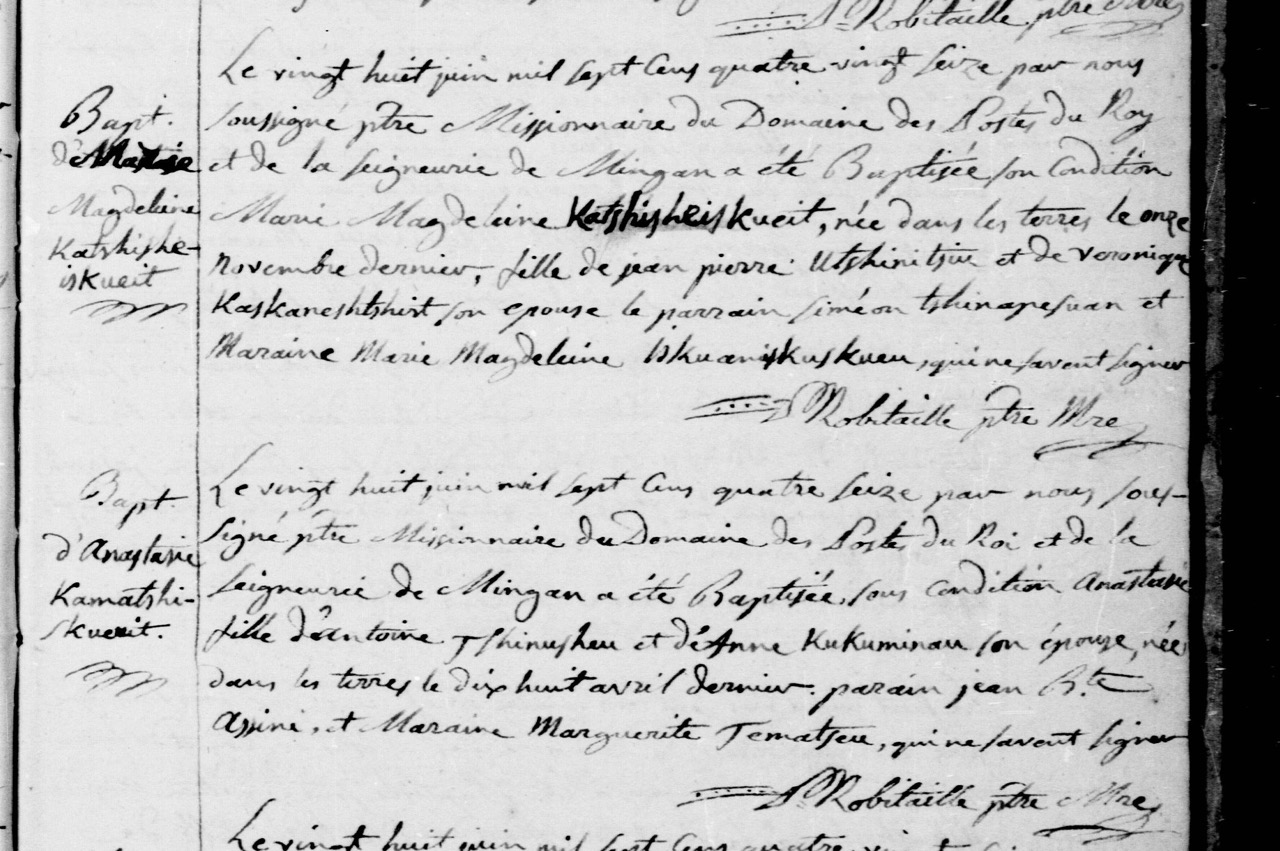
Image of baptism records of Marie Madeleine and Anastasie, handwritten in French. [Drouin Institute]

This morning, a realization dawned. The most likely scenario is that the priest who originally recorded the baptisms had made a mistake. He had assigned the wrong child’s name to each set of parents. They were baptized together on the same day. And in fact, in the record, you can almost see that he started to write “Anastasie” where he later wrote “Marie.” It is the marriage record that is more likely to be correct—only Anastasie’s father, Jean Pierre Utshinitsiu, and the parents of the groom—who were her godparents, Simon Tshinapesuan & Marie Madeleine Iskuamiskuskueu, were present for that ceremony.

So the new moon in Scorpio revealed a probable mistake in the original baptism record, and shifted my search back again to Antoine Tshinusheu and Anne Kukuminau as Marie Madeleine Katshisheiskueit’s parents. Ironically, I had started there, because Jean Joseph Roy, or the person following him, had recorded her parents as Antoine and Anne in his Catalogus. Maybe his account had not been an error, but a correction, because he knew the people involved. Or maybe what is revealed is a whole series of mistakes. But the hunt continues, with correction.

Screen shot of the page in the Catalogus generalis totius Montanensium Gentis, with Marie Madeleine and Anastasie [names are in Latin]

Each time something changes in this search, I feel a bit of grief—for the people I thought I had discovered, possible relatives that turn out not to be related to me at all.

But the other night, even before this latest revelation, a small intuition crept into my consciousness about all these Marie Madeleines I am searching. It was like they whispered in my ear, “We are all your relatives! As you search for us, and find our stories, we are pleased, and take you under our wings. We are all your relatives.” That is what I hold onto now, in this search. “We are all your relatives.” And that it pleases them when I search out their stories.

All Hallow’s Eve/Samhain

Fresh cedar sprigs under a pair of cardinals welcome sign on our white front door.

Today we welcome the ancestors with special foods, with herbal incense, and with a fire in our fire circle! For herbal incense I use cedar–I’ll use a dried bundle I made before, and burn it in our fire circle. Cedar was widely used by my Innu ancestors, and so I think their spirits will especially appreciate it. We also have a cedar tree right on the edge of our own yard, so I ask the cedar tree for permission to cut some sprigs to make more cedar bundles, and also to put cedar on our front and back doors for protection from harm, and welcome to benevolent spirits.

The special food I made is bannock, a traditional Innu bread, called ińnu-pakueshikan, which they adapted from the Scottish. Since I can’t eat wheat bread, I used 1/2 oatmeal flour (which is actually what the Scottish used) and 1/2 almond flour. Here is my recipe, adapted from several I found online. It is a very simple bread with many variations. Mix all ingredients together.

  • 1 1/2 cup oat flour (made in a blender from GF rolled oats)
  • 1 1/2 cup almond flour
  • 1 Tablespoon baking powder
  • 1/2 tablespoon salt
  • 1 1/3 cup water (this might have been more than I needed)
  • 1 cup frozen blueberries.

I put it in a greased skillet, and let it bake in a 375 degree oven for 55 minutes. After about 40 minutes, I cut it in four, and turned the sections over in the pan. A small dish is all set to go outside for the spirits, for when we have our fire. It is crusty on the outside, and a bit mushy on the inside. Tasty with butter.

Blueberry bannock in cast iron pan, cut.

I have been continuing my search for my Innu ancestor Marie Madeleine’s family. Lately this has been by hunting for as many details as I can about Marie Madeleine Katshisheskueit, which means “hard-working-woman”, who was born 11/11/1795, and baptised in Portneuf 6/28/1796. I was finally able to see an actual image of her baptism record, and discovered her actual parents, Jean-Pierre Utshinitsiu (Utshinishkushu=whirlpool?) and Veronique Kaskanieshtshist. (Kashkanatshish=rock ptarmigan) (The earlier source had directed me to another set of parents entirely.) So I began hunting for the rest of their family and found a few more generations, and many cousins.

This was a relief to me because I also discovered that Marie Madeleine Katshisheskueit’s mother died in 1797, when she was only two years old. I was filled with grief for this toddler, and wondered how she would be able to survive such a loss. Then I remembered that my Passamaquoddy teacher Roger Paul said that the whole community always cared for all the children. They didn’t divide into small nuclear families, but rather in extended families. I saw that her godmother, Marie Madeleine Iskuamiskuskueu, was the cousin of her father (and also the mother of another Marie Madeleine that is not my ancestor). So she was likely taken care of and loved by all these relatives.

I haven’t been able to find other records of her life after 1800, so far, which means there is nothing to rule her out. It might mean that she disappeared somewhere, or it might possibly mean that she is my own ancestor, showing up in 1830 without any surname or Innu name that would clarify her identity to me. The hunt continues, only now I am looking at her family members, to get a picture of their relatedness.

Finally, another update: I had been wondering what to do about the frogs in the pond, as winter approaches. Well, it turns out they are doing it for themselves. The last time we saw frogs in the pond was a week ago, and just two small ones remaining. We don’t know where they went, but they must know how to take care of themselves, perhaps find some mud to bury in, or someplace protected for the winter. Our pond is probably too shallow, with too little mud for that purpose, I assume. So the pond is getting colder, and the frogs are gone. Hopefully, we’ll see them again in the spring.

May the blessings of this season be with you, may your ancestors bring you blessings when you open your heart to them, and may we survive the coming cold with grace and peace! Blessed Samhain! Now I’m going outside to the fire circle.

Two small frogs on a rock near iris stalks, with fallen leaves in the water.

A Kettle of Hawks

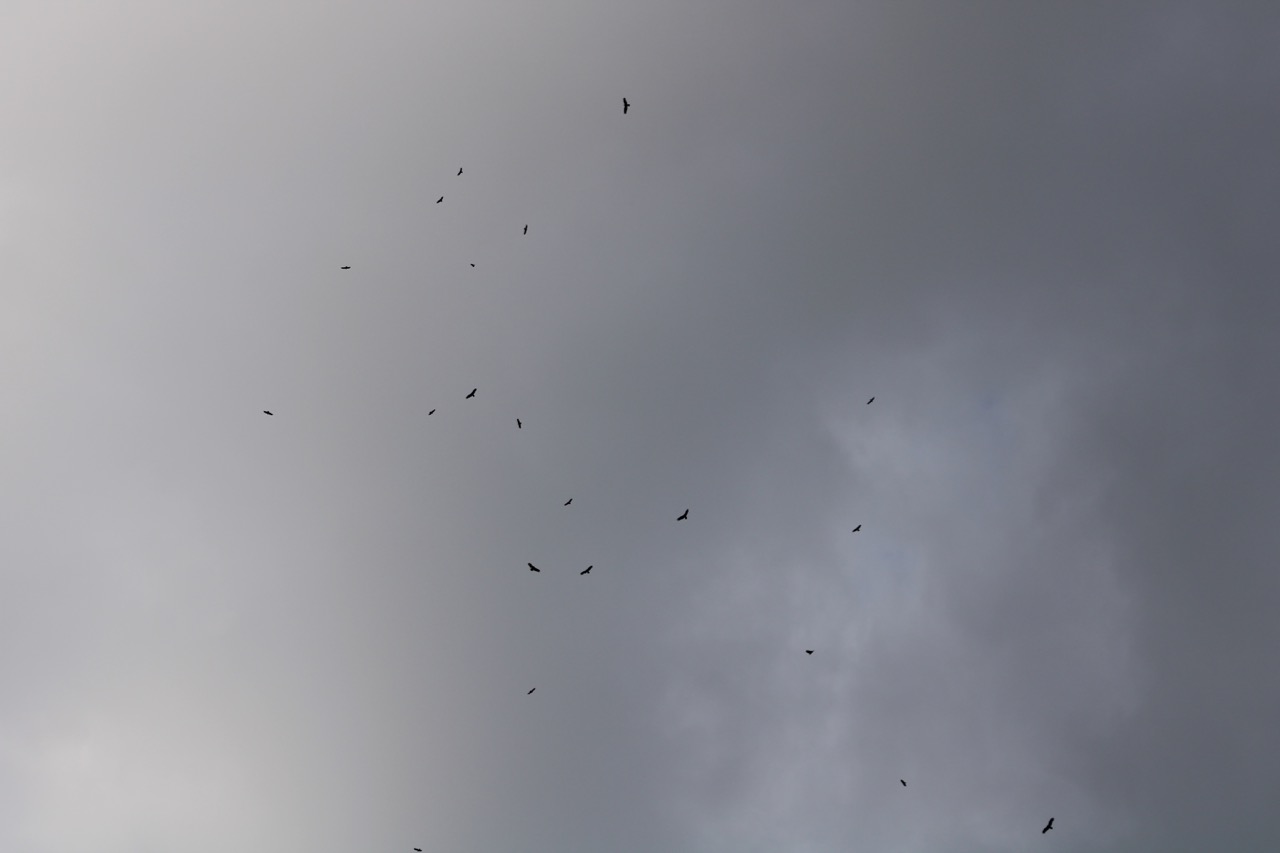
Over 20 hawks high in a cloudy sky.

I was outside lying in the hammock two days ago, when I saw a hawk flying overhead, and then more and more hawks, higher and higher. I understand that a group of hawks is called a kettle of hawks, and only occurs during migration. It was amazing to see! A reminder that the seasons are changing. I am writing this outside today on a sunny day, but wearing my winter jacket.

I think I may have found an important clue in my search for the roots of my third great-grandmother Marie Madeleine. In the record for the baptism of her son Simon, in 1833, in Jeremy Islets, she is identified as “sauvage du dit poste,” which means, translating the racist imagery, “Indian of said post.” And just above that record, Jeremy Islets is the post in question. I just want to say that it took a lot of close handwriting inspection to pull out those four words, but I am fairly confident in them now. And so it seemed to me it might be identifying her place of origin. (Now, on the other side, I know that her husband Peter McLeod was a clerk of that post in 1833. But she, along with two other Indian couples baptizing their children were all identified as Indians of that post.)

To further clarify, generally speaking the Innu went into the woods in fall, winter, and spring to hunt, and came to the posts to trade and to connect with the priests who did the baptisms, marriages, burials, and such. And they didn’t just go to one post, while necessarily avoiding others. But following the clue, of the several Marie Madeleines in my list of possibilities, one was connected to Jeremy Islets, in the right time frame. She was identified in her baptismal record as Marie Madeleine Napeteiashu, baptised June 26, 1803, when she was about 7 years old, they said, which would put her birth about 1796. Napeteiashu was actually said to be her father’s name, with no Christian name attached, and her mother was identified as Catherine Mitisku.

After searching through hundreds of other records, I found a Catherine Mistiku, born in 1773, and baptized in 1786 in Jeremy Islets. She was married to Stanislaus Mishtanapeu, baptized in 1778 in Jeremy Islets. In other records, they are identified as Catherine Mistigu or Mitigu, or Stanislas Tshiuapan (actually the name of his son Paul). I think this is likely the same couple, though in this process, one can’t be positive. I found baptism and marriage records for sons Simon (b 1794, bap 1796) and Paul (b 1798), but no other links for Marie-Madeleine. (And why would Paul be baptized in 1798, but not Marie Madeleine until 1803?) In the marriage record for Paul, in 1817, Catherine is said to be deceased.

Along with the genealogy hunt, I have also been exploring the possible meanings of their Innu names. Mistiku (likely now spelled Mishtiku) can mean, a tree (animate), or a log (inanimate), or possibly a French Canadian or white person-(though Catherine would not be French, but someone might be called this perhaps because she was hanging around the French?) (I think the French were called this because of wearing wooden clogs.) Mishtanapeu means a remarkable man. Napeteiashu was harder to decipher–“nape” refers to a male, and if I stretch the spelling, it could mean a male fox–napeiatsheshu. Spelling was not a hard science in those days. I couldn’t find any other references to Napeteiashu. The one possibility was a marriage with no details attached of Catharina Matshiskueu to Nipituashu. No dates/places/or parents. Matshiskueu means “she is an ugly woman”. So you see, it’s all very mysterious and uncertain.

By the way, several of the names I was researching seemed to have “negative” connotations. I wondered if it was some kind of internalized oppression, or if maybe there was a function of the name to protect the child by acting as if it were not valuable in some way. There was a lot of oppression by the priests. For example, when an “illegitimate” child was baptized, often they did not even name either of the parents at all in the record. Some priests took more care than others. I think the earlier Jesuits learned the Innu language and taught people to read and write in their language. Later priests did not know the language at all.

But as for me, I was so excited to find this possibility. Maybe it was really her, with a place and parents! Then today, I was slowing down to remember that this process of search will continue, and I have to pace myself, to live with each possibility as it emerges. There are hundreds of pages of records, much of it not indexed, so I go through page by page looking for names–and with new names, that means all new searches. Still, I am amazed that these ancestors feel closer to me now, even if they are still like the hawks flying in the sky so far above me that I can’t see the individuals very well. Am I related to a tree, a fox, an ugly woman, a very remarkable man? Am I related to the place called Jeremy Islets? In Innu, Ishkuamishkᵘ, which is similar to the word for a female beaver ishkuemishkᵘ. And how does this all relate to my life as a white woman in Maine, in Wabanaki territory? Still, it does feel like one part of my own journey of finding our way home into the earth community.

A fox near the Capisic brook, surround by trees and other greenery. (This photo was taken in 2018)

Magic Happens!

Yesterday, I wrote, concerning my search for my matrilineal ancestor Marie-Madeleine:

“Why do I write about it here? I’m putting some magic out into the universe, hoping that some kind of thunder might open the cloudy skies between me and the past, between me and the place my ancestors are from. … It has been my experience that when I reach out to my ancestors, they reach back—more so when I have actually traveled to Quebec, but since that is not possible, I hope they will reach across the border.”

And then some magic did happen!

After being stuck not finding people on the GénéalogieQuebec website, I meandered around some more, and some records of the Postes du Roi index of people, not related to my ancestors, linked to images from the actual Postes du Roi records. If I went to those images, I could move back and forth from page to page in the images of actual records. And by doing that, I found the baptism records of six of the Marie Madeleines or Madeleines, from the list I had, from 1800 to 1805, even though they were not “indexed.” Also, I was able to download all the images as I accessed them, to be able to look back as I needed. So now I am able to keep researching, a way opened up.

Some magic happened!

Sometimes it is easy to forget—in my intellectual research mode, in our rather secular world—that magic is alive, that ancestors reach out to us. Even though I have experienced it in the past, and believe in its power. So easy to forget.

And the intellectual research is part of the magic, not separate from it. It is a lot of work to attempt to decipher 200-year-old writing in funny penmanship, in French. But I am so thankful to be able to attempt it. And to learn as much as I can about the lives of all of these women. I also learned that for some of them, the Innu name is that of their father—at some point (1803?), the Innu names switched from being a descriptive personal name to function more like a surname. (Those are in parentheses)

Marie Madeleine Katshisheiskueit, b. 1795 in the woods, baptized 1796 Portneuf

Marie Madeleine (Napeteiashu), b. 1796, baptized in 1803 Îlets-Jérémie

Madeleine Peshmekueu, b. 1799 Sept-Iles, baptized 1800 Sept-Iles

Madeleine Pishikuskueue, b. 1801 Pointe-des-Monts, baptized Godbout

Marie Madeleine (Utsinitsiu), b. 1801, baptized 1805 Chicoutimi

Madeleine Moistashinagusiu, b. 1802 Rivière Godbout, baptized Godbout

Marie Madeleine (Arishinapeu), b. 1805, baptized Tadoussac

Magic happens! May I keep being open to the magic, and may you feel it opening where you need it too.

Close up of hazelnut leaves in full color.

Thunder Magic

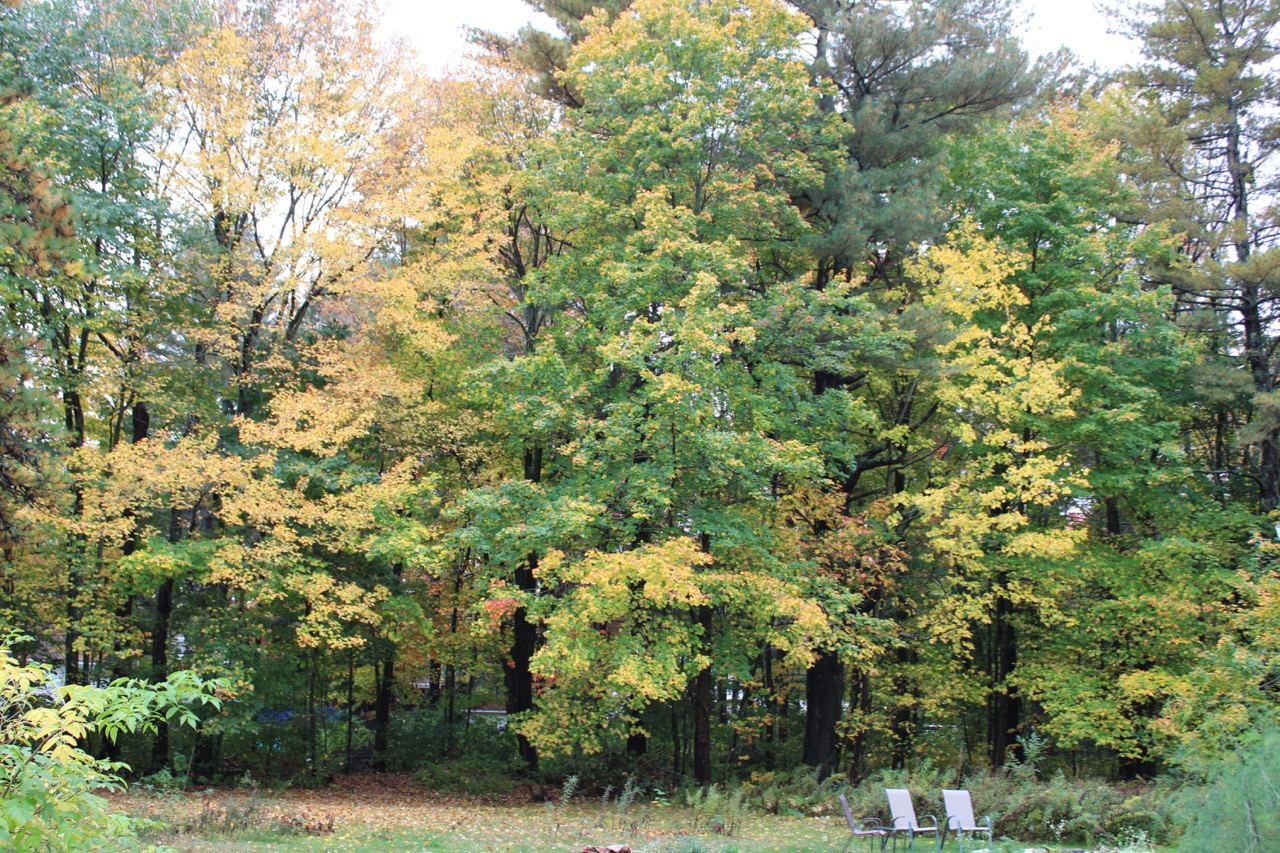
Trees at the back of our yard in fall colors

I woke to a crash of thunder about 7 a.m. this morning, with a driving rain pounding against the wall and window near the head of my bed. What a beautiful sound to start the day! The rain only lasted about an hour, and then the skies were gray, but the air was lit by leaves of gold and orange encircling our back yard. We’ve had no frost yet, and the October transformations are unfolding with beauty and grace.  

I’ve been surprised by how low in the sky the sun travels at this time of year—even at noon it is lurking behind the tree canopy shading the back half of the yard. You’d think after all these years I would be used to it by now. I’ve also been surprised by new raspberries ripening fat and delicious. Usually our “everbearing” raspberries don’t ripen in the fall—there is not enough sun and warmth in their spot to bring them to completion—but perhaps taking out the (invasive) Norway maples near the fence helped them to get more morning light. They taste better than any of the summer raspberries.

October is also a month for ancestors, leading up to Samhain on the 31st. I have continued to search for more information about Marie-Madeleine, my Innu great-great-great grandmother. I’ve been lucky that I emailed two people who seemed to have some resources, and they both replied and sent information. Magic! One told me that, from looking at his records, Marie Madeleine Manitukueu could not be my ancestor, because she married someone else in 1815, and then that person remarried in 1825 after her death. So that was incredibly helpful. Most of the work will be eliminating the women who cannot be my ancestor.

Then he also sent me a list of 17 “Marie Madeleines” or “Madeleines” recorded births from 1790 to 1818 at the Postes du Roi, from the databases he had access to, and agreed with me that it seemed most likely that she would be born closer to 1800, rather than 1789, since her last child (Marie Sylvie) was born in 1846. (The 1789 date is based on her death record stating that she was about 60 years of age at her death in 1849.)

I believe that going by child-bearing years is the best guide. A late baby in her 40s is more possible than in her 50s. The child before the one in 1846 was born several years earlier in 1839 (Sophie)—so it seems also more likely that 1846 was a late baby. Her prior children were about 3 years apart. Her first documented child was born around 1828, but it is possible that she was the mother of earlier-born children of her spouse Peter McLeod.  (Most sources say that he had an earlier Montagnais woman spouse, but there is less agreement about which children had which mother.) To go by a childbearing age of about 16 to 50, it seems like her own birth would be between 1796 and 1812.

This leaves 11 women on the chart—stretching slightly to include Marie Madeleine Katshisheiskuet (born 11/11/1795). So, the next thing I did was explore GénéalogieQuebec.com, to see if I could do research on each of the women. But I ran into a problem immediately. The records of the Postes du roi included on that site seem to be missing many of these vital years, not yet indexed, and none were available in direct images. I could not seem to find access to the databases to which my email correspondent had access. To complicate things a bit more, the parents listed for Marie Madeleine Katshisheiskuet in GénéologieQuebec are different from my earlier resource, and I think the only way to clear that up would be to look at an original record.

So, I feel stuck again—there is such a distance between Quebec and the United States—so much knowledge does not cross the border. I would like nothing better than to pore over these old records looking for the lives of these 11 women, seeing if I could find other marriage and death records that would steer me away from some, and toward my own ancestors. I don’t know why I think I can succeed where prior genealogists have not found a link. But maybe they didn’t have the same motivation. I’ve sent an email to the GénéologieQuebec site asking about the Postes du roi records. I also think I found some at the Catholic Archdiocese of Quebec, but not published or indexed.

It’s like the detective stories I’ve been reading—so many mysteries, so many clues. Why do I write about it here? I’m putting some magic out into the universe, hoping that some kind of thunder might open the cloudy skies between me and the past, between me and the place my ancestors are from. I’ve learned a lot in the process. It has been my experience that when I reach out to my ancestors, they reach back—more so when I have actually traveled to Quebec, but since that is not possible, I hope they will reach across the border.

Ancestor Yearnings

My great grandmother Claudia Tremblay

Today, September 29, is my great grandmother Claudia’s birthday–she was born in 1865. I never got to meet her, but I was named for her (my middle name) and so I have felt a connection to her for quite a while. This week I was once again caught in the throes of this strange yearning obsession to try to understand the lives of my matrilineal forbears. I happened to be looking at a document about Claudia that I compiled a few years ago, and it mentioned a resource–the “General Catalogue of the Entire Montagnais Nation.” [Except the title was in Latin and the book was in French. Denis Brassard, Catalogus generalis totius Montanensium Gentis of Father Jean-Joseph Roy, 1785-1795 ]

It was a record of baptisms and other religious rites at the King’s Posts (Postes du Roi) in the Saguenay River area and North Shore of the St. Lawrence River of Quebec, in the 18th century. The Postes du Roi were the site of trading between the Innu/Montagnais and the French/British. They were also the site of missionary priests coming round to offer religious instruction and ceremonies to the Innu people. (The French called the Indigenous people of this region Montagnais, but since then, the people have reclaimed their own word, Innu.)

Claudia’s mother was Angele McLeod, and her mother was Marie-Madeleine, who was identified as “Montagnaise” in any records I had been able to find. But I had been unable to go any further back in her family, and only had estimates of her birth to be about 1789, perhaps linked to a Post du Roi. So I went looking for that book, which was available in a digital format for not so much expense. And it had a built-in translation function, which helped a lot since my French is shaky. The first half of the book was a description of how things were at the Postes du Roi. The Innu generally spent fall/winter/spring in the inland forests, hunting and gathering, and then came to the shores of the Saguenay or St. Lawrence in the summer, to fish and gather with each other. The Posts were built at these established summer gathering places to foster the fur trade, and the conversion of Innu people to Catholicism by the priests.

By searching record by record through the hundreds in the chart, I was able to find two Marie-Madeleines (Maria Magdalena) whose births were within 10 years of 1789: 1795, 1797. The Innu people did not use surnames, but rather single descriptive names, so each record included a Christian name (in Latin) and a personal name for the child in the Innu language. I found Marie Madeleine Katshisheiskueit (record #1065), and Marie Madeleine Manitukueu (record #1079). I don’t know that I will ever be able to establish a definite link between one of them and my Marie Madeleine, but one of them could be related to me. My Marie Madeleine eventually was married to Peter McLeod who worked for the King’s Posts in many places. And she was identified as Catholic, so it would be likely for her to be in these records.

Finding these names is touching a deep place in my spirit. I can’t even describe it. And deeper still, was searching out the meanings of the Innu names in the language. I was able to determine that Katshisheiskueit likely means “Hard-working/female” and her parents’ names were Antonius/ Tshinusheu which means “Northern Pike”, and Anna/ Kukuminau, which means “old woman” or “wife.” (Now the parents were only about 16 then, so likely it was an endearment, or Tshinusheu just said–“that’s my wife.”)

Manitukueu has something to do with Spirit–Manitu is the Innu word for Spirit. But I couldn’t find an exact reference. Manitushiu means someone who uses spiritual or mental power. “kueu” seems to be a common verb ending signifying something being or having. It is like detective work–and I wouldn’t be able to do any of it if I hadn’t been studying Passamaquoddy, which is related to the Innu language. Words are formed polysynthetically, with smaller parts joined together to create long descriptive concepts in one word. So I search the online Innu dictionary, with my framework of Passamaquoddy, and try to recreate what they might mean.

Manitukueu’s parent’s names were also challenging. Her father was Simeon Tshinapesuan, and the closest word I could find was something meaning “slips on a rock”, or “slippery.” Her mother was Marie Madeleine Tshuamiskuskueu, part of which meant “finding it by detecting it with body or feet.” But then I lucked out because her own birth record called it Iskamiskuskueu–which means “from Jeremy Islets,” and she was from Jeremy Islets. According to another source, this Innu name of that place meant “where you can see polar bears.” (Where you can find polar bears?) I guess I was rather far off.

So, it’s hard to trace “family trees” without surnames, but each child was listed with their parents, and by going through again searching for the parents’ names, I could find their parents too. And in fact, there were a few generations in each of their families to be found in the charts, with a lot of holding a magnifying glass over my computer screen so I could read the small letters in the charts. Much more still to do.

It is a whole world uncovered to me. And whether or not one of these women is my actual relation, this is the world she lived in, the world she came out from to enter a path that eventually would lead her daughters and granddaughters into other worlds. I never imagined that I might learn the Innu name of my great, great, great grandmother… and now there are all these names dancing in my mind, trying to form in my mouth, bringing much depth to my heart. I feel such gratitude and curiosity.

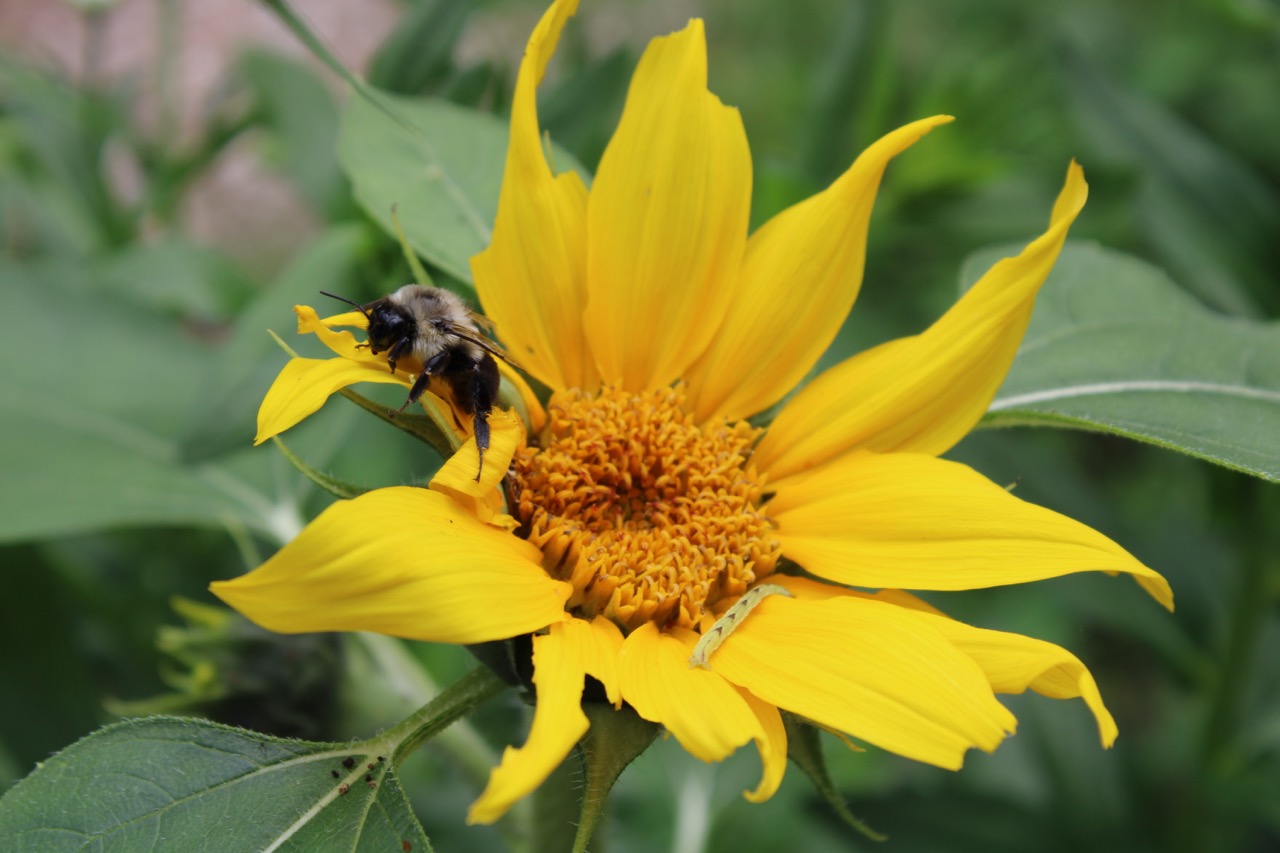
Yellow sunflower planted by squirrels, with a bee inside.

What We Hold Onto

Yesterday, my Mail program on my Macbook crashed, and kept crashing. While I pursue attempts to fix it, I am pondering how I have used email, and what those possibly lost emails hold for me. One thing they hold is memory and relationships. I have some old friends that I keep in touch with through email, maybe once a year or every few months. The emails between us hold the long conversation, the details of events in their lives that I might otherwise forget, the cherished connections we make to each other. My emails also hold networking on issues I care about, future possibilities for workshops or activism, relationship building in the here and now. My emails also hold a record of these writings I post on the blog, to save on my own laptop.

But in the meantime, the Mail program is also clogged with thousands of emails that I never bother to read, never bother to erase. Not all junk, per se, but reports from organizations, updates on political issues, daily inspirations that I once thought would be uplifting, but I’ve stopped caring about. And it was much easier to ignore them, rather than try to go through and unsubscribe or move to the trash. Since I can’t open the Mail, I don’t have exact numbers, but I am pretty sure that there are at least 20,000 unopened emails in there. I wish I could magically extract the important ones and abandon the rest.

Yesterday evening, after giving up for a while on the computer fixing, Margy and I watched the movie Nomadland, with Frances McDormand. She plays Fern, an older woman who has lost her husband and her home, and who sets out in a van equipped with mattress and cupboards and cooking options, to travel to seasonal jobs in the American west. Along the way she meets other similarly displaced people, and in the film these are actual “nomads” playing fictionalized versions of themselves. It was powerfully beautiful in its closeness to the natural world of deserts and mountains and rivers, achingly solitary yet full of community in surprising places, and deeply sad in its indictment of our society’s abandonment of aging people.

It also got me thinking about what we hold in our homes, and what I might carry with me, if I ever lost this home and had to set out with only a van full of what I needed, what I cherished. We see Fern looking through a tin box of old photos, listening to music on her little radio, carefully repairing a broken plate, eventually giving up the stuff in the storage unit back in her old town. What would I hold onto, what would I leave behind?

I like to watch Henry Louis Gates, Jr.’s Finding Your Roots. There are times when the paper trail runs out for people on the show, there are no more records to be found to show the names of their ancestors, or the places they were born and died. Sometimes the paper trail ends because of slavery or genocide or oppression. Sometimes it ends because most people didn’t document their lives in ages past, like we do today. But I wonder if future generations looking for their ancestors of today would have different problems. They might have the problem of technologies changed or lost, such that they could no longer access the online records we so carefully accumulate. But they might also have the problem of getting lost in the avalanche of “paper” we now compile, the over-accumulation of words. Will they no longer be able to follow the trail of what is most important amid the towering clutter of what is not?

And so I come back to my own life, remembering the times I set out with a backpack, or a little car, starting a new life with only what I could carry. I got pretty good at winnowing things down, valuing the simplicity of it, feeling the freedom of it. But in the last twenty years, I’ve been able to settle down and really root myself in home. So things accumulate, some things cherished and beautiful, others practical, necessary, and then the stuff that serves no purpose any longer, but won’t magically disappear unless I do that work of taking it away, giving it away, sorting and erasing. What do I want to hold on to, what do I want to let go?

And yet, eventually, we all leave this life with nothing we can hold onto, all that is left is what we have given away.

Tree stump design-traces of all the years of life

Magic in the midst of illness

Woke up to a misty morning on this new moon day, and started reading my journal from the last new moon until today. It is a ceremony I honor each new moon, and it is a way for my life to teach me.

I was struck by some passages from the time of Halloween/Samhain, that special time of connections to the ancestors. Because of chronic illness and its deep fatigue, I haven’t felt very spiritually focused lately, not much energy for deep ritual. Plus in COVID times, we don’t have our seasonal gatherings either. But it seems like the ancestors and spirits are reaching out to me nonetheless.

I did manage to cook salmon and potatoes for dinner on Samhain to honor some of Margy’s and my various ancestors. I listened to Quebecois music while doing dishes, and drank East Frisian tea. During the night of the full moon/blue moon I suddenly woke at 4 a.m. and saw the moon shining brightly outside my window. The next day, I saw a cardinal–my healing messenger bird–at the bird-feeder–the only time I’ve seen one there all this season. I was watching TV a couple days later and stumbled upon the movie Coco, which (despite its flaws) got me into the mood of Dia de los Muertos.

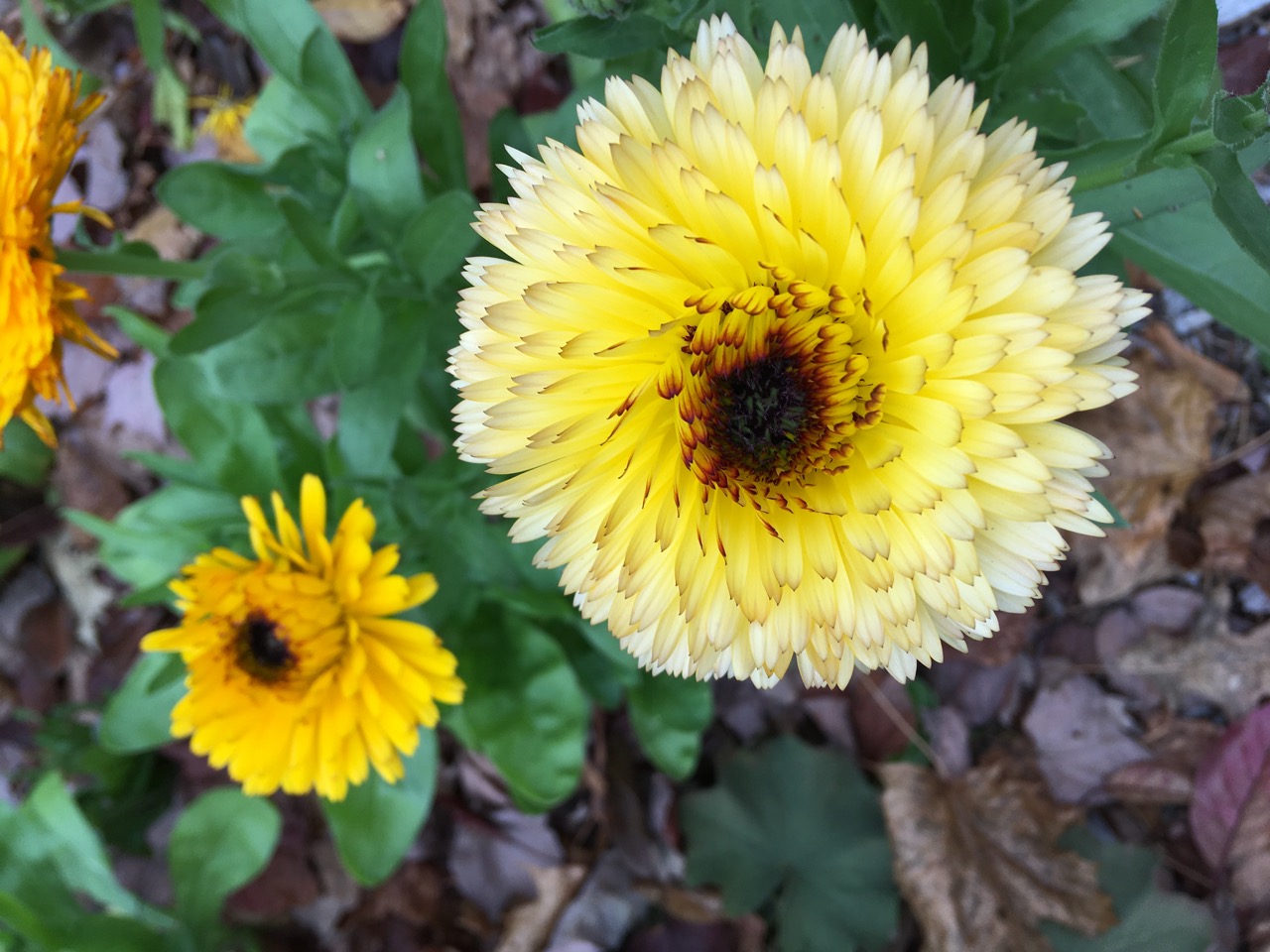
Marigolds growing self-seeded in our garden strip near the road.

I was looking for things to watch on our Roku and stumbled upon a series on Canadian Rivers. The best episode was on the Moisie River, or Mishtashipu in the Innu language. I had first learned about this river from Innu people who were fighting to protect it from a hydrodam planned by Hydroquebec. They won that fight, partly because there were also rich white people trying to protect their own salmon fishing. It was beautiful to see the river, and to listen to the Innu people who call it home. (And by the way, the word-segment “ship” in Mishtashipu is a cognate to “sip” in Passamaquoddy, which means river. I feel happy to know that.)

All these little threads meandering unexpected through my days, pulled from me this prayer: “Ancestors, are you reaching out to me from the other side of the veil? Even though I have so little spiritual concentration or focus right now? I open my heart to your presence.” I remembered magical moments of other times when I felt the presence of spirit close by. When my Innu ancient-grandmother, Nukum, first appeared, holding a bowl full of the universe. When I was able, despite all odds, to find the grave of my great-grandmother Claudia in Ottawa. When I was sitting right next to my dad as he took his final breath on this earth.

At the tiny headstone of my great-grandmother Claudia.

During those Samhain days, I was also working on a testimony about my family’s role in colonization. I was feeling the weight of the ancestors–the migrations, the wars, so much. I was feeling overwhelmed by that weight, I was feeling that I could not carry that weight, or imagine ways to find healing for this aspect of my heritage. I feel weary even from the weight of my many living relatives who seem trapped in a cult of lies, there is much estrangement between us. And so once again I reach back to spirit kin.

Finally, I hear: “You don’t have to carry the weight. Let go. Remember trust. I am here even when you cannot hear me, in this dark night of the mind and body. You are already in my hands. It was never a question of guilt or innocence. It was always about love. It is okay to trust my love. Breathe in love.”

And so, today, day of the new moon–this new moon which is also considered part of the time of closeness to the ancestors and spirits–I let myself hear those words again. There is room for magic to intervene, even in the midst of illness and fatigue, even when I cannot dance or sing or build a fire. And I am filled with gratitude.

Language Roots

Some presenters at Healing Turtle Island this summer suggested that we all, colonizers included, should seek to uncover our own distant Indigenous languages. I had the idea then to learn to introduce myself in the Innu language, the language of my matrilineal ancestors, and then to mark their transitions to other languages. (Three of my grandparents have Germanic roots, but in this exercise, I limited myself to my matrilineal line.)

I want to thank Roger Paul, my teacher of Passamaquoddy/Wolastaqey, because I could not have approached the Innu language without having learned so much about Passamaquoddy. From what I can tell, the structures of these languages are the same, the grammar, the animacy, even some of the words are cognates. So with this foundation, I was able to use the Innu dictionary online to shape sentences that might bear some resemblance to how the language is spoken, though no doubt I have made errors.

After I was deep into it, I laughed at myself, because to whom could I speak these words, since I am not in touch with any Innu people right now? But then it seemed that perhaps they were for my ancestors in the spirit world. And so this is dedicated to them. I also want to acknowledge that though I have studied French, Google translate was my helper in the French language parts of this exercise, and unfortunately there is no Quebecois French in that translation program, so some subtleties have not been included. I have heard it said that Quebec French is closer to ancient French ways of speaking. I begin with a photo of my great-grandmother, since she is at the heart of the story.

Claudia Tremblay

My great-grandmother Claudia Tremblay.

Mishen Claudia nitishinikashun.
My name is Mykel Claudia.

Claudia iapit nitanishkutapanukum ishinikashu.
Claudia is also the name of my great grandmother.

Shekutimit utshiu, ińnu-assit.
She is from Chicoutimi, in Innu territory.

Ukuma ińnushkueuńua, Mańi-Matińin ishinikashuńua.
Her grandmother is an Innu woman, whose name is Marie-Madeleine.

Ińnu-aimińua.
She speaks the Innu language.

Eukuannu nui ińnu-aimin.
That is why I want to speak the Innu language.

Mańi-Matińin uitshimeu Pień McLeod, kie mitshetusheu.
Marie-Madeleine marries Peter McLeod and she has many children.

Utanishu, Anisheń ishinikashuńua.
She has a daughter, named Angele.

Ashku Anisheń kutuńnuepipuneshit ashu nishtᵘ, ukauia Mańi-Matińin nipińua.
When Angele is thirteen years old, her mother Marie-Madeleine dies.

Natshe uitshimeu Anisheń kakussesht. Shushep Tremblay, kie mitshetusheu.
Later, Angele marries a French-Canadian, Joseph Tremblay, and she has many children.

Anisheń utanishu Claudia, nitanishkutapanukum an.
Angele has a daughter Claudia, that’s my great-grandmother.

Kakusseshiu-aimu.
She speaks the French-Canadian language.

Mon arrière-grand-mère Claudia parle la langue canadienne-française, comme son père Joseph Tremblay.
My great-grandmother
Claudia speaks the French-Canadian language, like her father Joseph Tremblay.

Très probablement, Marie-Madeleine et Angele parlaient aussi la langue canadienne-française, ainsi que leur langue maternelle.
Most likely Marie-Madeleine and Angele also spoke the French-Canadian language, along with their mother tongue.

Mes ancêtres canadiens-français sont au Canada depuis le début de la colonisation, depuis l’an seize vingt.
My French-Canadian ancestors have been in Canada from the beginning of colonization, since the year 1620.

Je ne peux pas compter le nombre d’ancêtres français qui se sont installés au Québec, atteignant onze générations en arrière.
I cannot count the number of French ancestors who settled in Quebec, reaching eleven generations back.

Ils ont abattu de très nombreux arbres et cultivé la terre dans un climat difficile.
They cut down many, many trees and farmed the land in the difficult climate.

Malheureusement, leur arrivée a entraîné la maladie et la mort de nombreux Innus.
Sadly, their arrival brought disease and death to many Innu people.

Les Innus vivent dans leur terre depuis des temps immémoriaux, et y vivent encore aujourd’hui.
The Innu have lived in their land since time immemorial, and still live there today.

Claudia a une fille Yvonne, c’est ma grand-mère.
Claudia utanishu Ipuan, nukum an.
Claudia has a daughter Yvonne, that’s my grandmother.

Par ma grand-mère Yvonne, j’ai l’héritage des colonisateurs mais aussi, dans ma descendance matrilinéaire, l’héritage des colonisés.
Through my grandmother Yvonne, I have the heritage of the colonizers but also, in my matrilineal descent, the heritage of the colonized.

Yvonne a déménagé aux États-Unis à l’âge de dix-huit ans, où elle parlait anglais.
Yvonne moved to the United States when she was eighteen, where she spoke English.
Ipuan atutsheu Upashtuneu-assit ashku kutuńnuepipuneshit ashu nishuaush, tanite akańeshau-aimit.

Yvonne has a daughter Carol, that’s my mother.
Yvonne a une fille Carol, c’est ma mère.
Ipuan utanishu Kańań, nikaui an.

English is my first language.
L’anglais est ma première langue.
Nitakańeshau-aimin ńishtam.