Moments of Joy

Capisic Brook invisible cardinals

I saw a group of cardinals on my walk today! I haven’t seen them all winter, but as I stood still, watching the beauty of Capisic Brook, first one and then another and then more appeared in the distance.  You can’t really see them in the photo, but after the brook bends to the right, and then to the left–they were there in the bushes near the water. Then, as I was walking home, I heard a cardinal sing in the trees nearer my house. Joy!

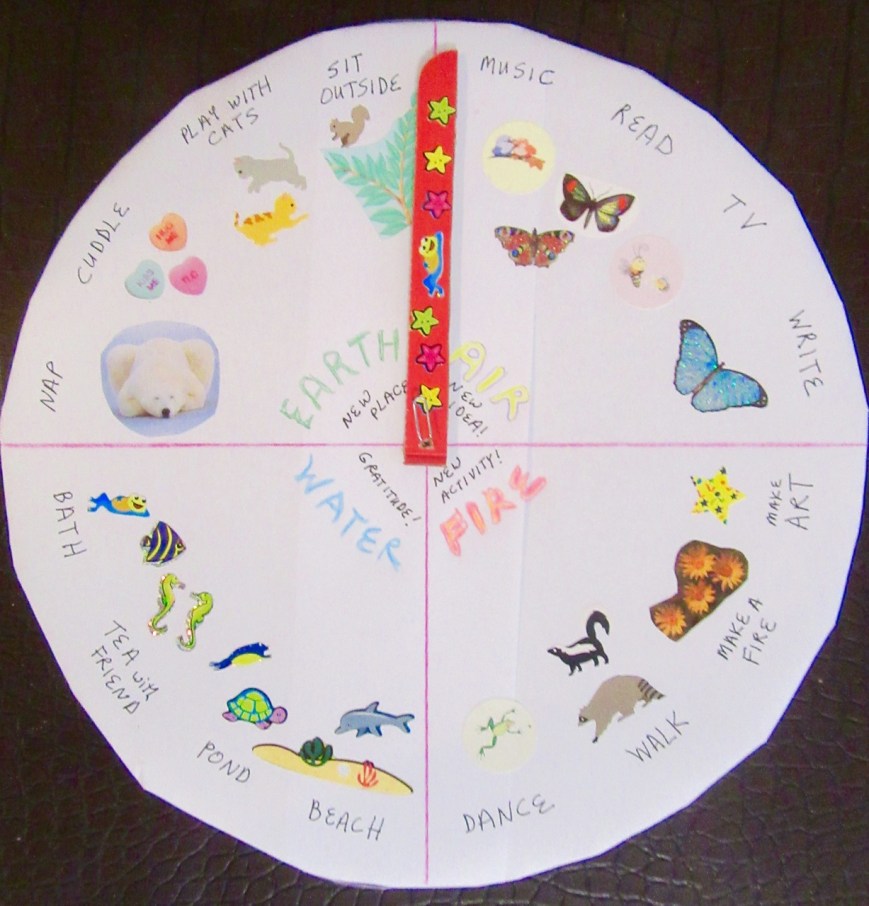
I was thinking more about the fun wheel I created the other day. I put “Walk” as something to do under the element of fire, but really, my morning walks include all the elements. Fire is for the movement of my body, and sometimes, the bright sun rising.  But I almost always walk to the brook–which is water.  And I am connecting to the trees and the land and sometimes little animals–which is earth. Hearing the songs of birds, breathing in the invigorating air, well that is air.

Sometimes the walk feels like a chore–getting out there in the cold–it’s exercise, you know, good for me, I should do it, etc.  And my usual definition of fun is something I don’t have to do–no “shoulds.” But often, even usually, once I get out there, a walk is a doorway into moments of delight, moments like seeing the cardinals today, or finding turkeys in the street, or sometimes near the brook, catching a glimpse of a fox or a raccoon. Moments of surprise and moments of joy.

What might you do today to open a doorway into possibility, into moments of joy?

Wheel of Fun

Fun Wheel

Today, Margy and I made art together.  She was coloring Celtic goddesses, and I made this fun wheel.  It is on the model of a chore wheel–you know, where you spin the dial and know who is doing dishes, or laundry, or sweeping the floor.  Only this is for activities that bring joy.  Since that is not always my forte.  So this way, I can spin the dial, and have a suggestion for a fun thing to do.

I constructed a wheel out of cardboard and paper, and then I brainstormed a list of ideas for activities.  I decided to categorize them by the four elements–Earth, Air, Fire and Water.  Because I am a witch and that is how my mind works.  Plus it occurred to me that to care for ourselves, it might be good to have nourishment in all four elements.  Then I decorated with stickers.

We were listening to music while we made art! Plus I took a break to drink a cup of tea and play with Sassy… so that is air, fire, water and earth in one afternoon.  In the center is traditionally the element of spirit, and I thought to add new places, new ideas, new activities, and gratitude to fill out the center of the circle. Today, doing art is our new activity.

What I noticed:  in my original list of activities, the fewest were for water–I had to ponder that and add a couple more.  In my everyday life, most of the activities for earth and air already happen every day, fewer for fire and water.  What do you do for fun and self-care?

[Note–because I use free WordPress for blogging they sometimes add ads at the bottom of my posts. I have no control over these ads and invite you to ignore them.]


Hummingbirds?

Hummingbird Feeder

Margy got a new hummingbird feeder for us!  I put it up today, plus our old one too, attached to opposite sides of the beams on our new roof on the deck.  I hope we aren’t too late to catch the migration–we used to put out the feeders when the viburnum near our door (in North Yarmouth) started blossoming, the first week of May.  We’re still figuring out the best timing for here in Portland.  I’ll let you know when we see any.

In the meantime, lots of watering to do, and I also divided some comfrey and some oregano to take to the Plant Swap tomorrow at the Resilience Hub.  Last year we got all of the companion plants we needed for our cherry trees.  The comfrey and oregano seem like basically fool-proof plants, and grew abundantly in the food forest.  So I was confident enough to take some out to share.  This year, I hope to find some kale seedlings, perhaps, and just see what might be there.  Maybe elderberry starts?  It has been a beautiful day in the garden.

Hummingbird Feeder small

Trout Lilies

Trout Lilies

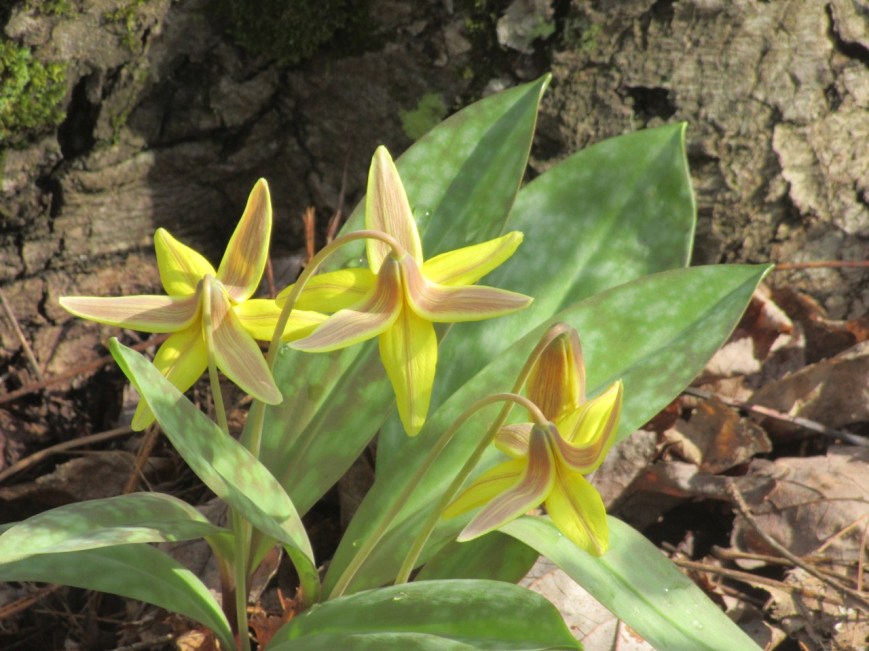
With all my working in the garden, I didn’t have a chance to walk by the brook for a few days.  When I came back, I found these little beauties.  The woods is absolutely carpeted with Trout Lilies.  I even thought about transplanting some for our yard, but read that they take several years to settle in and bloom.  So why not just enjoy them where they are?

There is so much beauty everywhere I walk–singing catbirds and cardinals, flowering cherries and magnolias, even just the leaves opening up on the trees are so magnificent.  The ferns are stretching out, and swamp cabbage is green along the brook.  Violets, dandelions and wild strawberries are flowering in the lawn.  Meanwhile life is busy, but I have to steal some moments to stop and enjoy it all.

Planting the Orchard

Peach Tree

[Contender Peach]

The new trees are here!  Once the frost was off the morning, I went out and started planting.  I took the eight bare root trees out of the box first and letting their roots soak in fish/seaweed solution, while I started digging in the beds we’d already prepared last June.

I had a fright before I went outside–I thought to take a look at planting suggestions in the Holistic Orchard book, and he suggests putting Rock Phosphate and Wood Ash in the holes–I hadn’t been thinking of that.  But then I found a bag of Rock Phosphate in the garage from last year, and we have a can of wood ashes, so we were all set.  These help the roots to get a good start.

I started with the “Contender” Peach tree, since it seemed to have the biggest roots.  It was a job to get all of them spread out and under the soil.  I feel my age when I am digging and kneeling in the dirt moving things around, and then getting up again.  I was happy to use water from our rain barrels to give it a good soaking.  This is a self-fertile tree, so one will do fine by itself.

Myke & Jersey Blueberry

[Myke & the Blueberry, Photo by Margy Dowzer]

After a short rest, I decided to plant the two blueberry bushes next–because they were little and easy.  We got one “Blueray,” and one “Jersey.”  Then I moved on to the “Honeycrisp” Apple.  The apple needs another tree for fertilization, but we’ve got a lot of wild crabapples around so that should do.

Finally, I planted three Hazelnut bushes. We decided to get an experimental hybrid hazelnut, Corylus Cross.  These shrubs are produced from crosses of three hazelnut species: American hazelnut, Corylus americana; beaked hazelnut, C. cornuta; and European hazelnut, C. avellana.  The nuts from these shrubs will likely be larger than American hazelnuts, because they are crossed with the European variety–(which is the kind that we usually can find in the store–small enough as it is.)

Margy diggingMeanwhile, Margy came out, and we talked again about where to position the “Illinois Everbearing” Mulberry tree.  We decided to get the mulberry because birds love them, and they can draw birds away from the other fruit. Plus the fruit is good for people too.  But we didn’t have a bed ready, and we decided to put this one further back in the yard–partly because it is a standard size and we don’t want it to shade the solar panels. Our other fruit trees are dwarf or semi-dwarf.  Margy took on this project and is still working on it.  After planting 7 trees or bushes, I am taking a break!  We still have the small plants to do, but I can hardly lift my arms.

Asparagus Beds

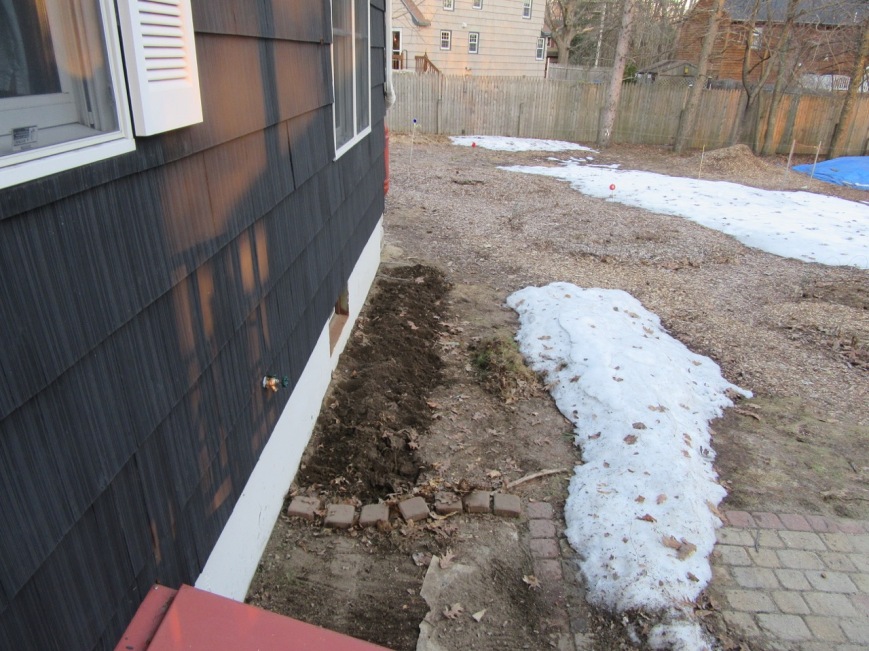
Asparagus BedOur plants from Fedco are being delivered some time today!  And, I still have to dig the beds for the 25 asparagus plants.  I started the other day, by turning over the soil behind the house, and getting rid of any weeds there.  Saturday I dug a trench, and then put some compost in the trench.  It still needs more compost!  I also got rid of a no longer used drainage area filled with small stones and dirt–I moved the stones and dirt to under our water spigot.

Aparagus Bed part 2My understanding is that for asparagus crowns, you make a mound in the middle of the trench, and then position the roots around it, each crown about a foot apart, and cover with a couple inches of soil, gradually filling the trench as the small plants grow, keeping a couple inches of shoot exposed.  This particular bed has room for about 12 of the plants–so today I will try to dig another bed near the garage.

I am feeling a little bit panicked and excited about all the plants to plant:  along with 25 asparagus crowns, there will be an apple tree, a peach tree, two blueberry bushes, three hazelnut bushes, (those garden beds have been ready since last summer).  Also a mulberry tree which we hope to put further back in our yard.  Also a licorice plant, and 3 golden seal plants which will go into pots until frost danger is past.  Our friend said we could put them in her greenhouse for a few weeks.

So, not much time to write, but I wanted to make a log of the garden’s progress. Now out to dig for a while before going to the office.

Moon rhythms

IMG_4590

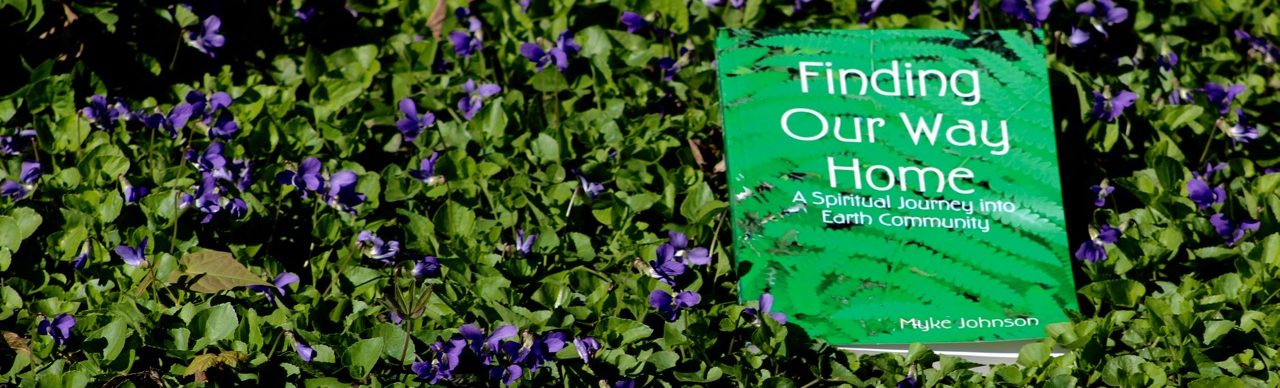
On my walk this morning I saw this lovely waning half moon, and remembered a conversation after our Candlemas ritual.  Most people have no idea how the cycles of the moon work.  We don’t learn about it in school.  Years ago, when I was in my twenties, I was curious about why I saw the moon sometimes in the evening and sometimes in the morning with different degrees of light and shade.  So I investigated. (This was before Google–how did I do that?)  I learned that the moon follows a consistent and lovely rhythm. I talk about it in my book Finding Our Way Home.

The moon is always half in light and half in darkness from the light of the sun. When the moon is full, we are seeing the whole of its light side, because the sun and moon are on opposite sides of our sky. The full moon rises at sunset and stays in the sky all night, setting at sunrise. Then, as the days go by, we see less of the light of the moon and more of its shadow, and it rises about fifty minutes later each day, until there is only a waning crescent in the morning just before and after dawn. About two weeks after the full moon, the moon rises unseen with the sun and sets invisibly with the sun. The night is dark. This is called the dark moon or the new moon. Then a day or two later, a thin waxing crescent appears in the western sky just after sunset and sets soon after. Each day it is seen in the evening for a little longer time until we come round to full moon again.

What is sad and funny to me is when fiction writers misplace the moon–for example most recently, I read a line something like this one: “I saw the waxing gibbous moon in the morning light.”  The thing is, no one will ever see a waxing moon in the morning light.  Waxing moons are only seen in the evening.  Am I a nature snob if I want the moon to be accurately represented in fiction?  The actual realities of the moon’s cycles are beautiful and magical–like a cosmic dance, which it accurately is.  Here is a rather fuzzy photo of a waxing moon, taken about 8 p.m. in April several years ago.

DSC04244

Into the Beauty

We never know when there might be magic and beauty right around the corner–if we only make a choice to look.  My day started a bit upside down and backwards–I woke before 4 a.m. with sinus pain, and never got back to sleep after I started up a vaporizer.  Finally I turned on the light, and slowly started my day in a rather bedraggled and sluggish way.  After a while, it occurred to me to just let go of the upside down feeling, and enter the day afresh.  I offered a prayer to the Mama to help me step into the flow of the River, let the magic guide me.

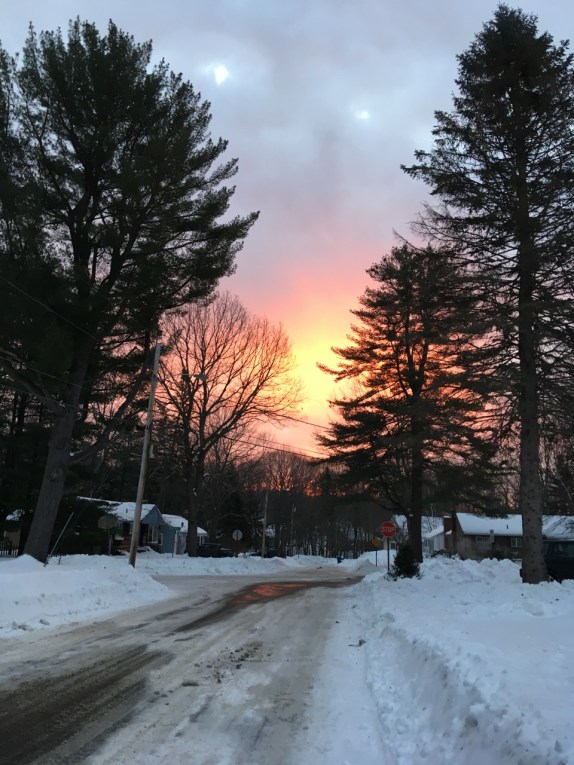
So in that spirit, I put on my coat and boots and went out for a walk about 7 a.m.  I went out the back door and walked around the west side of the house along the driveway to the front.  When I turned to go into the street, toward the east, there was suddenly this beauty of a pink and golden sky before me.  It felt like an affirmation of my prayer.   May you also find magic and beauty right around the corner today!
Sunrise surprise

Healing the Wounds of Turtle Island

Margy and I are packing up this morning to drive north for a special ceremony.  It has been difficult to pull everything together.  This packing, the 2-3 hour drive, finding the strength it requires to travel–all of this is really a part of the ceremony.  We bring our complete selves, with our own wounds and brokenness, our own love for the earth.  We ask that our participation may be a blessing.  Send us your blessings too.  It is quite an amazing gathering and hundreds of people from around the world will be together from July 14-17. Here is the call and description from the event page posted by Sherri Mitchell:

Prophecy of the Eastern Gate

Our ancestors tell us that the Eastern Gate is where we will gather to begin the healing of this land. It is here in the East where first contact was made between the Native peoples and the newcomers. It is here that the first blood was spilled between our people, and our history of violence began. So, it is here on this same land that the healing must begin.

The Wabanaki, the people of the first light, are the keepers of the Eastern Door. We are the first peoples to greet Kihsus, the Sun, each morning, and Nipawset, the Moon, each evening. Now, we open our hearts and our homes to greet all of you, so that together we may begin to heal the wounds of Turtle Island and set a new path forward for all life.

This ceremony will be a coming together of people from all over the world, to acknowledge the common wound that we all carry from our shared history of violence. No matter where we come from, we all carry the wounds of historical trauma within us. Whether we were the victims, the perpetrators, or the witness to that violence, that wound is imprinted on our spirits. Now, the time has come for us to acknowledge that wound, together, so that we can heal it and begin working together to heal Mother Earth.

Structure of Ceremony
The first day will be for healing the wounds carried within the hearts and minds of the people. The second day will be for healing the wounds of Mother Earth. And, the third day will be for healing the energetic and spiritual imprint of that wound that lays over the Earth.

The ceremonies will be conducted by spiritual elders from Indigenous communities around the world, and by spiritual leaders from other traditions. We will be gathering on healing ground, along the Penawahpskek (Penobscot) River, at Nibezun in Passadumkeag, Maine.

People from every corner of the world, and from all walks of life are welcome. We ask that you come with a good heart, and good mind, and carry the intention of healing with you.

The Layers of Community

Before-marked for fruit tree beds

[Before–Growing beds marked with flour and flags]

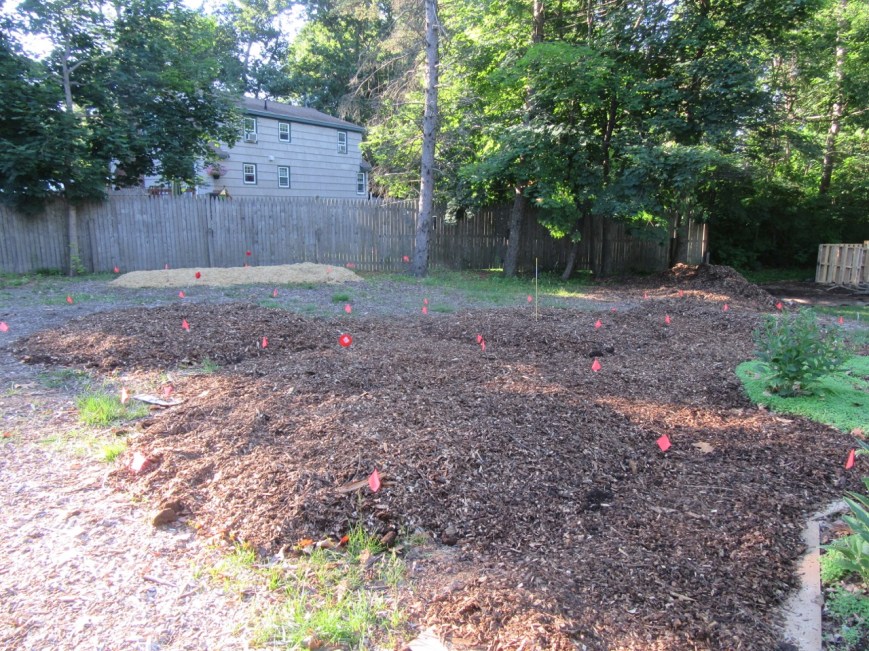
On Saturday, we hosted our Permablitz! (See “more before” photos here.)  Over 20 people came to our yard and worked together on projects such as installing rain barrels, building a composting system from pallets, building a fire circle, and creating five more  growing beds for future fruit trees, raspberry bushes, & hazelnut bushes, and one bed for flowers & herbs.  We also got the first shovelfulls dug for a pond.

Opening Circle-Sylvia, Cathleen, Ali

[Opening Circle]

At the end of the day, I got teary-eyed with the sense of Gift.  The generosity of so many individuals coming together and creating something so beautiful and full, helping us to realize our dreams for this piece of land was deeply moving.  There is something about this giving and receiving of human attention and wisdom and care, that feeds our hearts. Much of our lives are shaped by transactions—we pay a certain amount of money, and receive a product. Or, we put in so many hours and receive a paycheck.  But giving and receiving freely and generously touches something much deeper. Giving and receiving must trigger deep neurotransmitters in our internal chemistry, sparking a profound sense of well-being and belonging.

I also realized how many layers of community are involved in such a project.  One layer is this community of people who care about the earth, and who come together to give and receive, to learn, to share, to grow, to get to know each other.  People connections are made.

Another layer is the community of the soil.  During the blitz I was mostly working with several others on the project for creating new growing beds.  We were adding nutrients through sheet mulching so that the soil could create a thriving fertile community.  I have learned so much about the variations in soil communities from the book The Holistic Orchard by Michael Phillips.

What a food forest needs, what fruit trees need, is soil whose fungal community is stronger than its bacterial community.  In contrast, annual vegetables and flowers and grasses prefer soil with a stronger bacterial community.  A bacterial community is enhanced by tilling the soil and incorporating organic matter by turning it into the soil.  A fungal community is enhanced by no tilling, but rather adding organic matter on the top of the soil to decompose, as it happens in the forest. (Similarly, compost that is left unturned will generate a stronger fungal community.)
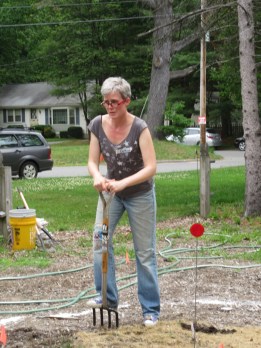
Forking the beds Cathleen

[Cathleen forking the soil]

We prepared the soil by aerating it with garden forks–since it had been rather compacted.  We added some granite dust for mineral enhancement, then put down a layer of cardboard to kill grasses and weeds.
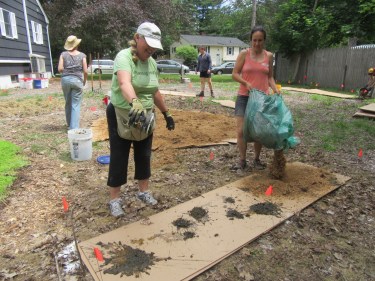
Raspberry Bed-manure & chaff Mihku & Heather

[Mihku & Heather adding manure and chaff]

Then, we added chicken manure, coffee chaff, seaweed, leaves, grass clippings, composted manure, and a really thick layer of deciduous wood chips.  We were able to get a delivery of 8 yards of wonderful ramial deciduous wood chips–these are chips which include lots of thin branches, which have more lignin content that is not yet woody.  The wood chips are the most important part of enhancing the fungal community.

We also made several pathways with cardboard and wood chips, and I will complete those bit by bit in the next days.  Now, the process works on its own–I add some water or it gets rained on–and the microbes will work together over the next several months (and years) to create a thriving soil community.  We will plant trees and bushes next spring.  My friend Roger Paul said that the Wabanaki word for “soil” means giver of life.After-Fruit Tree & Flower/Herb Beds