Asparagus Drama

Asparagus Crown

Asparagus Crowns positioned

I am trying to catch up on my blogging about all the garden excitement last week, but then we had some more drama this week.  On Saturday, I was able to plant the second asparagus bed, along the side of the garage.  (Sylvia and I had planted the first bed last Wednesday and then started digging the trench for this one.)  Saturday, I finished digging the trench–which also involved pulling out lots of big and small rocks.  Then I added compost and a bit of rock phosphate and wood ashes.  I positioned the crowns on little mounds, spreading out their roots in a star shape around the center.
Asparagus Crowns buried

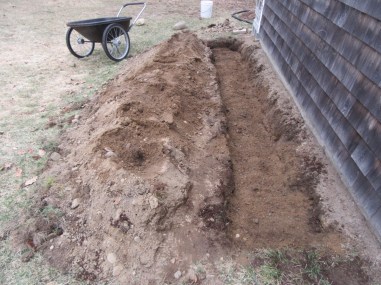
The part I couldn’t photograph was me trying to lean over the big pile of dirt on the side, to actually reach into the trench to position all those crowns.  It was pretty funny.  After that, I covered them with more compost, and then soil.  As the spikes emerge, you are meant to keep covering them so that only a couple inches show, until the soil is even with the ground again.  So this next photo is rather boring, just a trench of dirt really.  But now you know what is hiding underneath.


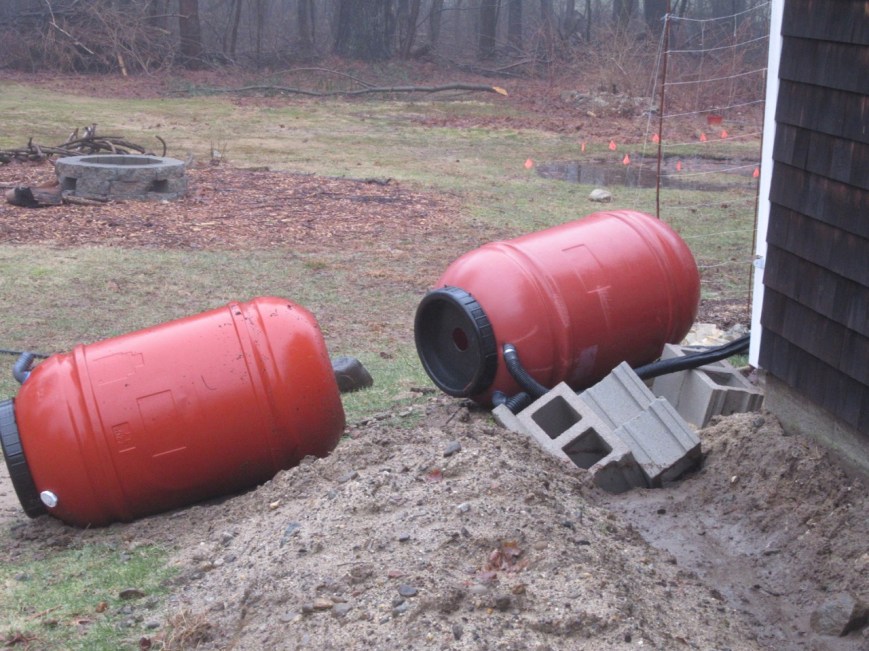
THEN, on Monday night we had torrential rain here in Maine.  Tuesday morning, when I woke up, this next photo was what I saw out my window.  The rain barrels and their foundations had toppled over.  I had extended the trench a couple feet beyond the garage wall, along the side of the rain barrel, thinking that the asparagus would be lovely next to it.  And all might have been well once the trench was filled in again.  But when the rains came pouring down, the soil was weakened, and the barrels were at their heaviest.  The cement block near the edge must have sunk down, destabilizing the balance of the barrels, and the whole set-up collapsed.  The cement blocks fell into the trench.
Rain Barrel calamity

I was able to pull out the blocks, and move the barrels, but will have to wait until the ground dries out a little to set them up again.  I guess I had better fill in that end of the trench before I do it too.  Margy always is reminding me that mistakes are a part of this process–that I am learning as I go along.  Yep–don’t dig a hole next to your rain barrel foundations!

Planting the Orchard

Peach Tree

[Contender Peach]

The new trees are here!  Once the frost was off the morning, I went out and started planting.  I took the eight bare root trees out of the box first and letting their roots soak in fish/seaweed solution, while I started digging in the beds we’d already prepared last June.

I had a fright before I went outside–I thought to take a look at planting suggestions in the Holistic Orchard book, and he suggests putting Rock Phosphate and Wood Ash in the holes–I hadn’t been thinking of that.  But then I found a bag of Rock Phosphate in the garage from last year, and we have a can of wood ashes, so we were all set.  These help the roots to get a good start.

I started with the “Contender” Peach tree, since it seemed to have the biggest roots.  It was a job to get all of them spread out and under the soil.  I feel my age when I am digging and kneeling in the dirt moving things around, and then getting up again.  I was happy to use water from our rain barrels to give it a good soaking.  This is a self-fertile tree, so one will do fine by itself.

Myke & Jersey Blueberry

[Myke & the Blueberry, Photo by Margy Dowzer]

After a short rest, I decided to plant the two blueberry bushes next–because they were little and easy.  We got one “Blueray,” and one “Jersey.”  Then I moved on to the “Honeycrisp” Apple.  The apple needs another tree for fertilization, but we’ve got a lot of wild crabapples around so that should do.

Finally, I planted three Hazelnut bushes. We decided to get an experimental hybrid hazelnut, Corylus Cross.  These shrubs are produced from crosses of three hazelnut species: American hazelnut, Corylus americana; beaked hazelnut, C. cornuta; and European hazelnut, C. avellana.  The nuts from these shrubs will likely be larger than American hazelnuts, because they are crossed with the European variety–(which is the kind that we usually can find in the store–small enough as it is.)

Margy diggingMeanwhile, Margy came out, and we talked again about where to position the “Illinois Everbearing” Mulberry tree.  We decided to get the mulberry because birds love them, and they can draw birds away from the other fruit. Plus the fruit is good for people too.  But we didn’t have a bed ready, and we decided to put this one further back in the yard–partly because it is a standard size and we don’t want it to shade the solar panels. Our other fruit trees are dwarf or semi-dwarf.  Margy took on this project and is still working on it.  After planting 7 trees or bushes, I am taking a break!  We still have the small plants to do, but I can hardly lift my arms.
Asparagus Beds

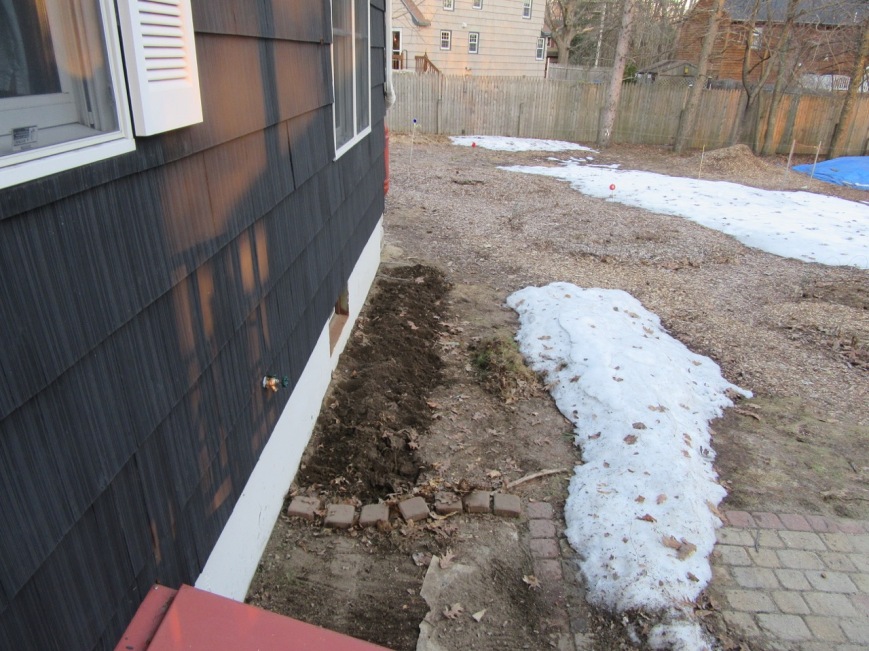
Asparagus BedOur plants from Fedco are being delivered some time today!  And, I still have to dig the beds for the 25 asparagus plants.  I started the other day, by turning over the soil behind the house, and getting rid of any weeds there.  Saturday I dug a trench, and then put some compost in the trench.  It still needs more compost!  I also got rid of a no longer used drainage area filled with small stones and dirt–I moved the stones and dirt to under our water spigot.

Aparagus Bed part 2My understanding is that for asparagus crowns, you make a mound in the middle of the trench, and then position the roots around it, each crown about a foot apart, and cover with a couple inches of soil, gradually filling the trench as the small plants grow, keeping a couple inches of shoot exposed.  This particular bed has room for about 12 of the plants–so today I will try to dig another bed near the garage.

I am feeling a little bit panicked and excited about all the plants to plant:  along with 25 asparagus crowns, there will be an apple tree, a peach tree, two blueberry bushes, three hazelnut bushes, (those garden beds have been ready since last summer).  Also a mulberry tree which we hope to put further back in our yard.  Also a licorice plant, and 3 golden seal plants which will go into pots until frost danger is past.  Our friend said we could put them in her greenhouse for a few weeks.

So, not much time to write, but I wanted to make a log of the garden’s progress. Now out to dig for a while before going to the office.

Planting Peas

Planting peas

Friday, March 30, on the day before the full moon, I planted 32 sugar snap peas in the garden bed that I created last fall.  It seems early, but the ground was workable, and I set up the string trellis for them to climb, and re-attached the rain barrels near the back of the garage to make it easy to water them.  (And today it is raining!)  We’ll see how they do.  I will plant more a couple weeks later so that we get peas ripening in stages.  And we’ll add lettuce and carrots and spinach which like to grow with peas, and maybe other things too.  Last year I focused on perennials, but this will be an annual bed.

We noticed last spring that this area was free of snow before other parts of the yard, and got some good sun.  In permaculture, observation always comes first!  So we put this spot into our plan for a veggie bed.  Then, as I was starting to dig out the pond late last summer, I needed to put that top soil somewhere.  So I laid down cardboard over the grass in this spot, and then added layers of soil with compost and grass clippings and other amendments to create a raised bed.  There is still a long ways to go before the pond will be done–who knows how many more raised beds it will inspire?

By the way, that long black hose you can see in the photo is an overflow from the rain barrels, and eventually will be attached to another length of hose to be the water source for our pond.


Synchronicity

Today I woke late, so I started my walk late–and just as I was coming out onto our street, I said hello to a woman who was walking with her big black dog.  Turns out, she grew up in our house–her family built it. Her dad, who passed away earlier this year, had a huge garden in the back yard. He used a rototiller, and brought in manure and loam, and involved all the neighbor children in planting vegetables.  He’d give them a stick and point to its length and say plant the seeds this far apart.

He planted a peach tree–which did very well, (sadly no longer here) and lots of raspberries and blackberries–which are still coming up behind the garage on the land just next to ours which had belonged to them.  (It still belongs to her mother who lives in a house we can see from our yard–which we already knew.)  Her dad would do the planting and her mother liked to weed.

The big spruce tree next door would be lit up like a Christmas tree every year, to the delight of all the kids.  The man who lived there was in the fire department, so when the tree got tall, he would put on the lights with a fire truck ladder.  (Sadly, that spruce, along with the others in our yard are no longer doing very well.)  At that time, all the families in the neighborhood knew each other, and the kids played together all the time.  She also spoke about the delight of wandering into the big woods behind the house.

She was thrilled about our solar panels and our rain barrels, and hoped she might do that where she now lives on an island.  She is staying with her mother a few nights a week while she takes a class in town. I invited her to come back sometime when the snow had cleared and we were able to be out in the yard.

It delights me to know that there were gardens in this place fifty years ago, and people who were tending to it with care. It delights me that a small unexpected change in my routine led to an unexpected encounter.  Meanwhile, the snow is melting, and the ground will soon be workable–maybe peas this weekend?

back yard

The Back Yard


Spring Arrives in Maine

Spring Arrives in MaineToday is the first day of spring everywhere in the Northern Hemisphere.  What it looks like in my neighborhood is huge piles of snow and a really cold morning, but with a bright sun leading us into a clear day.

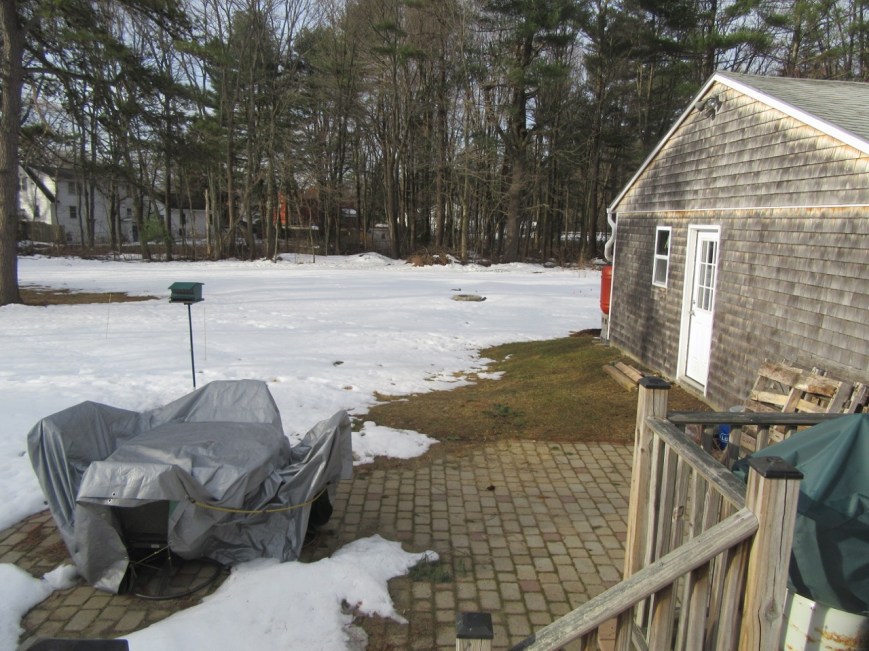
Margy and I hosted an Equinox ritual at our house last night.  It was a small group of five this time, and most of us were weary from the winter, so our ritual was simple and low key.  We named the friends who had joined us for Solstice and Imbolc, and sent blessings to all of them.  (You know who you are!)  We shared thoughts and readings about our lives and about winter and spring.  We talked about what we wanted to let go from the winter season, and what intentions we wanted to carry into this new season.

I thought about the next several weeks until Mayday.  The snow will disappear, and the ground thaw, and begin to fill with green.  Our plants will arrive from Fedco:  an apple tree, a peach tree, two blueberry bushes, three hazelnut bushes, a mulberry tree, a licorice plant, 25 asparagus plants, and 3 golden seal plants.  By Mayday, I hope they will be in the ground.  Our friends volunteered to help with the planting.

I remember when we first imagined this new home, when we began to lay out our intentions to find greener housing in the summer of 2015.  Our intentions included creating a permaculture garden, and having space in our living room for people to gather.  And here we are!  Living those dreams into reality.  The magic of deeply felt intentions can be surprisingly powerful.

Portland Gardens

About a hundred years ago, in 1912, Jacob Wilbur decided to “develop” the large area of  land in which the old white pine tree lived and is living.  He purchased it from H.H. Holm. He called it “Portland Gardens,” but the first thing that happened was that he had a plan created in which the open land was divided into very small rectangles.  Over the years, some roads were created and houses built, but the area in the upper left corner of the plan–where our old pine lives–was never completed.

Plot plan Portland Gardens

In 1924 that area was sold to Amato Kataruchi, and then a couple years later the City of Portland took possession of it for taxes unpaid.  In 1969 the city sold it cheaply to the D—– family that had bought our house when it was first built in 1967. (Our house is actually in an adjacent development that was called Sunset Heights–it was “developed” by a firm called Jordan and Hammond in 1967.)

I learned all of this by searching online land records and deeds via the Cumberland County Registry of Deeds.  After thinking about the pine tree’s possible 162 year life, I was inspired to see what I could learn about the history of the land to which we now belong.  I didn’t realize how easy it was for anyone to trace one aspect of the history of their land through deeds, its so-called “ownership.” And, I didn’t realize the challenges either.  The boundaries of our yard were formed in 1969 through the combination of two lots–front (where the house is) and back–which in our deed is actually described as four small lots, and a corner of another.

So I could trace the “owners” of our yard from us back to the D—– family, with three families/individuals in between.  But prior to 1967, I had to start searching separately the front and back sections–the back section leading me to the Portland Gardens development plan in 1912.  Then the search got even more complicated because tracking how the developers acquired the land meant investigating multiple sellers, and entirely different descriptions of the land.  Still working on that.

All of this feels important to me as part of understanding our relationship to this land, and as part of a decolonization process–moving beyond the norms of our society which treats land as a possession, rather than as the place to which we might belong. And understanding the many ways that colonizers sought to acquire land–through purchase, through theft, through trickery, and through misinterpreting the early agreements made with indigenous peoples–they treated the offer to settle here in right relationship with the indigenous people as instead granting ownership of the land for whatever use they might want to make of it.

There are so many land records in the registry of deeds.  So many pieces of paper dividing the land into large and small pieces. There are whole professions built up around establishing who owns or owned what pieces of land.  Title insurance, title search companies, and all the rest.  I want to understand the history, but it is wearying to track such an ultimately destructive operation.  My ancestors were not part of this process here in Maine, but perhaps by learning more about this land right here, I can better understand the process as it happened over the whole continent.  It is a long story of the ways those of us who have European descent broke our relationship to the land and to her peoples.

Changes

IMG_4095

This coming summer, I plan to retire from my ministry at the Allen Avenue Unitarian Universalist Church.  I have loved being a minister and have loved serving this congregation for 12 1/2 years.  I think the congregation would also say that it has been a good match.  But last summer, I began to think I might need a change.  I have been dealing with auto-immune health issues for some time, and just don’t have the energy I used to have. I will be turning 65 this coming summer, and that means I will be eligible for Medicare–which in turn makes it possible to consider this change.

Unlike when Margy and I were searching for greener housing, and had such a clear sense of intention guiding our efforts, this change is more mysterious.  It comes from a deep place of weariness in my body, and a deep hunger for spaciousness in my spirit.  I am not sure exactly what the future will hold.  One thing I do know is that I need to tend the garden in our yard.

We’ve already ordered a bunch of trees and other perennials that will arrive in the spring:  one “Honeycrisp” apple tree, one “Contender” peach tree, an “Illinois Everbearing” mulberry tree (that one is mostly for the birds), three hazelnut bushes, two blueberry bushes–Blue Ray & Jersey varieties, a licorice plant, twenty-five Asparagus plants, and three goldenseal plants.

My spirit feels like the ground hidden under the snow, or the berries encased in ice.  I am trying to find quiet and solitude to listen to what it wants to tell me, to find out, as David Whyte says,

What shape waits in the seed of you to grow and spread its branches against a future sky?”


The Visitor

Woodchuck hiding under woodpile

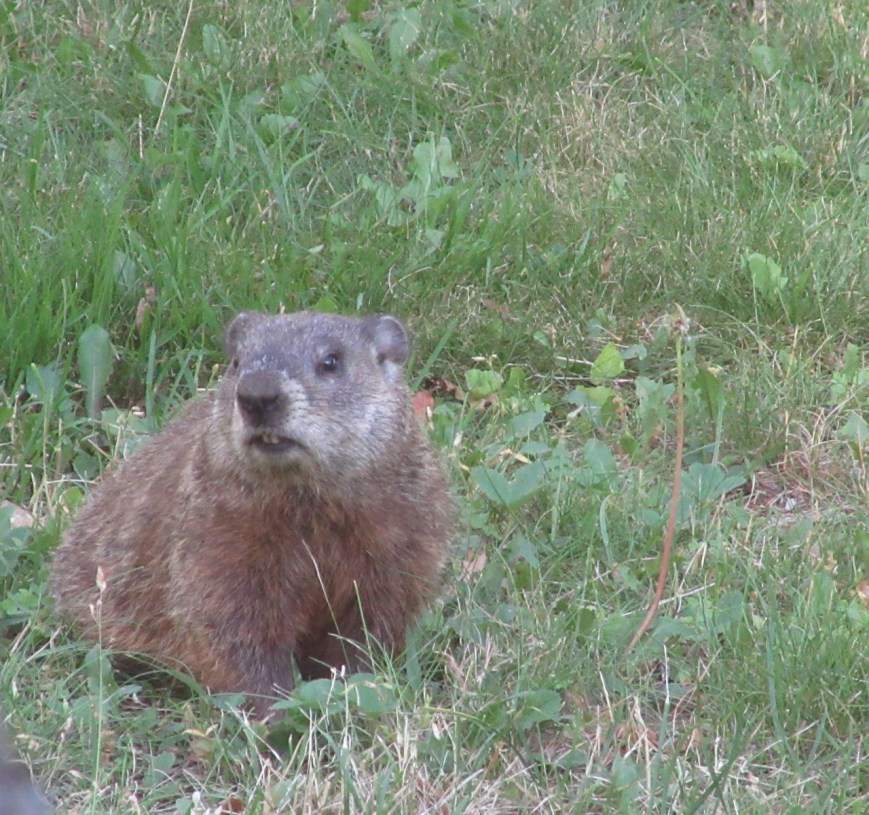
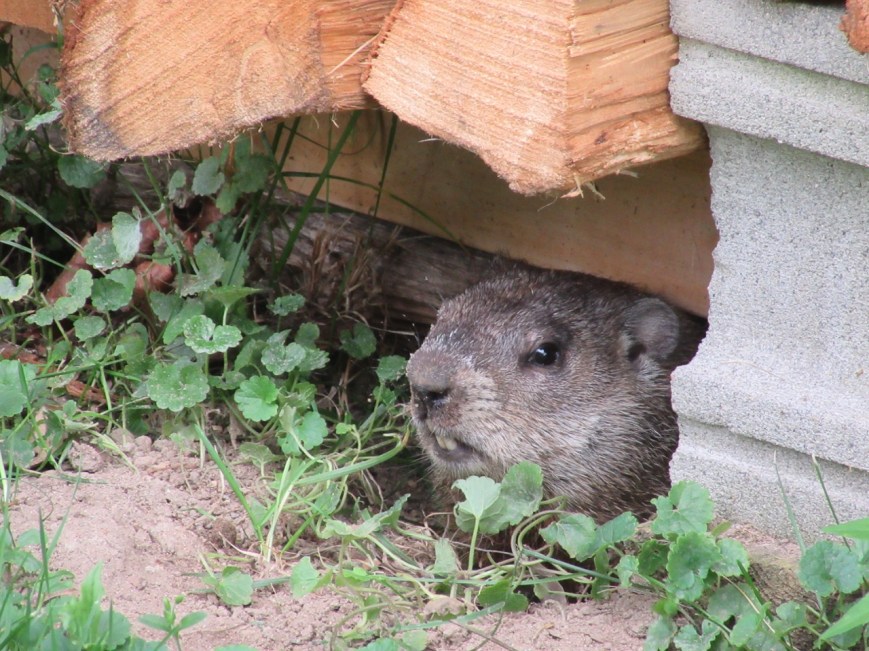
Our neighbor mentioned this little woodchuck (aka groundhog) had eaten her flowers when she planted them, and now she or he has been visiting our yard.  When we saw him the other day through the side window, he was eating something in the grass between our two houses.  I went outside to take a photo and he lumbered over to hide below the neighbors woodpile.  So cute.  But the next morning, some of my kale plants had been eaten. Coincidence? I don’t think so.

Ever since we’ve been planting trees and making new garden beds, we’ve had many more birds and other critters come into the yard.  So mostly that is a wonderful thing.  But we are hoping to grow food!  So I will be searching the internet for natural ways to repel them.  Have any good ideas?

Woodchuck


Permablitz!

We just found out that we were chosen to be a Permablitz site this season, on June 24!  Permablitzes are organized by the Resilience Hub in Portland, and as described on their website:

Permablitzes are essentially the mother of all work parties, permaculture-style.  With permablitz events we tap into our own local “barn raising” ethos to help each other install edible landscapes, renewable energy, water collection systems and more all in one day.

Our hopes are to install several rain barrels, create a frog pond and a fire circle, maybe help with our bittersweet control, and do more soil enhancements and aeration.  We think of these as structural components of our garden, and it is also suggested by permaculture experts to do any earth shaping projects near the start of your work–the frog pond is in that category.   Also, depending on where we are in our planting process, we might get help with sheet mulching and plantings for our cherry tree guilds, and Sylvia’s herb garden.  Our friend Sylvia, who helped us plant our cherry trees, has studied herbal healing.  She doesn’t have land where she lives, so we invited her to create an herb garden here at our home.  We are so excited about this collaboration!

I have been to several Permablitz work parties over the last few years, and while there is a great benefit to hosting a Permablitz, there is also a lot of benefit to participating as a worker. Along with the joy of helping someone’s garden grow, I have learned a little more each time about the principles of permaculture, about strategies for water collection, about soil health, about growing gardens in general, about ideas for edible landscapes that I might never have heard about.  It is also a lovely way to meet folks who care about the earth, and our relationship to it.  So if you will be in Portland on June 24th, you are invited to come to our  Permablitz.  When the event is posted with all the details, I’ll share it.

Permaculture Design, Phase OneThis is a section of our evolving Permaculture Design for our yard.  (It didn’t really work to try to put the whole design into one photo, so this is of the half of the yard nearest the house.) I had started this design by measuring everything in our yard and putting them on grid paper–the grids equate to 3 feet square.  Then we had lots more input with our Intro to Permaculture Design class, and a conversation afterward with the leaders, Heather and Julie.

Last weekend, I went back to the original, and filled in some trees that were already on our land, and then began adding the design elements that are among our first steps in the plan.  I added color!  I haven’t drawn in all of our future ideas.  We are growing our garden slowly, so that we can learn what we need to learn as we go, and not take on more than we can handle right now.  (I am thinking of taking this design and making copies on which to draw our speculations for future ideas.)  I also haven’t yet drawn in Sylvia’ herb garden, which will be near the ornamental cherries, but she hasn’t determined the configuration yet.

I love the design part of the process, and while I sit in the back yard, I am always getting new ideas about where future plants might go.  Blueberries, hazelnuts, apple trees… and then I step back and breathe, and let myself go slow, and enjoy.  Because every step of this process has been such a joy!