All Hallow’s Eve/Samhain

Fresh cedar sprigs under a pair of cardinals welcome sign on our white front door.

Today we welcome the ancestors with special foods, with herbal incense, and with a fire in our fire circle! For herbal incense I use cedar–I’ll use a dried bundle I made before, and burn it in our fire circle. Cedar was widely used by my Innu ancestors, and so I think their spirits will especially appreciate it. We also have a cedar tree right on the edge of our own yard, so I ask the cedar tree for permission to cut some sprigs to make more cedar bundles, and also to put cedar on our front and back doors for protection from harm, and welcome to benevolent spirits.

The special food I made is bannock, a traditional Innu bread, called ińnu-pakueshikan, which they adapted from the Scottish. Since I can’t eat wheat bread, I used 1/2 oatmeal flour (which is actually what the Scottish used) and 1/2 almond flour. Here is my recipe, adapted from several I found online. It is a very simple bread with many variations. Mix all ingredients together.

  • 1 1/2 cup oat flour (made in a blender from GF rolled oats)
  • 1 1/2 cup almond flour
  • 1 Tablespoon baking powder
  • 1/2 tablespoon salt
  • 1 1/3 cup water (this might have been more than I needed)
  • 1 cup frozen blueberries.

I put it in a greased skillet, and let it bake in a 375 degree oven for 55 minutes. After about 40 minutes, I cut it in four, and turned the sections over in the pan. A small dish is all set to go outside for the spirits, for when we have our fire. It is crusty on the outside, and a bit mushy on the inside. Tasty with butter.

Blueberry bannock in cast iron pan, cut.

I have been continuing my search for my Innu ancestor Marie Madeleine’s family. Lately this has been by hunting for as many details as I can about Marie Madeleine Katshisheskueit, which means “hard-working-woman”, who was born 11/11/1795, and baptised in Portneuf 6/28/1796. I was finally able to see an actual image of her baptism record, and discovered her actual parents, Jean-Pierre Utshinitsiu (Utshinishkushu=whirlpool?) and Veronique Kaskanieshtshist. (Kashkanatshish=rock ptarmigan) (The earlier source had directed me to another set of parents entirely.) So I began hunting for the rest of their family and found a few more generations, and many cousins.

This was a relief to me because I also discovered that Marie Madeleine Katshisheskueit’s mother died in 1797, when she was only two years old. I was filled with grief for this toddler, and wondered how she would be able to survive such a loss. Then I remembered that my Passamaquoddy teacher Roger Paul said that the whole community always cared for all the children. They didn’t divide into small nuclear families, but rather in extended families. I saw that her godmother, Marie Madeleine Iskuamiskuskueu, was the cousin of her father (and also the mother of another Marie Madeleine that is not my ancestor). So she was likely taken care of and loved by all these relatives.

I haven’t been able to find other records of her life after 1800, so far, which means there is nothing to rule her out. It might mean that she disappeared somewhere, or it might possibly mean that she is my own ancestor, showing up in 1830 without any surname or Innu name that would clarify her identity to me. The hunt continues, only now I am looking at her family members, to get a picture of their relatedness.

Finally, another update: I had been wondering what to do about the frogs in the pond, as winter approaches. Well, it turns out they are doing it for themselves. The last time we saw frogs in the pond was a week ago, and just two small ones remaining. We don’t know where they went, but they must know how to take care of themselves, perhaps find some mud to bury in, or someplace protected for the winter. Our pond is probably too shallow, with too little mud for that purpose, I assume. So the pond is getting colder, and the frogs are gone. Hopefully, we’ll see them again in the spring.

May the blessings of this season be with you, may your ancestors bring you blessings when you open your heart to them, and may we survive the coming cold with grace and peace! Blessed Samhain! Now I’m going outside to the fire circle.

Two small frogs on a rock near iris stalks, with fallen leaves in the water.

Magic Happens!

Yesterday, I wrote, concerning my search for my matrilineal ancestor Marie-Madeleine:

“Why do I write about it here? I’m putting some magic out into the universe, hoping that some kind of thunder might open the cloudy skies between me and the past, between me and the place my ancestors are from. … It has been my experience that when I reach out to my ancestors, they reach back—more so when I have actually traveled to Quebec, but since that is not possible, I hope they will reach across the border.”

And then some magic did happen!

After being stuck not finding people on the GénéalogieQuebec website, I meandered around some more, and some records of the Postes du Roi index of people, not related to my ancestors, linked to images from the actual Postes du Roi records. If I went to those images, I could move back and forth from page to page in the images of actual records. And by doing that, I found the baptism records of six of the Marie Madeleines or Madeleines, from the list I had, from 1800 to 1805, even though they were not “indexed.” Also, I was able to download all the images as I accessed them, to be able to look back as I needed. So now I am able to keep researching, a way opened up.

Some magic happened!

Sometimes it is easy to forget—in my intellectual research mode, in our rather secular world—that magic is alive, that ancestors reach out to us. Even though I have experienced it in the past, and believe in its power. So easy to forget.

And the intellectual research is part of the magic, not separate from it. It is a lot of work to attempt to decipher 200-year-old writing in funny penmanship, in French. But I am so thankful to be able to attempt it. And to learn as much as I can about the lives of all of these women. I also learned that for some of them, the Innu name is that of their father—at some point (1803?), the Innu names switched from being a descriptive personal name to function more like a surname. (Those are in parentheses)

Marie Madeleine Katshisheiskueit, b. 1795 in the woods, baptized 1796 Portneuf

Marie Madeleine (Napeteiashu), b. 1796, baptized in 1803 Îlets-Jérémie

Madeleine Peshmekueu, b. 1799 Sept-Iles, baptized 1800 Sept-Iles

Madeleine Pishikuskueue, b. 1801 Pointe-des-Monts, baptized Godbout

Marie Madeleine (Utsinitsiu), b. 1801, baptized 1805 Chicoutimi

Madeleine Moistashinagusiu, b. 1802 Rivière Godbout, baptized Godbout

Marie Madeleine (Arishinapeu), b. 1805, baptized Tadoussac

Magic happens! May I keep being open to the magic, and may you feel it opening where you need it too.

Close up of hazelnut leaves in full color.

Thunder Magic

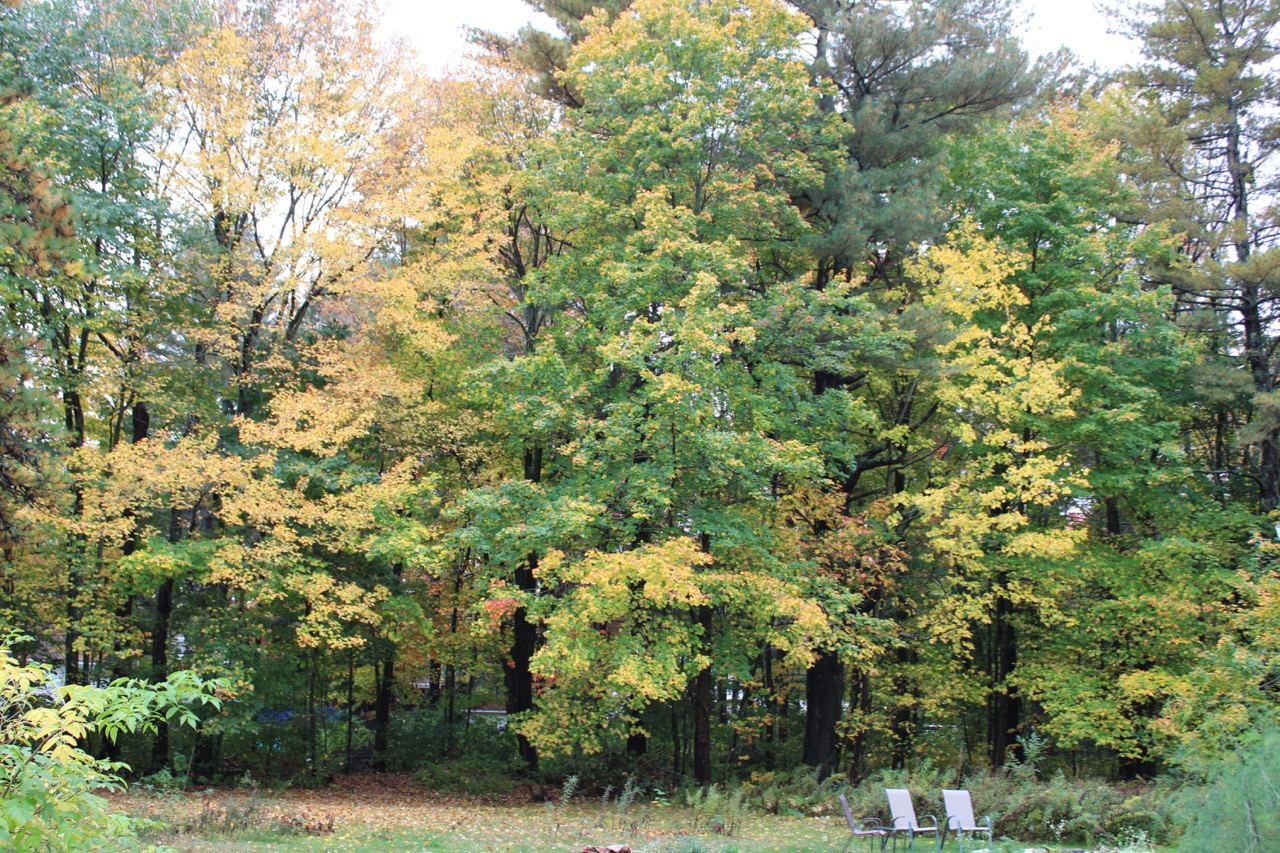
Trees at the back of our yard in fall colors

I woke to a crash of thunder about 7 a.m. this morning, with a driving rain pounding against the wall and window near the head of my bed. What a beautiful sound to start the day! The rain only lasted about an hour, and then the skies were gray, but the air was lit by leaves of gold and orange encircling our back yard. We’ve had no frost yet, and the October transformations are unfolding with beauty and grace.  

I’ve been surprised by how low in the sky the sun travels at this time of year—even at noon it is lurking behind the tree canopy shading the back half of the yard. You’d think after all these years I would be used to it by now. I’ve also been surprised by new raspberries ripening fat and delicious. Usually our “everbearing” raspberries don’t ripen in the fall—there is not enough sun and warmth in their spot to bring them to completion—but perhaps taking out the (invasive) Norway maples near the fence helped them to get more morning light. They taste better than any of the summer raspberries.

October is also a month for ancestors, leading up to Samhain on the 31st. I have continued to search for more information about Marie-Madeleine, my Innu great-great-great grandmother. I’ve been lucky that I emailed two people who seemed to have some resources, and they both replied and sent information. Magic! One told me that, from looking at his records, Marie Madeleine Manitukueu could not be my ancestor, because she married someone else in 1815, and then that person remarried in 1825 after her death. So that was incredibly helpful. Most of the work will be eliminating the women who cannot be my ancestor.

Then he also sent me a list of 17 “Marie Madeleines” or “Madeleines” recorded births from 1790 to 1818 at the Postes du Roi, from the databases he had access to, and agreed with me that it seemed most likely that she would be born closer to 1800, rather than 1789, since her last child (Marie Sylvie) was born in 1846. (The 1789 date is based on her death record stating that she was about 60 years of age at her death in 1849.)

I believe that going by child-bearing years is the best guide. A late baby in her 40s is more possible than in her 50s. The child before the one in 1846 was born several years earlier in 1839 (Sophie)—so it seems also more likely that 1846 was a late baby. Her prior children were about 3 years apart. Her first documented child was born around 1828, but it is possible that she was the mother of earlier-born children of her spouse Peter McLeod.  (Most sources say that he had an earlier Montagnais woman spouse, but there is less agreement about which children had which mother.) To go by a childbearing age of about 16 to 50, it seems like her own birth would be between 1796 and 1812.

This leaves 11 women on the chart—stretching slightly to include Marie Madeleine Katshisheiskuet (born 11/11/1795). So, the next thing I did was explore GénéalogieQuebec.com, to see if I could do research on each of the women. But I ran into a problem immediately. The records of the Postes du roi included on that site seem to be missing many of these vital years, not yet indexed, and none were available in direct images. I could not seem to find access to the databases to which my email correspondent had access. To complicate things a bit more, the parents listed for Marie Madeleine Katshisheiskuet in GénéologieQuebec are different from my earlier resource, and I think the only way to clear that up would be to look at an original record.

So, I feel stuck again—there is such a distance between Quebec and the United States—so much knowledge does not cross the border. I would like nothing better than to pore over these old records looking for the lives of these 11 women, seeing if I could find other marriage and death records that would steer me away from some, and toward my own ancestors. I don’t know why I think I can succeed where prior genealogists have not found a link. But maybe they didn’t have the same motivation. I’ve sent an email to the GénéologieQuebec site asking about the Postes du roi records. I also think I found some at the Catholic Archdiocese of Quebec, but not published or indexed.

It’s like the detective stories I’ve been reading—so many mysteries, so many clues. Why do I write about it here? I’m putting some magic out into the universe, hoping that some kind of thunder might open the cloudy skies between me and the past, between me and the place my ancestors are from. I’ve learned a lot in the process. It has been my experience that when I reach out to my ancestors, they reach back—more so when I have actually traveled to Quebec, but since that is not possible, I hope they will reach across the border.

Ancestor Yearnings

My great grandmother Claudia Tremblay

Today, September 29, is my great grandmother Claudia’s birthday–she was born in 1865. I never got to meet her, but I was named for her (my middle name) and so I have felt a connection to her for quite a while. This week I was once again caught in the throes of this strange yearning obsession to try to understand the lives of my matrilineal forbears. I happened to be looking at a document about Claudia that I compiled a few years ago, and it mentioned a resource–the “General Catalogue of the Entire Montagnais Nation.” [Except the title was in Latin and the book was in French. Denis Brassard, Catalogus generalis totius Montanensium Gentis of Father Jean-Joseph Roy, 1785-1795 ]

It was a record of baptisms and other religious rites at the King’s Posts (Postes du Roi) in the Saguenay River area and North Shore of the St. Lawrence River of Quebec, in the 18th century. The Postes du Roi were the site of trading between the Innu/Montagnais and the French/British. They were also the site of missionary priests coming round to offer religious instruction and ceremonies to the Innu people. (The French called the Indigenous people of this region Montagnais, but since then, the people have reclaimed their own word, Innu.)

Claudia’s mother was Angele McLeod, and her mother was Marie-Madeleine, who was identified as “Montagnaise” in any records I had been able to find. But I had been unable to go any further back in her family, and only had estimates of her birth to be about 1789, perhaps linked to a Post du Roi. So I went looking for that book, which was available in a digital format for not so much expense. And it had a built-in translation function, which helped a lot since my French is shaky. The first half of the book was a description of how things were at the Postes du Roi. The Innu generally spent fall/winter/spring in the inland forests, hunting and gathering, and then came to the shores of the Saguenay or St. Lawrence in the summer, to fish and gather with each other. The Posts were built at these established summer gathering places to foster the fur trade, and the conversion of Innu people to Catholicism by the priests.

By searching record by record through the hundreds in the chart, I was able to find two Marie-Madeleines (Maria Magdalena) whose births were within 10 years of 1789: 1795, 1797. The Innu people did not use surnames, but rather single descriptive names, so each record included a Christian name (in Latin) and a personal name for the child in the Innu language. I found Marie Madeleine Katshisheiskueit (record #1065), and Marie Madeleine Manitukueu (record #1079). I don’t know that I will ever be able to establish a definite link between one of them and my Marie Madeleine, but one of them could be related to me. My Marie Madeleine eventually was married to Peter McLeod who worked for the King’s Posts in many places. And she was identified as Catholic, so it would be likely for her to be in these records.

Finding these names is touching a deep place in my spirit. I can’t even describe it. And deeper still, was searching out the meanings of the Innu names in the language. I was able to determine that Katshisheiskueit likely means “Hard-working/female” and her parents’ names were Antonius/ Tshinusheu which means “Northern Pike”, and Anna/ Kukuminau, which means “old woman” or “wife.” (Now the parents were only about 16 then, so likely it was an endearment, or Tshinusheu just said–“that’s my wife.”)

Manitukueu has something to do with Spirit–Manitu is the Innu word for Spirit. But I couldn’t find an exact reference. Manitushiu means someone who uses spiritual or mental power. “kueu” seems to be a common verb ending signifying something being or having. It is like detective work–and I wouldn’t be able to do any of it if I hadn’t been studying Passamaquoddy, which is related to the Innu language. Words are formed polysynthetically, with smaller parts joined together to create long descriptive concepts in one word. So I search the online Innu dictionary, with my framework of Passamaquoddy, and try to recreate what they might mean.

Manitukueu’s parent’s names were also challenging. Her father was Simeon Tshinapesuan, and the closest word I could find was something meaning “slips on a rock”, or “slippery.” Her mother was Marie Madeleine Tshuamiskuskueu, part of which meant “finding it by detecting it with body or feet.” But then I lucked out because her own birth record called it Iskamiskuskueu–which means “from Jeremy Islets,” and she was from Jeremy Islets. According to another source, this Innu name of that place meant “where you can see polar bears.” (Where you can find polar bears?) I guess I was rather far off.

So, it’s hard to trace “family trees” without surnames, but each child was listed with their parents, and by going through again searching for the parents’ names, I could find their parents too. And in fact, there were a few generations in each of their families to be found in the charts, with a lot of holding a magnifying glass over my computer screen so I could read the small letters in the charts. Much more still to do.

It is a whole world uncovered to me. And whether or not one of these women is my actual relation, this is the world she lived in, the world she came out from to enter a path that eventually would lead her daughters and granddaughters into other worlds. I never imagined that I might learn the Innu name of my great, great, great grandmother… and now there are all these names dancing in my mind, trying to form in my mouth, bringing much depth to my heart. I feel such gratitude and curiosity.

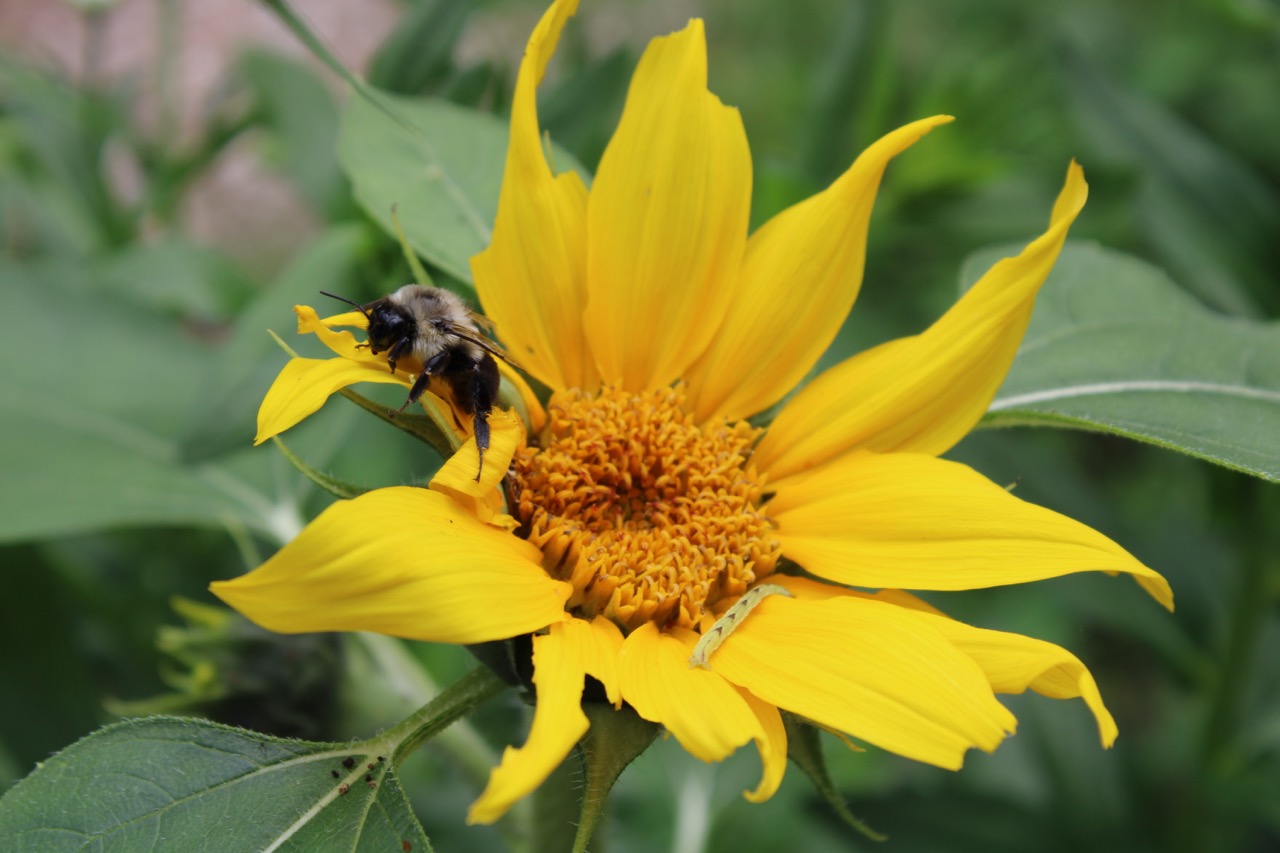
Yellow sunflower planted by squirrels, with a bee inside.

Beauty and Trauma

Juvenile female cardinal near Joe Pye Weed and flea-bane

I have been at a loss for words these past few weeks. But sitting quietly in the back yard–often next to the frog pond–has enabled me to see some beautiful birds. I’ll start with this cardinal, cardinals being for a long time my favorite bird. I saw this rather scraggly (like all juveniles) female while I was lying in the hammock reading. I love their little chirps.

I saw the cardinal just as I started reading a new book, Carnival Lights, by Chris Stark. It has taken me several weeks to finish because it was so painful. I had to stop and start, stop and start. This novel should have all the trigger warnings. It brings to life the theme of missing and murdered Indigenous women, and it also weaves the past into the near present (1969) with the long history of land theft, murder, and oppression. I grew to love cousins Sher and Kris, two teenage Ojibwe girls, running away in Minnesota. But I am not even sure to whom I might recommend the book? I felt like I was plunged into vicarious trauma as a reader, and I wouldn’t want to re-trigger that kind of trauma for my Native friends, one of whom already mentioned that, yeah, she’d never be able to read it.

Yet there were also threads of beauty and resilience interwoven into the tapestry of the story that fed my spirit too. Such powerful gorgeous writing, such depth of expression, such love. It is a brilliant book. I first found it because it was recommended by a Native author I love–Mona Susan Power. So perhaps for some Native women, the trauma is well known and understood, and the beauty and love in this story is a healing balm.

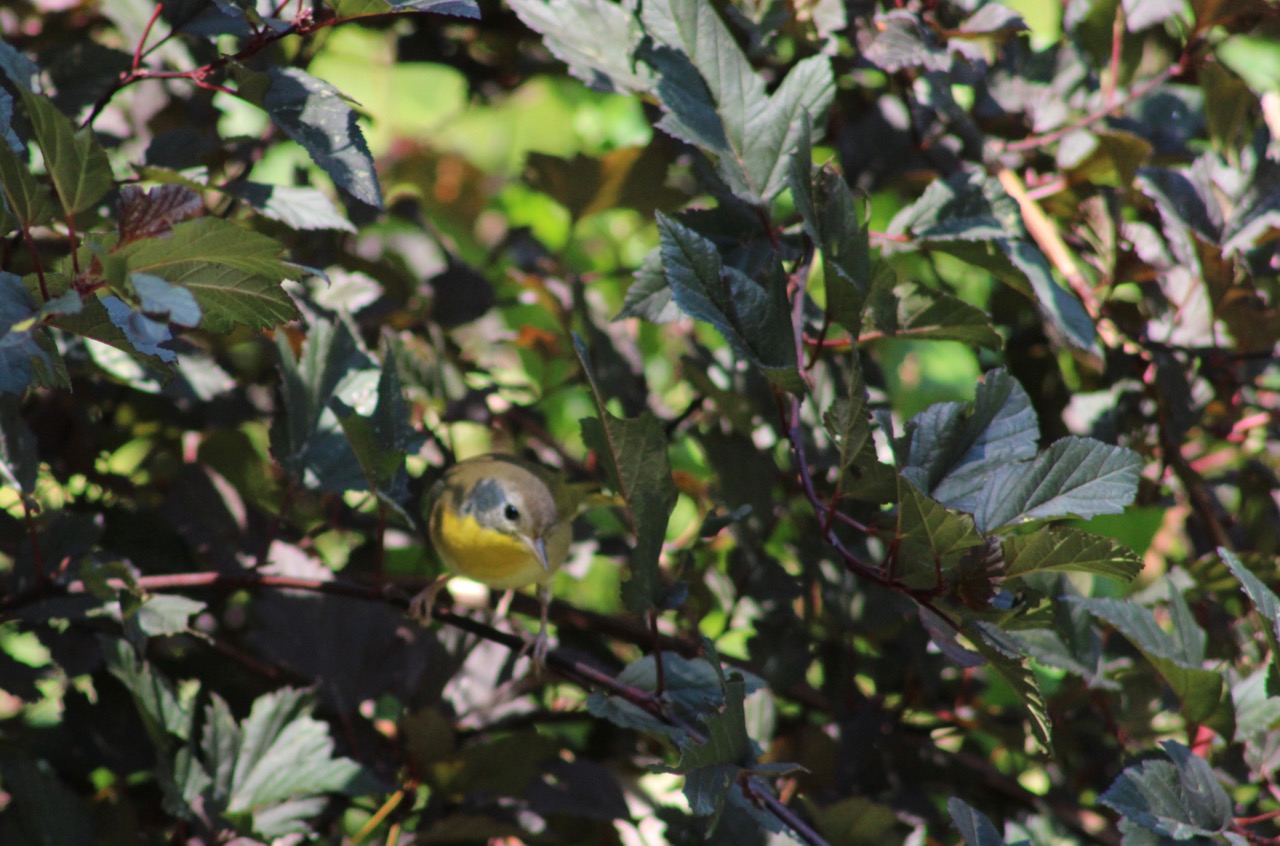
For me, in between reading, I had to go to my own backyard to find the grounding and fortitude to be able to continue. I was sitting near the pond watching the frogs when two yellow warblers (I think that’s who they are) started flitting about in the bushes, trying to attract my attention–perhaps away from something else? It seems too late for there to be a nest, but who knows? It must be almost time for their migration south. They were definitely letting me see them, and then flying to another bush close by. I saw them on two or three separate days, and caught these photos.

I think this is a yellow warbler in the nine-bark bush near the pond.
I think this is a yellow warbler female, seen on a different day in the same nine-bark bush, with a summer sweet bush in the background.

What do we do with the obscene brutality and violence that our whole society is built upon? What do we do with the exquisite beauty of a bird on a summer day?

A hummingbird hovering while drinking at the feeder

Pond Frog Sitting

Photo: Tiny frog sitting on a large stone at the edge of the pond

Today the frog in the pond let me take its picture! I came outside this morning and just sat for a while at the edge of the pond, writing in my journal and being quiet under a cloudy sky. It felt a little bit peculiar to be done with the work of building the pond. To let go of the strange obsession for finding stones that has filled the last several weeks. I have been working on the pond since April! I didn’t see the frog at first. I was glancing around at the yard, and all the ways that Margy and I get overwhelmed trying to care for the land. We are old, we are disabled, we are ignorant of the many needs of plants, just beginners. It is hard to be good stewards of the land. There is always more to do than we can do. So I make a decision to let go: let go of the burden of it, let go of the overwhelm, let go of trying to do more than we can. Here I am, it’s a new day: be amazed at life!

At some point, I decided to walk around the edge of the pond to look at how the plants are doing. And then I suddenly saw the frog, sitting quietly. No plops into the water, no jumping away. Just sitting quietly, paying no mind to me while I was also sitting quietly, and now walking quietly. (Perhaps it has figured out that we people who come to this pond are no threat–we can share the pond?) It was on a big stone at the bottom of the beach, with its eyes out of the water and its very tiny body in the water. Its head maybe a half inch long, its body another inch, long folded legs. It let me take its picture many times. When I walked back to my chair, this is how it looked from over there, almost invisible, but now visible to me:

Photo: Can you see the tiny frog on the mottled stone near the deeper water, five stones to the right of the red stone?

When I came back inside, I did more research, and this frog seems to be of the species called the green frog–the most common frog in our region-it can be green, olive, brown. (One site joked–close your eyes and think of a frog–that is the green frog.) It is likely a female, because the tympanum–the round “ear” circles behind its eyes–are the same size as its eyes. In males, they are larger.

UPDATE: I’VE GONE ROUND AND ROUND ON THE IDENTIFICATION OF THIS FROG. I WONDERED IF IT COULD BE A FEMALE BULLFROG, BECAUSE THE DORSAL-LATERAL RIDGES GO BEHIND THE EARS, RATHER THAN DOWN THE BACK. BUT THEN I REALIZED IT WAS MUCH TOO SMALL FOR A BULLFROG. I AM BACK TO THINKING IT IS A GREEN FROG. SEE THIS CAN YOU ID THE FROG SITE.

I sat with the frog for quite a bit longer, until some raindrops started falling on the water, on me, on the frog. I stood and looked away for a moment, and when I looked back she was gone without a sound. What a lovely teacher she was for the practice of sitting quietly, for letting go, and being amazed by life.

Looking Back

Photo: Crow looking at her reflection in the pond

We finally have someone to clean our house today, after no one since COVID. (A true blessing for those of us allergic to dust.) So I am in the basement, where I have an office filled with old papers that I still haven’t cleaned out since I retired three years ago. I am allergic to old papers, too, (and old books, which is a real sadness). But it is hard to just throw them out or shred them, they are like messages from my earlier self. I thought maybe if I could capture some of them here, it would be easier to release these reflections of the preacher I used to be. (During the summers, I’d be pondering what to preach during the following year. I’d be trying to get grounded in what was most important.) It is grounding to read them now:

What is my message? What is my good news? God is love. You are loved. You are beloved, you are sacred, each one of you. (Especially to the ones who are on the edges, to women, to lesbians.)

Around to the question–who is my audience, who are my people? What is my message? Love is on the side of equality and we are all brothers, sisters, siblings. Every being is beloved and we are all one family. What is my message to the men and to those who are comfortable? Your privilege does not bring you closer to heaven. If you have privilege, share the wealth. I don’t like being “negative” or challenging. I like lifting up the lowly. Is that true? I like clear thinking–see what is going on and understand the times we are in. What are the big issues we face as a people?

What is my message? Look at the power dynamics that are hidden–Who benefits? Who lies? Organize yourselves–alone we can do something, but together we can really do something. Be smart about change. Hold up the vision of where we are going and also talk about the ways to get there. How to live sustainably? How to live in mutually beneficial relationship with each other and with the earth. The earth is us, we are the earth. We are children of the earth, this is our mother and our home, our only home. Stand with our relatives. What touches one, affects us all.

What gives me hope? The sense of being beloved. The witness of people before us who loved, who created change.

What are my questions? How do I preach about God? What is at the soul of my wanting to preach about God? Anger at the fundamentalists who put God into a box–an idol, who use it to go to war, to condemn other people, including me–who use God as a weapon of hate. Anger at the atheists who argue there is no God–but the only God they argue against is the fundamentalist God that I don’t believe in either.

I experience God–is “God” even the word?–but I want to claim that word “God.” They’ve stolen it, corrupted it, they’ve tried to use it to shut the true gates of heaven. Starhawk reminded us that it is not about belief, but knowledge.

What can I say about my own experience of God? How do I experience God? As the power to leave the church of my childhood, to find the experience of myself as woman, as a whole and equal person. Goddess. (Ntozake Shange “I found God in my self and I loved her fiercely.”) The power to take a leap of courage into the unknown, toward wholeness and strength and transformation. God is a power beyond institutions, uncontained. “The sound in the soul of a man becoming free.” [from the song “Mystery.”] The joy I see in a lesbian couple finding the strength to be proud of who they are and to become public spokespersons for equal marriage. God is the comforter of the lonely. The lover. God is everywhere in everything, imbues the world with beauty. God is the power of creativity. We say “Creator.”

What would be the greatest personal risk I could take? Can I be the minister I feel called to be? Why is it so hard to say I experience the presence of God? To challenge the atheists who ridicule those who experience God? God as personal, the old Universalist idea that God loves everyone so much that we’ll all get into heaven. Can I invite an atheist to go inside themselves to experience God for themselves? To pray?

It is okay to have an image for God, a doorway. We need pictures–as long as we remember they are just doorways into something beyond our ability to picture. The mystical. God isn’t just someone to make good things happen to us. God is a presence in the midst of the hard things. The cardinal who sang when I was lost and lonely. The grandmother who appeared when everything fell apart. Comfort and strength when loss comes. But what about those who don’t experience that. What feeds you? What is large enough to win your allegiance? Any other gods are too small.

Just random thoughts, like looking at my reflection in a still pool of water. After so many days of working in the garden and working on the pond, it is good to be quiet with these old pieces of paper.

Humbled

Photo: Future Peaches?

I have been having a few days in the garden that humble me to my core. This process of finding our way home to earth community is so difficult. Trying to care for fruit trees involves learning about so many insect pests and disease processes. Observing the trees carefully every day. Yesterday and today I was thinning the tiny peaches leaving only one every 6 inches, so that the branches can support them to grow. Often I am trying to figure out which organic solution goes with which problem. And yesterday morning, I saw one of our squirrel neighbors climbing the peach tree–a whole other issue. Will we get to eat any peaches, or will the squirrels take a bite out of each one? Or will birds peck holes in them? Or some other insect pest eat them from the inside?

I hate how gardening sets me at odds with the other critters on this land–figuring out which are “beneficial” (to us) and which are “enemies” (to us.) I remember that when I first had a little garden, many years ago now, I was surprised that so much of it was about killing–pulling weeds, drowning slugs in beer, and so forth. And now that I am caring for an orchard, a permaculture food forest, it’s the same thing. A constant battle. So how is that teaching me how to live in a mutually beneficial relationship with this land?

I start to wonder if human beings should ever have shifted from hunting/gathering to agriculture. Hunting and gathering certainly included the taking of animal life, but it seems like it was more in balance, it was received with gratitude, it was a kind of partnership. I am thinking about the different role of the groundhog in the lives of different cultures. The bane of many gardeners’ lives, groundhogs are incredibly inventive and persistent garden eaters. It was amazing to me that here on our land, the groundhog whose den was next door seemed to respect the orchard as our place, while the garden bed behind the garage she claimed for her own. But I have a friend who built a fence deep into the ground around her entire garden, and still the groundhog family dug a tunnel and emerged right in the center of the garden to eat her vegetables.

However, the groundhog played a different role in Wabanaki cultures, in tribes that were traditionally hunting and gathering. I only know a few of the stories about the legendary figure for good, Koluskap (Glooscap), the creator of human beings. But I learned that his grandmother was the groundhog, Munimqehs, and she guided him and taught him the wisdom he needed. What a different perspective! She taught him that people and animals relied on each other, that hunting was necessary for the people to be strong, but that taking more than was needed was destructive to both.

Photo: The groundhog who used to live near our yard.

Likewise, deer might be a blessing for hunters, but destructive to trees and gardens. We see about one deer each year passing through the back of our yard. We used to have a gang of turkeys that roamed the streets of our neighborhood. They are gone now. Eventually, the groundhog disappeared too–I think a neighbor had something to do with that. Now, it seems, along with birds, we only have squirrels and a little star-nosed mole that tunnels under our wood chip paths, and an occasional chipmunk. But the squirrels are very adept at causing trouble to our garden. All winter long, for example, they climbed up our hazelnut bushes, eating the catkins that would pollinate the flowers in spring. After, they would act drunk and run around wildly in circles. Eventually I put some nets over the two smaller shrubs, to try to protect them. Maybe it worked? The smallest shrub now for the first time has some “future hazelnuts” forming on the end of its branches. I don’t know why the larger two do not.

Photo: Future hazelnut?

Sometimes I am amazed at what grows, what we can harvest. I just cut a whole bunch of soft thyme to dry, and I’ve been finding wine cap mushrooms hiding under clover to add to meals. The sea kale was delicious, and now its flowers smell like honey. There are green berries on the blueberry plants. I got the advice to buy some fake rubber snakes and hang them in the trees to scare off the squirrels–as long as I move them every few days. Last night, Margy and I sat in the back of the yard and watched fireflies signaling to each other in the tall grasses and weeds. In this garden, I am bewildered, sometimes discouraged, often exhausted, and always humbled by how little I know, and how difficult it is. What are you trying to teach me, little squirrels?

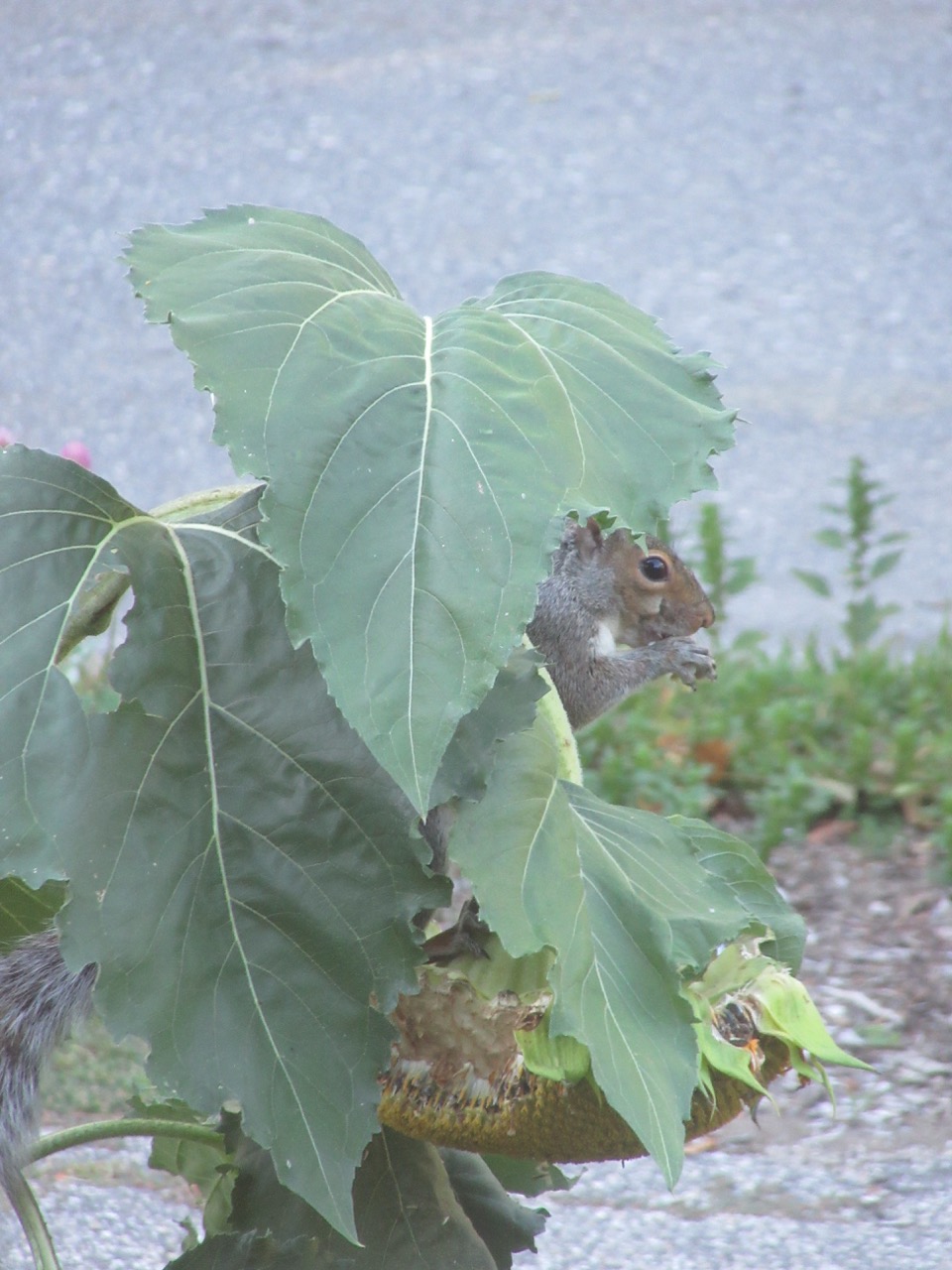
Photo by Margy Dowzer: Squirrel sitting, eating, on a sunflower last fall

Pond, next steps

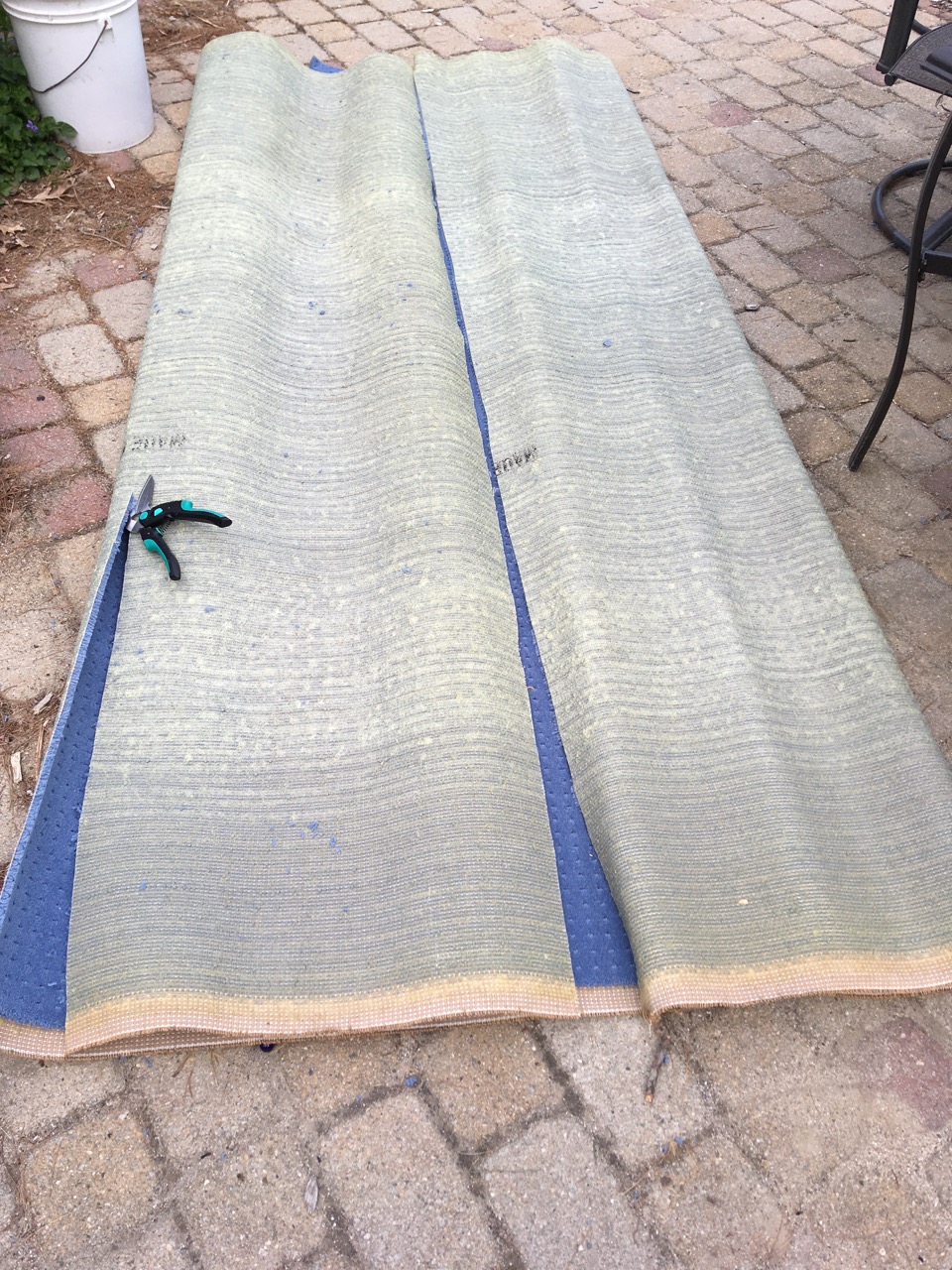
Photo: Cutting old donated carpet in 2 feet+ strips

I had a slow start today. I haven’t talked much lately about living with chronic illness, but for some reason I’ve been feeling much better energy than usual this spring. Still, I have a method for energy use: First of all, I rest when I need to. But what seems to work with garden projects is that I exert myself for a short while–say 10 minutes, or one wheelbarrow load. And then I sit and rest for 10 minutes. I don’t time myself, that is just a guess. I stop when I need to and rest until I can start again. While resting, I drink some iced licorice-root tea–that is a big help. I make a big batch of the tea (boiling licorice root for 15 minutes), and cool it to keep in jars in the fridge. Then I put together a big plastic glass (with a cover to take outside) adding ice and some lemon juice. Licorice root is said to be good for adrenal glands, so maybe this is why it has been so good for my energy.

But for example, this afternoon about 3 p.m., after my slow start, I was able to make my way outside. I started on the next step for the pond–cutting the old carpet (that I collected for free) into strips about 2 feet wide. I started with the biggest carpet piece I had received. Margy bought me a really good pair of carpet cutting scissors. Oh my gosh–they are so sharp and nice and easy to use. So I cut one 8 foot (?) strip, and then I rested. Then I cut another one. It went like that. After I had finished cutting that carpet piece into about 8 strips, I decided to see how it might lay on the pond surface.

But then I had another thought while experimenting. Since the pond is no longer going to be 3 feet deep, but rather about 2 1/2 feet, and since I have a pond liner that is 20 by 20, why not make it a bit wider at the top. (Since the equation for the pond liner size takes into account depth and width and length.) So instead of 11 by 11 1/2, just add a bit more on the half that has a one foot planting shelf, let the pond be closer to 12 by 12, and the planting shelf be a bit wider too. So I started digging again around the top edge. And then I remembered the advice to make a sloping “beach” edge for small critters to be able to get in. So I did some of that. Again, bit by bit.

While doing this further digging, I again saw more bright orange bittersweet roots. This is the biggest reason why we are using carpet strips as an underlayment. Some folks like sand better, but we need something that can stop the roots from puncturing the pond liner.

So the next photo is what it looked like when I called it a day. I was lying in the hammock a bit, resting, and then when I got up I could barely move. That is the other part of this process. I get really exhausted and sore all over. So I came in and took a hot shower, and then took two aspirin, which lately always seems to help. I’ll be down for the evening, but tomorrow, probably ready to start again. Unless I am not. I am sharing all these details to say that I am so grateful I am able to do this outside work, in this rhythm of work and rest. And also, maybe it might be a helpful suggestion for others who don’t have stamina for whatever reason. Work and rest, work and rest, in little segments. It has been a good day.

Photo: the pond, which is wider now (on the left and foreground), with blue carpet strips covering the “beach” area, and going down to the bottom.

What We Hold Onto

Yesterday, my Mail program on my Macbook crashed, and kept crashing. While I pursue attempts to fix it, I am pondering how I have used email, and what those possibly lost emails hold for me. One thing they hold is memory and relationships. I have some old friends that I keep in touch with through email, maybe once a year or every few months. The emails between us hold the long conversation, the details of events in their lives that I might otherwise forget, the cherished connections we make to each other. My emails also hold networking on issues I care about, future possibilities for workshops or activism, relationship building in the here and now. My emails also hold a record of these writings I post on the blog, to save on my own laptop.

But in the meantime, the Mail program is also clogged with thousands of emails that I never bother to read, never bother to erase. Not all junk, per se, but reports from organizations, updates on political issues, daily inspirations that I once thought would be uplifting, but I’ve stopped caring about. And it was much easier to ignore them, rather than try to go through and unsubscribe or move to the trash. Since I can’t open the Mail, I don’t have exact numbers, but I am pretty sure that there are at least 20,000 unopened emails in there. I wish I could magically extract the important ones and abandon the rest.

Yesterday evening, after giving up for a while on the computer fixing, Margy and I watched the movie Nomadland, with Frances McDormand. She plays Fern, an older woman who has lost her husband and her home, and who sets out in a van equipped with mattress and cupboards and cooking options, to travel to seasonal jobs in the American west. Along the way she meets other similarly displaced people, and in the film these are actual “nomads” playing fictionalized versions of themselves. It was powerfully beautiful in its closeness to the natural world of deserts and mountains and rivers, achingly solitary yet full of community in surprising places, and deeply sad in its indictment of our society’s abandonment of aging people.

It also got me thinking about what we hold in our homes, and what I might carry with me, if I ever lost this home and had to set out with only a van full of what I needed, what I cherished. We see Fern looking through a tin box of old photos, listening to music on her little radio, carefully repairing a broken plate, eventually giving up the stuff in the storage unit back in her old town. What would I hold onto, what would I leave behind?

I like to watch Henry Louis Gates, Jr.’s Finding Your Roots. There are times when the paper trail runs out for people on the show, there are no more records to be found to show the names of their ancestors, or the places they were born and died. Sometimes the paper trail ends because of slavery or genocide or oppression. Sometimes it ends because most people didn’t document their lives in ages past, like we do today. But I wonder if future generations looking for their ancestors of today would have different problems. They might have the problem of technologies changed or lost, such that they could no longer access the online records we so carefully accumulate. But they might also have the problem of getting lost in the avalanche of “paper” we now compile, the over-accumulation of words. Will they no longer be able to follow the trail of what is most important amid the towering clutter of what is not?

And so I come back to my own life, remembering the times I set out with a backpack, or a little car, starting a new life with only what I could carry. I got pretty good at winnowing things down, valuing the simplicity of it, feeling the freedom of it. But in the last twenty years, I’ve been able to settle down and really root myself in home. So things accumulate, some things cherished and beautiful, others practical, necessary, and then the stuff that serves no purpose any longer, but won’t magically disappear unless I do that work of taking it away, giving it away, sorting and erasing. What do I want to hold on to, what do I want to let go?

And yet, eventually, we all leave this life with nothing we can hold onto, all that is left is what we have given away.

Tree stump design-traces of all the years of life