Tonight I feel grateful to participate in the virtual opening ceremony for the Healing Turtle Island gathering. Songs, prayers in Indigenous languages, stories of grief, woundedness, devastating loss, and yet, gratitude. How do we bring healing, bring back balance in our relationships, with each other, with the earth, with spirit? This weekend will be filled with many speakers… (anyone can join on Facebook, or on Zoom, just follow the link). I don’t have a lot of words right now but one of the strange blessings of the pandemic is that because this gathering is virtual, I am able to participate. I was present for the very first gathering here in Wabanaki land, the eastern door. There will be 21 gatherings all together.
This photo is of two deer whom we sighted in our backyard on Tuesday–there were four all together. They were a gift in the midst of a painful week. I found myself just sitting on the back porch watching as they took their time amidst the trees and brush. Sitting still and watching. I feel the presence of such a compassionate Spirit through these visitors from the natural world.
Going through my boxes of old files in the basement, I am now working on files related to activism in solidarity with Indigenous people in Boston back in the 1990s. I found some correspondence with one particular activist, for example, and I am remembering the long process of getting to know each other, building trust, and finding ways to be helpful in that struggle. But when my ministry calling required that I move to another place (Cape Cod, at first, and then Maine), it meant that all of that relationship-building was lost, in a way, and I had to start all over again in a new place to build trust, to make connections, to find ways to be of use.
When white people are moved to act in solidarity with Indigenous people, it requires a lot of work to create relationships of trust. There is such a long history of colonization, of oppression, of theft, of genocide, between us–and a long history of “helpful” people doing damage. And yet, the more I became aware of that broken history, the more I have felt moved to participate in such solidarity. Not without mistakes. But I have continued in these other places seeking to build relationships of trust with other Indigenous people, doing the long work of decolonization.
I am not one who usually has spirit-filled dreams at night. Usually, in my dreams I am at a conference or gathering somewhere, along with a whole crowd of people, only some of whom I am acquainted with. I am trying to find my way around, or find food, or find my way back to where I was before–such mundane anxieties. Sometimes I meet old friends there. Often, I feel lost and overwhelmed by all the people I don’t know in places I don’t know.
I started feeling like that as I was going through these and other files from Boston. So many people with whom I have done work, shared conversations, struggled for justice, had significant experiences, lived in a household together, loved, hurt or been hurt by, and yet, I had forgotten so much of it. If I were not looking through these files, I wouldn’t remember much of what is in them. It all slips away with the effort and energy of building a life in a new place. Only a few relationships carried into long distance realities.
Sometimes I fantasize about not having moved everywhere, living somewhere and staying there my whole life. But I realize it is only a fantasy. This came clear to me a while back when I watched the movie Kuessipan, about two girls who grow up as best friends in an Innu community. In the description, “their friendship is shaken when Mikuan …starts dreaming of leaving the reserve that’s now too small for her dreams.” In reflecting on that movie, I realized, I would have been the one who left. In fact, I did leave a small town to go off to college, and I kept traveling to “bigger dreams.” I guess that journey is also in my blood. My grandmother left Canada to come with a foreigner to America when she was 17. Perhaps she too was seeking a bigger life, bigger dreams.
And now, here I am, sitting alone in the basement, going through memories, looking back on the many people I met over so many years. Sometimes I feel so tired. Sometimes I feel lonely in the midst of the crowded gatherings in my dreams. Sometimes it is a relief just sitting alone with the boxes, trying to make sense of the puzzle pieces of my life. It is a humbling journey. May Spirit help me to remain curious and grateful.
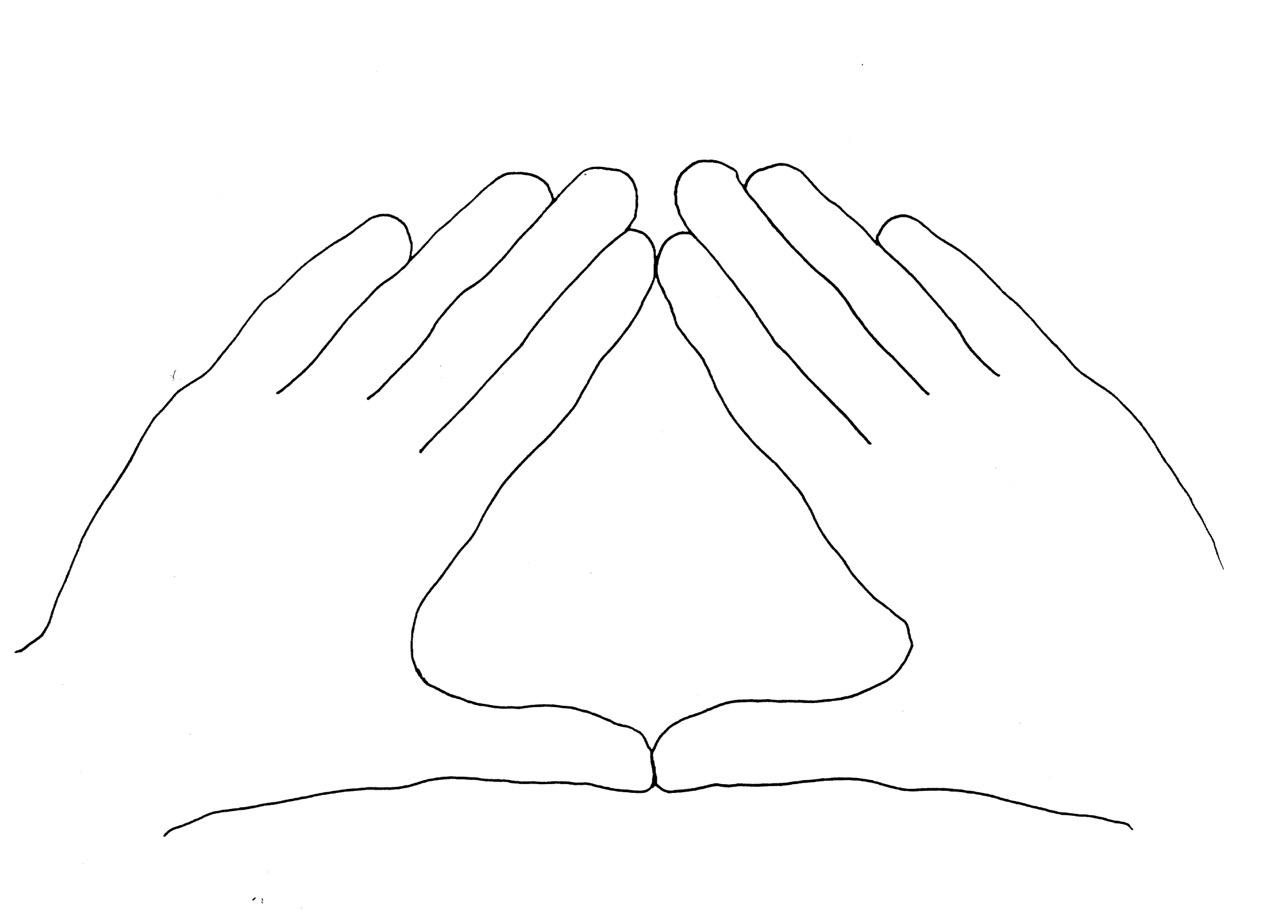
Two outlined hands form a triangle–a symbol of healing which I used as a logo for my feminist therapy practice in Boston.
Going through the old boxes from Boston are taking a long time. The other day, I came upon a few folders from the part-time private practice I had in feminist therapy for women. Of course, most of my notes from that practice were previously shredded for confidentiality’s sake. But a few notes and cards from the tail end of the practice had found their way into a box that was then closed up for 21 years. Anything that was confidential I fed into the shredder, but as I did so, I found myself saying little prayers, sending good energy to the women I had journeyed with in those days.
My longest-term client was a woman with a head injury. Because it was easier for her, we spoke by phone for our sessions. I found myself curious about what had happened to her, and googled her name to discover an obituary from 2014. She had died at the age of 73. I was glad to see the details of her life brought together as a whole. She had been a successful film-maker before an auto accident injured her brain. I met her several years after that had happened. I knew that our counseling sessions were helpful to her, and I also learned so much from her in our work together.
A few things that I remember: The brain is an amazing multi-faceted entity–someone could be smart about many things, as she was, and yet unable to accomplish some very basic tasks like counting or face-recognition. When she reflected on her own recovery, she knew she had disproved the prognosis that after one year she wouldn’t regain any other mental functioning. She kept slowly regaining aspects of her mental abilities. Oddly enough, online conversations were a big help to her–she was an early adopter of making friends via AOL chat rooms. Because of her brain injury, she had difficulty with sequencing–anything she needed to do had to be spelled out step by step. But she told me she began to write online erotica, which if nothing else required a great deal of sequencing. Who might have guessed the therapeutic value of that?
She told me that despite the limitations, she actually found greater happiness after her disability than before–when she was deep into the rat-race, she was successful, yes, but driven and deeply unhappy. When she had the solitude and slowness of her later life, she had a chance to heal from earlier trauma, to learn to love herself, and to find joy. She also found new ways to contribute to the world around her, especially in support of animals.
I am only writing about her now, even unnamed, because she has died. On the very unlikely chance that anyone who knew her thinks they might recognize her from these few details, I hope they know how fond I was of her. These memories awakened a very tender part of my soul. It was a great gift to be a part of her journey of life.
It was a great gift in so many ways to be a therapist during those years from 1986 to 1999. There is something quite sacred about listening, affirming, and gently encouraging–with the skills I had acquired–the healing power within each person. Often people came to me during times of great distress. I didn’t always like each person, though I often did. But with everyone, it felt like we were held, for one hour a week, in the intimate, infinite regard of a larger healing Love.
The things I ended up saving from the practice for my files were things like my advertisements in Sojourner, the women’s monthly paper in Boston, where there were usually 3 full pages of ads for feminist therapists. This is where my logo appeared month after month for several years. I saved some of the networking I had with other therapists. I saved a little sheet on which I spelled out my sliding scale–I was glad to be accessible to very low income women. I saved notes from a few of the workshops I offered or attended. As in my later work of being a minister, some of the best moments remain invisible to the world. But hopefully the ripples of those moments endure.
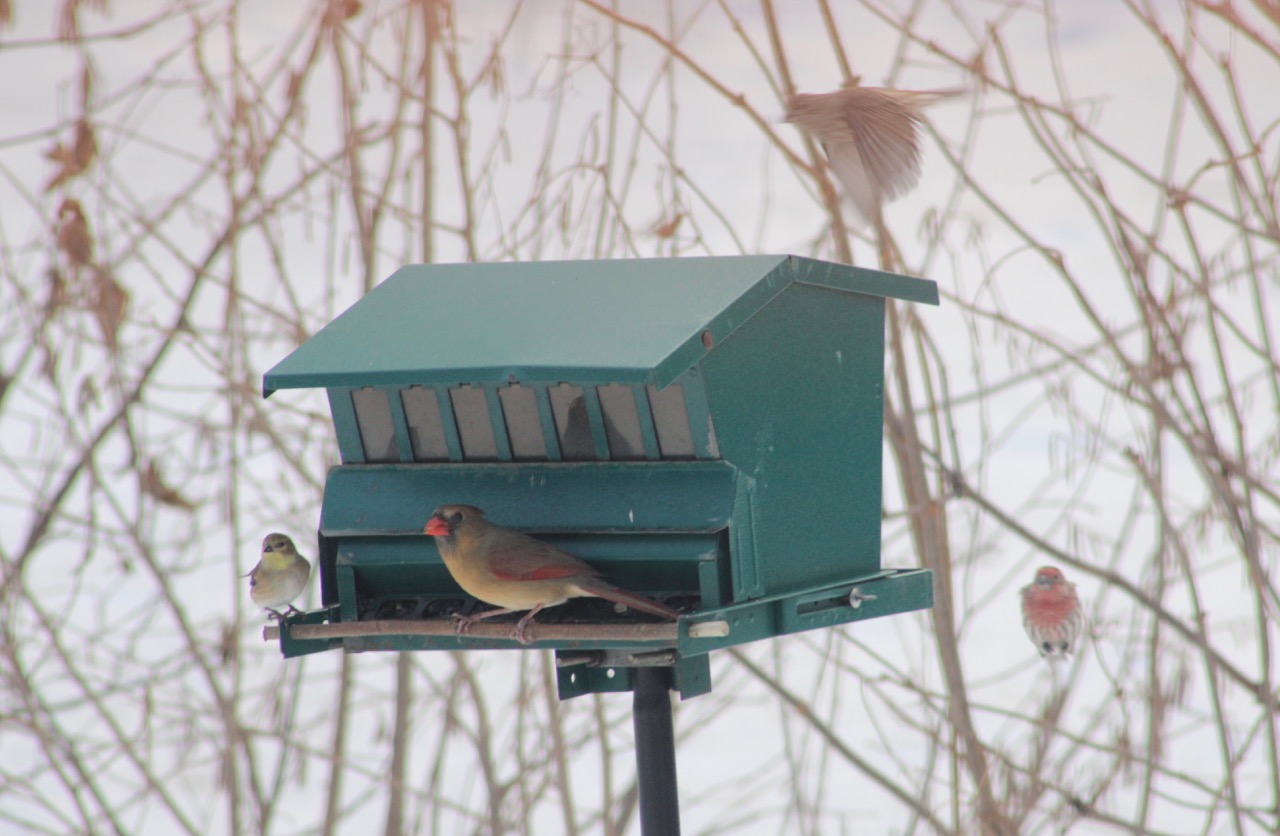
Photo: Female cardinal at feeder, with three smaller birds nearby.
I am finally embarking on a project to go through all of my papers, now in boxes in the basement. These range from files that I brought from my office when I retired 3 1/2 years ago, to boxes that I have carried around since college. This week I have been going through a box of writings–poems, essays, and an almost book, dating from about 1986 to 1996. During those years, I lived in Boston, surrounded by lesbian community, making a living in what today might be called the gig economy, while focusing my time and energy on activism, writing, feminist spirituality, and social change.
It was a scary time, financially, just getting by with no safety net, no health insurance, moving from rented apartments to other rented apartments in an increasingly difficult housing market. It was also, for a while, a joyous and exhilarating time, creating chosen family through collective living with other lesbians, wrestling with issues like classism, racism, and sexism, all the while imagining justice, mutuality, and queer beauty.
Reading the many words I wrote brings me back there, and I am impressed by the creativity which filled those pages and filled my life and the lives of those around me. But there was an undertow that sometimes threatened to drown me–a shift when housing got harder to find, when joyful cooperative situations became uneasy roommate situations, when loneliness began to plague me. Still, poetry and Spirit sustained me even then. I found this poem that seems worth sharing as 2021 comes to an end, and 2022 is about to begin. May you find the courage to follow the road where your heart leads you!
1/13/93
If there can be power in a word the word “courage” gets me out of bed surrounds my heart in hard times.
There are many poverties. Each moon waning, as I just get by financially, I find my true despair lurks in the isolation which has covered the walls of my days like some asphyxiating new paint and I feel I can’t breathe and I feel I don’t belong here.
I remember when I set out on a path to transform the world. We sang then, the joy of our meeting filling our mouths like lovemaking, our visions changing us into new beings. We laughed at how we didn’t fit our chains anymore, and big as life we set about to craft a new home.
There are many poverties. Loneliness is the unforgivable sin. I have always felt I could survive the insanity and cruelty of the world any poverty or hardship or struggle if only I had companions to share it.
But here I am. Loss and need my only mothers.
If there can be power in a word the word courage gets me out of bed. Courage rests her cheek against my heart. Courage squeezes my hands into her pockets. Courage plants her feet into the prints of my solitary steps as if of course this is where the road must go and I am still that traveler.
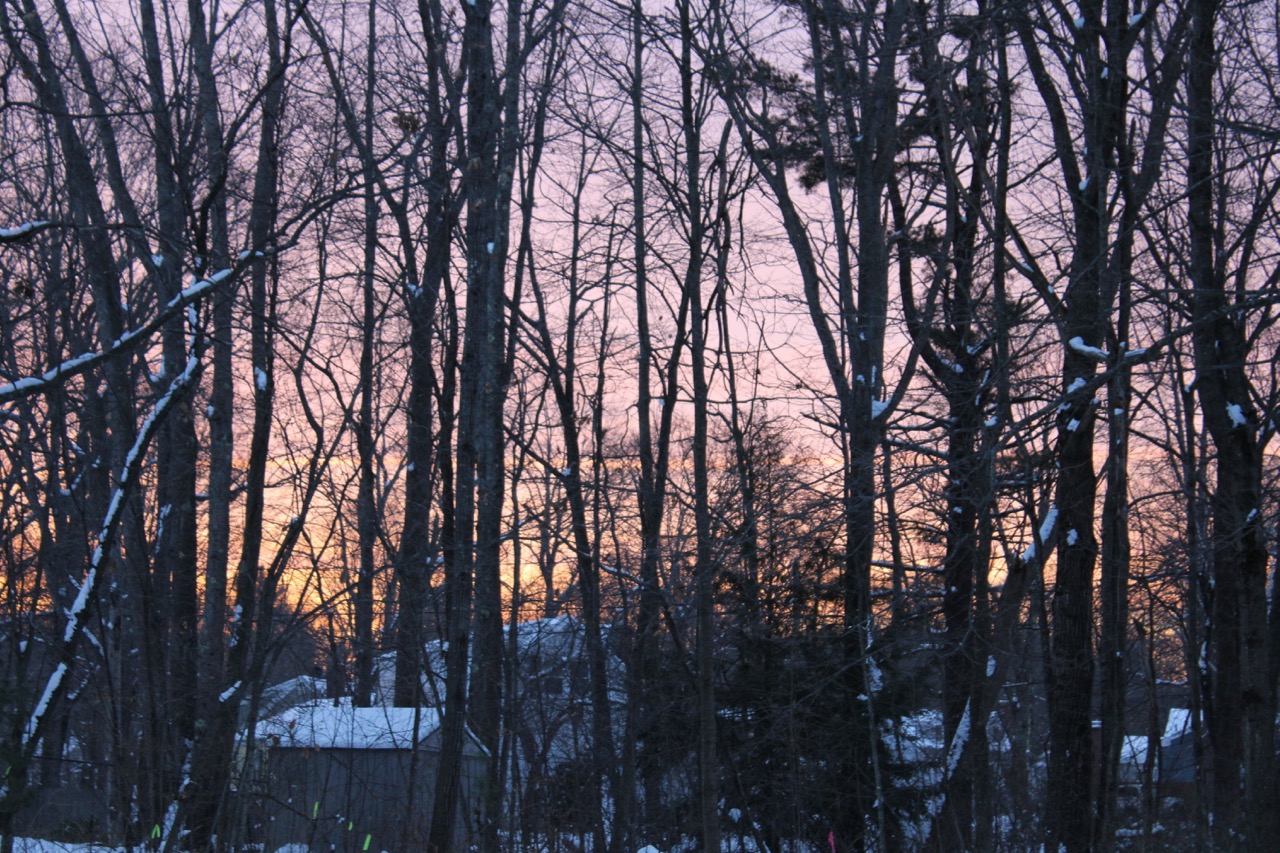
Photo: Solstice dawn seen through trees in our town.
After the longest night, the shortest day dawns with beauty in the sky, and draws me outside into the cold and colors of morning. Snow is covering the ground at last, which has brightened up these last few dark days. Margy and I are learning to play backgammon for holiday fun during the isolation of COVID. After our first full game, we ate a Solstice Eve celebration dinner last night. Traditionally pork is eaten at this season in honor of the European goddess Freya. Later, we pulled out runes for a message for this turning of the seasons. My rune was Gebo, the rune for giving and receiving, for love and partnership.
As the light returns, and the days lengthen, may our human hearts turn toward generosity and compassion, in reciprocity with all of the beings with whom we share this planet.
I have been posting recently about my latest research concerning my Innu third great grandmother, and because of that I want to write today some clarification about identity and relationship. The more I am learning about Indigenous people–through study, through language, through cultural sharing by Indigenous people–the more I understand that I am not Indigenous. This might not even need to be said, except that there is currently a problem of people with ancestors even more distant or nebulous than mine trying to use those ancestors as a way to claim status as Indigenous or Métis, to get benefits from governments, or preference in hiring or hunting rights, for example. Sometimes they actually use this to try to take away benefits from Indigenous communities.
Years ago, when I was still just beginning to learn about all this, I wasn’t sure if I was permitted to claim an Indigenous identity, or a Métis identity. A few times I did, out of my own ignorance. And it is not simple for those of us who are mostly something else, but want to honor our Indigenous ancestors. Even so, I can’t imagine trying to use it to take something away from Indigenous or Métis communities. What I hope for is to be a good relative, a friend, to use my position in this society to act in support of Indigenous communities.
For my latest presentation in our Passamaquoddy language class, I found myself drawn to a word in Passamaquoddy that has been used to describe non-Indigenous people: “Wenuhc.” What does it mean? Some definitions say, “white person.” And that is partly true—it refers to white people. But, its roots come from an old meaning. When, they say, strangers came here to Wabanaki land, the Native people said, “Wenuhc?” It meant, “Who are they?” It also held a question, like, “Where are they from?”
When I ask the question of myself, it comes out: “Wen nil?” “Who am I?” The traditional way to introduce oneself is by naming the place where you come from, and your relatives, the people you come from. But for me, as a wenuhc, that wasn’t so simple. The more I played with the concepts, the more confusing it became—which certainly is a characteristic of many of us living in the mainstream culture of the United States. I want to share some of what I wrote—but mostly just the English translation:
The early strangers said, “We are Englishmen.” I speak English, but my roots are not English—so am I English? Wen nil? Who am I? Three of my grandparents have Germanic roots. But, I can’t speak German. I have German roots, but am I German? Wen nil? Who am I? My grandmother came from Quebec, and she spoke French. I can speak French, a little. I have French roots, but am I French?
Wen nil? Who am I? My grandmother’s great grandmother is named Marie Madeleine. She was Innu. She spoke Innu. Now, I know how to speak Innu a little, only a very few words. I have Innu roots, but am I Innu? Now, I can also speak Passamaquoddy a little, but I am not Passamaquoddy.
Wen nil? Who am I? I don’t know. I am a wenuhc woman, a “who are they?” woman. I am far away from family. Sixteen years ago, I came to Wabanaki land in order to work. Now, I am done working. So, what am I doing? Am I a preacher? Am I a witch? Am I a writer? Am I a gardener? Wen nil? Who am I? Tama nuceyaw? Where am I from? All my grandparents lived in cities. Now, I live in the city, Portland. Am I lost? How do I find myself? Am I a stranger? Am I your friend? Am I foolish? Am I wise? I don’t know. Wen nil? Who am I? I am confused.
What I learn from this Passamaquoddy writing process is that I am not well connected to a place or to my relatives. My being a lesbian, my being a justice activist, my moving around a lot, all contributed to a feeling and reality of being disconnected from place and family. And given the injustice I found all around me in “American” culture, I don’t regret the need I felt to resist it, to break away from it. But in some ways, that is a very “American” way of being. “America” celebrates individual identity and mobility. It defines who we are by what we do.
When I seek to find my way into relationship with the earth, with all beings of the earth, with the ancestors, with spirit, when I begin to value this relatedness, I see more clearly how I have been cut off from places and people that I might have been from. And I see more and more clearly how I am not Indigenous. I am wenuhc. I am “Who are they?”
And that truth is real, it is okay. “Who am I?” is an open question. It is why I make a spiritual journey into earth community. I can learn. As I learn to be thankful for everything, I begin to feel how I am related to everything, despite being wenuhc.
Note: I first learned about the word “wenuhc” from my Passamaquoddy language teacher Roger Paul. More recently, the organization I volunteer with, Wabanaki REACH, posted about this word on its Facebook page, quoting Rebecca Sockbeson (Penobscot), 2019.
Photo: Pileated woodpecker on a pine tree near our house. The woodpecker is a symbol of friendship for Wabanaki people.
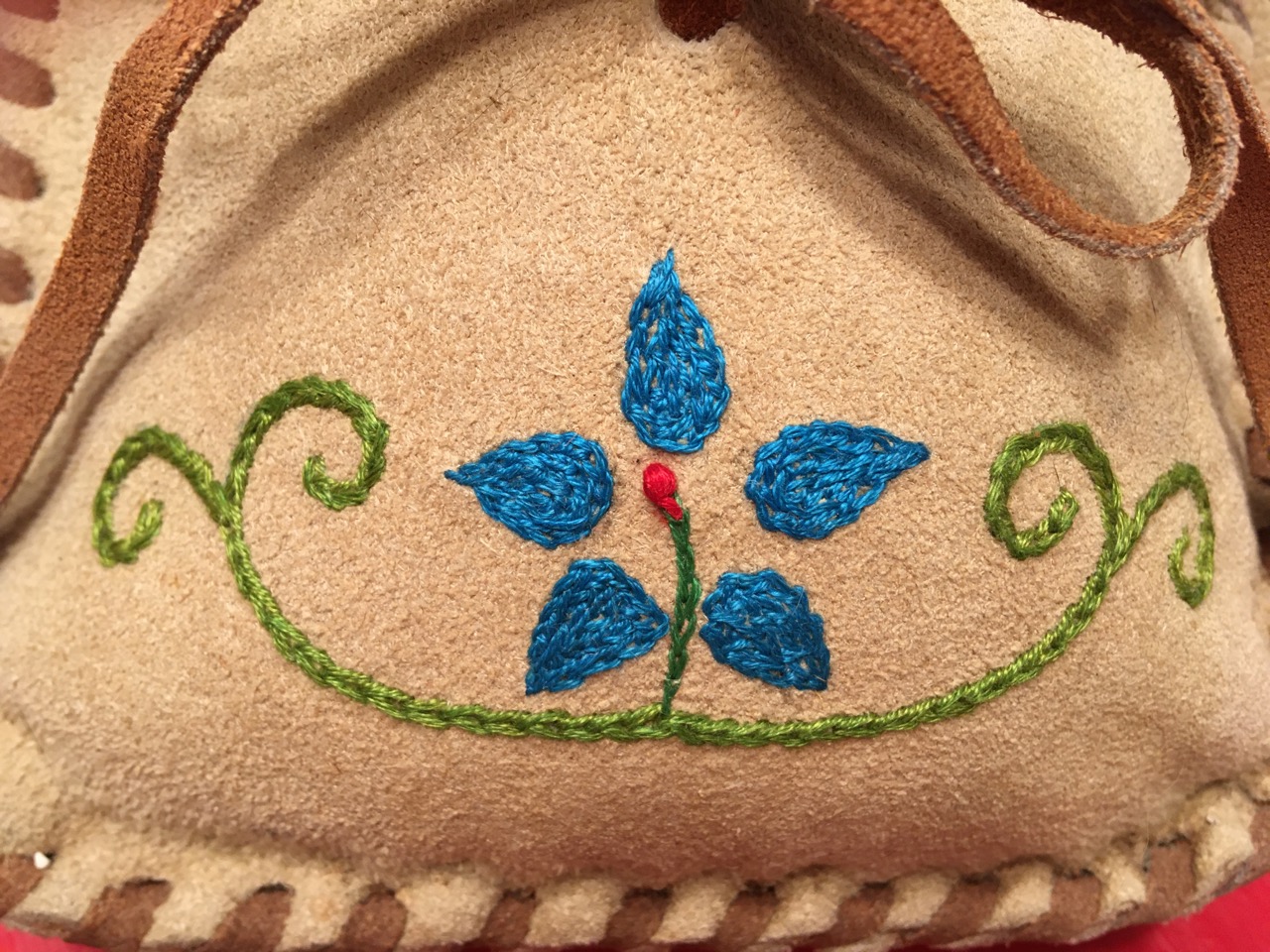
Innu embroidery on a leather bag from Lac St. Jean
“Even if you don’t know who your ancestors are, your ancestors know who you are.”
@drxicana Dra. Vanessa M. Bustamante
I think I am coming to the end of myintensivesearch for the family of my Innu third-great-grandmother Marie Madeleine. I have found the most likely Marie Madeleine of the many that I researched, though I cannot have conclusive proof of any connection. Here is what I found.
Marie Madeleine Napeteiashu was baptized June 6, 1803 at Îlets-Jérémie. She was at that time about 7 years old, “or even more,” so her birth would have been 1796 or perhaps a bit earlier. By that time, the priests started recording the father’s Innu name as a surname for the children, so she does not have her own personal Innu name listed. Certainly, she would have had an Innu name that she used for the first seven years of her life and beyond. Her brother Simon Napeteiashu was also baptized at the same time, and said to be about 4 ½ years old, so born in late 1798 or early 1799. Their parents were Napeteiashu, who did not have a Christian name, and Catherine Mitiskue. Their godparents were Simon Tshinapesuan & Marie Madeleine Iskuamiskuskueu, elders in the community who were also parents or godparents to other Marie-Madeleines I researched. Both brother and sister were named for their godparents.
I was able to find an older brother as well, Jacques Nahabanueskum (later also called Jacques Napeteiashu), who was baptized 6/19/1786, at 2 years old, at Îlets-Jérémie, his parents listed, with a slight variation as Nepiteiashu and Catherine Matshiskueu. I think the name Napeteiashu might mean “male fox” if you stretch the spelling a bit—napeiatsheshu. Mitiskue seems a combination of bead/mitish, and woman/skue, so “bead woman.” Matshiskueu means “ugly woman.” I’m not sure about Nahabanueskum. Sometimes the Innu names changed over time.
Sadly, I did not see any further clearly identifiable records for Marie-Madeleine’s parents. Today I spent hours looking at earlier records to see if I could find Catherine. I found many Catherines, but none with her Innu name or a clear link to identify. Unlike for some of the other families I researched, there weren’t multiple prior generations in the baptism accounts; I could open the mystery no further. Perhaps this family’s connection to the priests at the trading posts was more tenuous, at least prior to Jacques, with the father Napeteiashu unbaptized, and the children not baptized until they were 2, 4, or 7 years old. I would have thought there might have been more children between Jacques 1784 and Marie Madeleine 1796, but I could find no record of them. Perhaps might this family have been more tied to their own Innu culture in the forest, and warier of the trading posts?
However, I did find many other records for Marie Madeleine’s brother, Jacques Nahabanueskum. In May 14, 1804, he was married to Monique Peshabanukueu at Îlets-Jérémie, (with his parents identified as Napeteiashu and Catherine Mitiskue.) They had several children baptized through the following years, with their father’s Innu name listed as their surname: Agnes, 1809, Rose, 1810, Marie, 1812, Charles, 1814, all at Îlets-Jérémie, then Jacques 1818 at Riviere Godbout, and an unnamed child who died 1821, then Monique, 1822, at Îlets-Jérémie. Jacques died before 1824, when his widow remarried to Jacques Tshiuteshish, widower of Marie des Anges Tshimatshueu. The children of that Jacques and Marie des Anges would also have been part of an extended family: Simon, Beatrix, Christine, Hélène, and possibly more.
I also found a possible later link for Marie Madeleine’s brother Simon, as Simon Napitaietshunwith Marie Catherine Tshiatshe, parents of a daughter Marie, baptized in 1819, and a son Simon, baptized in 1821, both in Mingan.
One clue that led me to identify this woman as the most likely choice is in the record for the baptism of my own Marie Madeleine’s son Simon, in 1833, at Îlets-Jérémie, where she is identified as “sauvage du dit poste,” which means, translating the racist imagery, “Indian of said post.” And so it seemed to me it might be identifying her place of origin. Of the women on my list of possibilities, within the right time frame, she was the only one who was baptized at Îlets-Jérémie. Now, on the other side, I know that her husband Peter McLeod was a clerk of that post in 1833. But she, along with two other Indian couples baptizing their children were all identified as Indians of that post.
Another reason I find her a compelling possibility is her age. Born about 1796, that would make her about 50 years old at the birth of Marie Madeleine’s last child of record, Marie Sylvie, born in 1846. Late age, but possible. It also means that she would be 53 at the time of her death in 1849, where she was identified as “about 60 years old.” Close enough. I also thought about the fact of her father being unbaptized—and whether that might make it more likely that she would partner with a Protestant man, quite a divide in those days between Catholic and Protestant, but perhaps not unlike the divide between Catholics and the non-baptized. Until the year of her death, when it was conducted in a Catholic ceremony, her marriage to Peter McLeod was not considered a “legitimate” marriage.
A more ambiguous reason I am drawn to her has to do with the network of relationships she seems to be embedded in. My Marie Madeleine named one of her sons, Simon, at Îlets-Jérémie. This would have been the name of her brother, but also another Simon. When her daughter Angèle was baptized in 1836, her godparents were listed as Simon and Angèle, who possibly match a couple named Simon Utshinitsiu and Angèle Neukapne. (No godparents were listed for Simon’s baptism.) This couple appears often in the records, and this Simon is the son of Jacques Tshiuteshish, (whom Monique married after the death of Marie Madeleine’s brother Jacques).
There were several instances of people being in the same place for ceremonies at the same time. Here is just one example. In 1812, on the day after the baptism of Jacques and Monique’s child Marie at Îlets-Jérémie, Simon and Angele’s child Charlotte Utshinitsiu is being baptized there. It is hard to articulate those connections, but to see the names again and again, led to a feeling of interconnection between the families, that might have followed through into the baptisms of my Marie Madeleine’s children Simon and Angele.
The unfortunate thing about this Marie Madeleine is that there is little information about further ancestors. But with her there is a definite link to a place and a community. Might I be related to the place called Îlets-Jérémie/Jeremy Islets? In Innu, it is called Ishkuamishkᵘ, which one source said means “where you can find polar bears” but is also similar to the word for a female beaver ishkuemishkᵘ. Now, to further clarify, generally speaking the Innu went into the woods in fall, winter, and spring to hunt, and came to the posts only in summer, to trade and to connect with the priests who did the baptisms, marriages, burials, and such. And they didn’t necessarily just go to one post, while avoiding others, but they usually were found at ones that were close to each other. So there definitely seemed a connection to Îlets-Jérémie, over many years.
I feel a strange sort of sadness as I let go of further hunting. The records are so sparse, so much is unknown. And yet I have learned so much, I have a sense of the community that I had no awareness of before this search. All I had was her baptismal name, really, and the place where she lived the last few years of her life. And now I have this sense of visiting her world of 200 years ago, learning the places of the trading posts, which were first of all gathering places for Innu people before colonization. I glimpsed the multiple inter-relationships, I scanned hundreds of Innu names, I observed the seasons of gathering and then going into the forest, the births and the deaths. I could see that she was born into a world of mostly Innu people, and by the end of her life in 1849, the increasing number of settlers outnumbered the Innu. But in that world, one joy was she was able to bear many children, and to live to be in her 50s, which was old for that time. My imagination is now richly populated with all of these people I have glimpsed through the strange window of the scratchy French handwriting of the missionary priests.
I come back to the message I received in the middle of this journey. It was like all these women whispered in my ear, “We are all your relatives! As you search for us, and find our stories, we are pleased, and take you under our wings. We are all your relatives.” So I welcome them all now. And remember, “Even if you don’t know who your ancestors are, your ancestors know who you are.”
Photo of the full moon, taken before the cloud cover and the eclipse
I’m starting to write this early in the morning. The clouds are covering the sky, and the eclipse of the full moon is happening now, invisible, but I can feel it in how dark the outside has become. A funny thing about aging—I saw the most amazing full eclipse of the moon when we lived on Cape Cod—October 28, 2004, the night the Red Sox won the world series after an 86 year “curse of the Bambino.” We were watching the game, and intermittently going to the front door of our house, to watch the passage of the eclipse right there. As it was covered by the earth’s shadow, the moon got full deep red. Then the Red Sox won. What a magical night! So back to the funny thing about aging—after that experience, and with an older tired body, I don’t have the same urge to watch eclipses of the moon—especially if it involves getting up in the middle of the night. Tired body, cloud cover, greater memories. Yet here I am awake.
And somehow, it does seem a fitting time to write about another of the Marie Madeleines I have been researching. I’ll start by saying I don’t think she is my actual ancestor, though there is no conclusive proof to rule her out. At first, she was just another name, Marie Madeleine Utsinitsiu, baptized in Chicoutimi July 16, 1805, at about 4 years old, “fille naturelle” of Alphonse Utsinitsiu and Marie Kukuminash. “Fille naturelle” means she is the daughter of parents who are not married, at least by the church. At first when I began to research her, nothing seemed to fit together. But now I think I do have a picture, and I am not sure what to feel about it.
Her father Alphonse, in other records also called Alphonse Ukuinigsiu, was born in 1745 in Chicoutimi, so he was about 54 when she was born. I was able to find six of his other children, with 3 different mothers, only one of whom he was married to. Then he had one more marriage to Marie Louise Utshisk, in 1797, the record indicating it was “rehabilitated” which implies that there was something irregular about their union, and the marriage made it right.
But then it got weird to me. Because Marie Louise Utshisk is the mother of Marie Kukuminash. This means that Alphonse had a child, four actually, with the daughter of his last wife! I will come back to that. Marie Louise Utshisk has her own interesting series of marriages and children. Born in 1746, she was married to Jean Tshinupesuan, and with him had five children, four before Marie was born around 1781. In 1784, she also had a child with Bernard Pilote, who was French, a trading post clerk. She was 51 when she married Alphonse in 1797.
Her daughter Marie Kukuminash was herself married in 1793, at the age of 12, to Andre Tshinusheu, who was then 40 (and a widower with a child, Margaret Kukuminash, five years younger than Marie). Marie had a child with him, Marie Josephe Enukesh, in 1795, at 14, and then Andre died in 1796. The following year, her mother married Alphonse Ukuinigsiu. Then, about 1801, Marie Madeleine was born, the daughter of Marie Kukuminash at age 20 and Alphonse Utsinitsiu at age 56. Ironically, Kukuminash means “old woman” in the Innu language. Later they had three more children, Protais, Pierre, and Agathe, still unmarried, all these children baptized in 1811, but ages not given. I found a record of the death of Agathe in 1816, where she is listed as 10 years old, and the daughter of Alfonse and Marie Louise. But perhaps this was a cover-up of her actual mother.
This family is kind of the opposite of some of the others I researched, who seemed upstanding members of the Innu Catholic communities of the trading posts. Part of me wants to set aside my judgements and see them as people living in extended family community, freer about sexual relationships than the priests would like, having children, and finding partners in arrangements that enabled the group to function for hunting and trapping and gathering. People couldn’t be “single”—everyone needed a group to belong to, and when a partner died, it was necessary to find a new one, or your family couldn’t survive. And marrying young was not unusual either at that time.
But, I also feel creeped out about Alphonse having those four children with the 20-year-old daughter of his 54-year-old wife. Is it just an example of male creepiness, familiar to us in our own time? Or is there something that is hidden by the passage of time and the inadequacy of any records? The death of Alphonse “Ukunikushu” was May 12, 1813, 68 years old, recorded July 15, 1816 at the ceremony of his burial. (Note: these ceremonies did not happen usually at actual burials, but were a religious ceremony to account for the death.)
But, you see, I don’t really know what happened to most of these women and children. Not all deaths were recorded, and scrolling through the records year after year, I eventually notice that people don’t appear again. I didn’t see any further records for Marie Kukuminash. Into the later 1800s, the priests often recorded only first names of people, and it gets harder and harder to identify them. It is still possible that this Marie Madeleine could be my ancestor. A chaotic family life with many marriages and liaisons would certainly fit with her getting together with Peter McLeod, a Protestant clerk of the posts, without benefit of marriage. And Peter and Marie Madeleine later lived in the Chicoutimi area after 1844.
However, more likely, I think I might have found this Marie Madeleine, in the marriage record of Marie Madeleine Kukuminu to Joseph Akamkash, 06/25/1821 in Chicoutimi, with no other details given. Marie Madeleine “Utsinutsiu” would be about 20, and perhaps she adopted the name of her mother? Also it is in Chicoutimi, the same community. There weren’t other Marie Madeleines that I found in that community. These are the only real clues I have about this. This Marie Madeleine and Joseph appear clearly two more times, with the baptism of their children, also named Marie Madeleine and Joseph, and then appear with just their Christian names with possibly 5 other children, some being baptized, some being buried, and Joseph being married in 1839. All these records are in Chicoutimi or Tadoussac, nearby. So, I think it might be the same person, which is why she couldn’t be my own ancestor Marie Madeleine.
I learned a lot by hunting for this family, sparse though the details were. It raised so many questions for me too, all the important information that was never recorded. Surely some of the Innu people and their relationships were broken by the impact of colonization. I wonder about alcohol, I wonder about disease. I wonder about sexual predation by the clerks or priests. And yet, also, I feel heartened by the possibility of Marie Madeleine Kukuminau and Joseph Akamkash making family once again, and caring for children through many years in the place they called home.
After being away for a day, I have a new realization to share in my hunt for MarieMadeleine. Because, after 1802 or so, priests started recording names using the father’s Innu name like a surname, it occurred to me to look for Marie Madeleine Katshisheskueit as Marie Madeleine Tshinushiu, using her father Antoine Tshinushiu’s name.
Then I noticed that I had already made note of a marriage of a Marie Madeleine Tshinushiu on the 26th of July, 1815, father listed as Antoine Tshinushiu. However, the mother was not listed as Anne Kukuminau, her actual mother, but rather Genevieve Matshiskueu. Coming back to that, I realized that Marie Madeleine might be living with her aunt Genevieve, and that could be a reason for her name mistakenly appearing, albeit with a different Innu name, as her mother. In fact, it made sense that this was her: right name, right father. Also, it took place in Ilêts Jérémie, where so many other events have taken place.
She was married to Protais Atikurnu, widower of Catherine Kaskamisku. The day before, there was a marriage for Christophe Atikurnu, Protais and Catherine’s son, with Elizabeth Prituttekan. I also found listings on the same page of the deaths of two children of Protais and Catherine, at Tadoussac, Martin age 8 and Angelique age 5. Many losses that year, but life goes on.
So then I started searching for records after that time for any of those names. In 1817, there was a child Dominique, age 10 months, son of Protais Atikuriniu and Marie Madeleine Uashbanukueu. I had read that sometimes Innu people changed their Innu names, and though I hadn’t seen many examples of that, I think it is reasonable to conclude that this was the same Marie Madeleine, since her husband was the same. In 1818, Protais Atikuiniu & Marie Madeleine Pashabanukueu are listed as godparents for a child’s baptism in Portneuf. Again, that is a very slight difference in the name, that might even be a misspelling. In 1820, there was a child Prisque, age 9 months, son of Protais Attikurnu and Marie Madeleine (no Innu name given), and that same day, a child of Christophe and Elizabeth was also baptized at Portneuf. That might indicate that they were all living together as an extended family group. Continuing through the records through 1833, I didn’t happen to see any further mention.
Since she has this husband and these children, I think what it means is that I need to let go of Marie Madeleine Katshisheskueit/ Tshinushiu/Pashabanukueu in my hunt for my own great-great-great-grandmother. The process of elimination is the path forward, so this is a big step. Still, it is a bit hard to let go, after spending so much time and energy learning about her and her family. She has a big family! I guess that is why I wanted to blog about her today, to share this path of clues, to feel gratitude for the life she lived, and all of her relatives. And to remember the message I felt a while back, that all of these ancestors are my ancestors in some way.
And thank you to all of you who read these musings–these last several posts have been so personal to my own life, to my search for my own matrilineal ancestors. I don’t know for sure why I feel so pulled to do all of this searching, but I am trying to follow the path that my heart leads me, to trust the intuition that guides me through these days of our COVID solitude. I am remembering a line from one of my favorite authors, Linda Hogan, from her book, Dwellings, [p. 40], “The ceremony is a point of return. It takes us toward the place of balance, our place in the community of all things.” Finding my ancestors helps me to understand my place in the community of all things.
In the search for my matrilineal ancestor Marie Madeleine, I am feeling the need to summarize where I’ve come to so far. If you’ve been following along, you know that I’ve been searching through hundreds of images of records from the Postes du Roi on the north coast of the St. Lawrence River in Quebec. With all of those names and dates, I believe now that there are two women who are the most likely to be my own Marie Madeleine. The first characteristic that I am counting on is the year of her birth, and her age at the birth of her last child. In her death record of 1849 she was described as about 60 years of age, but those estimates are notorious for being inaccurate. (Her last child was born in 1846, which would give her the impossible age of 57.) Assuming that her child-bearing years could not realistically go much past 50, that would put the earliest year of her birth at about 1796. But also assuming that she would likely not be younger than 50 at her death, the latest year of her birth would be about 1799.
One of my frustrations these last several days has been how as the years moved along, the priests who were keeping the records were writing less and less, until in the 1820s and 30s, for example, they would often record marriages with first Christian names only, no parents listed, and baptisms with first names only. For example, in 1820 at Rivière Godbout, there was a death listed as “Marie-Madeleine” with no further information. The racism seemed to increase as the years went by. Instead of an Innu name, they started attaching the word “sauvage” to the names, “savage.” So it has become increasingly difficult to hunt for clues. At least the earlier priests took the care to spell out both Christian and Innu names, and parents full names.
But with all of that, these are two women who have emerged as the most likely to be my ancestor.
1. Marie Madeleine Katshisheskueit was born in the forest either Nov 11, 1795 or April 18, 1796. (Today could be her birthday!) In Feb 1846, she would have been either 50 or close to it. At her baptism on 6/28/1796 at PortNeuf, her records were mixed up with Anastasie Kamatshiskueuit. Because of later records for Anastasie, I determined that Marie Madeleine’s parents could only be Antoine Tshinusheu, born 11/20/1778, baptized in Chicoutimi 7/4/1779, and Anne Kukuminau, born and baptized in 1779 in Manicouagan. (They were listed as Anastasie’s parents but see my last post for untangling all that.)
I can’t determine for sure which parts of the baptism record went to which child, so her godparents were most likely Simon Tshinapesuan & Marie Madeleine Iskuamiskuskueu, or possibly Jean Baptiste Assini (sibling to Anastasie’s mother Veronique) & Marguerite Tematseu. Both families have interrelationships through the years.
She had two younger brothers I could find: Ambroise Kanatsheshiu, baptized Jul 2, 1801 in Chicoutimi, born in the forest around 3 years prior, 1798. And Thomas Mishtapeu, baptized Jul 2, 1801, born in the forest around April 1801, who died and had a burial ceremony at PortNeuf, 23 July 1803, age 2 year, 3 months and 27 days. Both Ambroise and Thomas’s Christian names were after their godfathers, so it is possible that Marie Madeleine’s was after her godmother, another reason to point to those godparents.
There are records going back to her great-great grandparents in certain lines, meaning that her relatives had become Christian and were regular frequenters of the trading posts, in Chicoutimi, Manicouagan, and Îlets-Jérémie for many years previously. Her grandparents were Ignace Pikuruish & M. Jeanne Menastatshiku on her father’s side, and Pierre Rene Mishtapeu & AnneMok on her mother’s side.
In the summer of 1805, sadly, her parents had burial ceremonies in PortNeuf, having died in August and October of 1804, when she was 8 or almost 9, and Ambroise was 4 or 5. After her parents’ deaths, all her grandparents had already died, but each came from large families, as did her parents. I looked for aunts and uncles she and her brother might have lived with. The one I found listed the most was Antoine’s sister Genevieve Ushitasku who was married to Francis Xavier Uabushuian. They are in the records for the births/baptisms of six children. It is likely that Marie Madeleine and Ambroise would have lived with their relatives, though I can’t determine who that would have been, but maybe it was these two.
2. Marie Madeleine Napeteiashu was baptized June 6, 1803 at Îlets-Jérémie. By that time, the priests started recording the father’s Innu name as a surname for the children, so she does not have her own Innu name listed. She was at that time about 7 years old, “or even more,” so her birth would have been 1796 or perhaps a bit earlier. Her brother Simon Napeteiashu was also baptized at the same time, and said to be about 4 ½ years old, so born in late 1798 or early 1799. Their parents were Napeteiashu, who did not have a Christian name, and Catherine Mitiskue. Their godparents were Simon Tshinapesuan & Marie Madeleine Iskuamiskuskueu, (the same as for the other Marie-Madeleine!) and both brother and sister were named for their godparents.
(Note: for a while I thought these parents might be the same as Stanislas Mishtanapeu and Catherine Mistiku, but further records made that not possible.)
I was able to find an older brother as well–Jacques Nahabanueskum (later also called Jacques Napeteiashu with several spellings), who was baptized 6/19/1786, at 2 years old, at Îlets-Jérémie. In May 14, 1804 he was married to Monique Peshabanukueu at Îlets-Jérémie. They had several children baptized through the following years from 1809 to 1822, most at Îlets-Jérémie and two at Riviere Godbout. Jacques died before 1824, when his widow remarried. I did not see any further identifiable records for Marie-Madeleine’s parents or brother Simon.
This family’s connection to the trading posts was more tenuous prior to Jacques, with the father Napeteiashu unbaptized, and the children not baptized until they were 2, 4, or 7 years old. There weren’t records of their prior generations in the baptism accounts. There might have been more children between Jacques 1784 and Marie Madeleine 1796, but I could find no record of them. Perhaps this family might have been more tied to their own Innu culture in the forest, and more recently come to the trading posts.
So here I am with these two. It was a major breakthrough for me to search for family members along with the Marie Madeleines. No one was isolated outside of community. I have discovered parents and siblings, aunts and uncles. I have also been drawn to the godparents Simon Tshinapesuan and Marie Madeleine Iskuamiskuskueu. Their names reappear again and again like wise elders to their community, along with the records of many of their own children. I am not finished going through records, but I have reached 1833, in which the birth of my own Marie-Madeleine’s son Simon is recorded at Îlets-Jérémie, with her spouse Peter McLeod.
Today I feel the need to reach out in a spiritual way once again, not that I will find THE ANSWER, but that I find a way forward in this search. I feel the grief of the racism that hides their names and details from those of us who search for them. I have grown to love all of these people whose names I have learned. I made some more bannock, and burned cedar. As I reach out to them I listen for them reaching out to me.





 Finding Our Way Home